
ED-LP05-04 · ED-LP05
Prepare donors to consider donor-conceived people's possible interests and questions without scripting feelings, relationships, or future contact. Useful education keeps donor autonomy, bodily risk, privacy, practical burden and future implications visible at the same time.
Visual lesson summary
Review the lesson as a carousel.
Swipe or scroll through the key ideas, then continue with the detailed guidance below.

01 / 06Donor-Conceived People and Future Questions 
02 / 06Why this matters 
03 / 06How the process should work 
04 / 06How to read the evidence 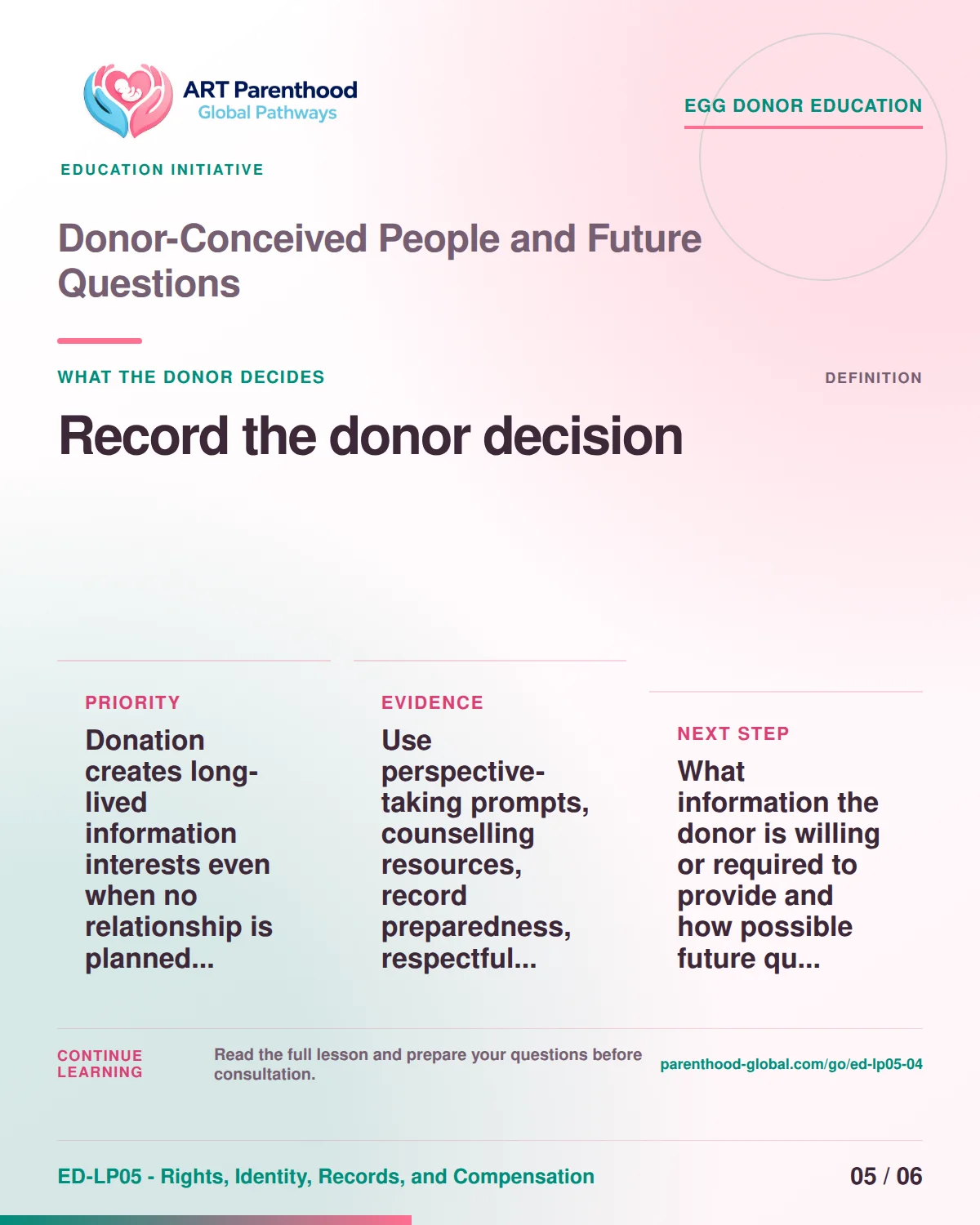
05 / 06What the donor decides 
06 / 06Keep donor choice visible
Keep the donor at the centre
Address genetic origins, medical history, identity narratives, siblings, age-appropriate disclosure contexts, diverse experiences, and unresolved ethical questions. The donor remains the person whose health information, body, consent, time and privacy are involved. Program eligibility is not consent, recipient preference is not clinical authority, and compensation does not transfer decision ownership. Start by identifying the exact decision, the donor's options and the professional accountable for explaining the evidence.
For donor-conceived people and future questions, connect explore, relational, and autonomy to the exact donor decision. Ask privately who created each record, who can see it, what it can establish, what remains uncertain, and whether declining an optional use or pausing participation changes medical care, payment already earned, privacy, or future contact.
Donor checkpoint for donor-conceived people and future questions: obtain the complete debates, record its date and accountable owner, and keep its interpretation limit beside the next action. If policy or law changes the answer, ask for the named jurisdiction, effective date, and independent review route rather than relying on a verbal summary.
Why this changes informed choice
Donation creates long-lived information interests even when no relationship is planned, and perspectives among donor-conceived people are not uniform. A donor-centred process does not ask whether a reader is cooperative enough to proceed. It asks whether information is complete, pressure is absent, practical burdens are visible and a pause can be expressed without retaliation. Acceptance by one program is not a certificate of health or worth; a decline is not a diagnosis unless an appropriate clinician explains a finding separately.
For donor-conceived people and future questions, connect right-to-identity, debates, and independent advice to the exact donor decision. Ask privately who created each record, who can see it, what it can establish, what remains uncertain, and whether declining an optional use or pausing participation changes medical care, payment already earned, privacy, or future contact.
Donor checkpoint for donor-conceived people and future questions: obtain the complete identity model, record its date and accountable owner, and keep its interpretation limit beside the next action. If policy or law changes the answer, ask for the named jurisdiction, effective date, and independent review route rather than relying on a verbal summary.
How the process should be documented
Use perspective-taking prompts, counselling resources, record preparedness, respectful language, and boundaries that leave room for changed circumstances. Put the sequence in writing. Record the applicable policy or protocol version, responsible entity, appointment or document, information collected, possible result categories, privacy route, decision point and escalation contact. Separate a clinic's medical role, an agency's coordination role, an independent adviser's role and the donor's continuing participation decision.
Read evidence without overclaiming
For donor-conceived people and future questions, distinguish professional guidance, program policy, agreement terms, consent choices, and current jurisdictional rules. Keep donor-conceived, explore, relational, autonomy, right-to-identity linked to the named document, version, effective date, location, and person whose rights or duties are affected. A form can record agreement without proving that consent was informed, independent, current, or legally effective everywhere. Online summaries and recruitment assurances should never outrank qualified advice or the signed record.
Make risk and escalation usable
The relevant escalation route for donor-conceived people and future questions is informational, legal, privacy, financial, or psychosocial—not a generic medical emergency script. Record who handles a data error, unwanted contact, missing payment, disputed expense, agreement concern, identity or recontact question, conflict of interest, or pressure to continue. The donor should be able to seek independent advice and pause without retaliation while urgent health concerns still go directly to clinical or emergency care.
Protect privacy and future records
Long-term privacy is not the same as secrecy. For donor-conceived people and future questions, identify the custodian for autonomy, right-to-identity, debates, independent advice, agreement version, who can request an update, what may be released later, and what happens if a clinic, bank, or agency closes. Consumer DNA databases, relatives, linked public records, and changing law can undermine anonymity; the consent discussion should separate information access, identity discovery, and any future relationship.
Build a decision record
What information the donor is willing or required to provide and how possible future questions influence participation now. Make the next step reversible where possible. Keep copies of the relevant forms and answers, mark unresolved questions, name the independent reviewer and define a stopping condition. The following remain outside this lesson: Promising a future relationship; Legal advice on a specific person's rights; Contact logistics and safety planning. Route those questions rather than allowing a broad assurance to stand in for clinical, legal, genetic or psychological review.
- What information the donor is willing or required to provide and how possible future questions influence participation now.
- Ask who owns the decision and who only advises.
- Request the current document, protocol or policy version.
- Record privacy, cost, escalation and stopping arrangements.
For Nerds: Technical Deep Dive
Explore relational autonomy, right-to-identity debates, psychosocial research sampling limits, sibling-network scale, consumer-DNA discovery, genetic information continuity, and differences between information and relationship claims.
Mechanism, burden and donor safety
A defensible technical record for donor-conceived people and future questions starts with donor-conceived, explore, relational, autonomy, right-to-identity, debates, independent advice, agreement version, identity model, data-use permission, jurisdiction and effective date, medical-update route. Each item needs a stable claim or document identifier, source authority, date, method or legal basis, applicable population or jurisdiction, accountable interpreter, access rule, and an explicit limit. Explore relational autonomy, right-to-identity debates, psychosocial research sampling limits, sibling-network scale, consumer-DNA discovery, genetic information continuity, and differences between information and relationship claims. The donor-facing implication must remain separate from recruitment, recipient preference, and program convenience. Program eligibility cannot substitute for consent, and a signed consent cannot cure missing risk information, coercion, unclear data use, or an absent escalation route. Evidence review should compare authority, applicability, completeness, conflicts, and uncertainty. Current source set: ASRM donation rights and interests opinion; HFEA donor information rules; HFEA Code of Practice; ASRM donation guidance. A professional guideline may describe recommended practice; a regulator may establish a minimum; a clinic policy may be narrower; and a personal clinical or legal opinion depends on individual facts. Do not turn a population association into an individual prediction, a program threshold into a diagnosis, or a jurisdiction example into a universal rule. Record missing denominators, assay or observer variation, sampling limits, selection bias, incomplete follow-up, changing law, and which reviewer must resolve the uncertainty.
- Address genetic origins, medical history, identity narratives, siblings, age-appropriate disclosure contexts, diverse experiences, and unresolved ethical questions.
- Use perspective-taking prompts, counselling resources, record preparedness, respectful language, and boundaries that leave room for changed circumstances.
- What information the donor is willing or required to provide and how possible future questions influence participation now.
Expected ranges / examples
- Donor decision sequence: donor-conceived -> people -> future -> questions -> address. A non-numeric example showing why screening, consent, treatment and outcome labels must remain distinct. Source: ASRM donation rights and interests opinion.
Measures, policies and uncertainty
Operationalize autonomy with a responsibility matrix and a stop-point log. The donor controls participation and personal consent; clinicians control diagnosis and treatment recommendations; laboratories control validated methods and reports; genetic professionals interpret genetic findings; independent counsel advises the donor on legal consequences; and coordinators manage handoffs without absorbing those authorities. Record which action is optional, what happens after a pause or withdrawal, what care and payment remain due, how privacy is protected, and who handles urgent and non-urgent concerns. Compensation must never be described as purchasing eggs, compliance, medical risk, silence, identity rights, or future contact. What information the donor is willing or required to provide and how possible future questions influence participation now. Build the decision record with the exact question, supporting records, unresolved conditions, professional owner, source date, donor preference, other participants' separate rights, and a trigger to proceed, proceed conditionally, pause, seek review, or stop. Test the proposed action against the exclusions: Promising a future relationship; Legal advice on a specific person's rights; Contact logistics and safety planning. Those boundaries prevent this package from drifting into diagnosis, prescribing, contract drafting, outcome prediction, or relationship promises. The technical layer supports better questions; it does not make the decision for the donor.
- Address genetic origins, medical history, identity narratives, siblings, age-appropriate disclosure contexts, diverse experiences, and unresolved ethical questions.
- Use perspective-taking prompts, counselling resources, record preparedness, respectful language, and boundaries that leave room for changed circumstances.
- What information the donor is willing or required to provide and how possible future questions influence participation now.
Expected ranges / examples
- Donor decision sequence: people -> future -> questions -> address -> genetic. A non-numeric example showing why screening, consent, treatment and outcome labels must remain distinct. Source: ASRM donation rights and interests opinion.
Consent, privacy and decision limits
Evidence review should compare authority, applicability, completeness, conflicts, and uncertainty. Current source set: ASRM donation rights and interests opinion; HFEA donor information rules; HFEA Code of Practice; ASRM donation guidance. A professional guideline may describe recommended practice; a regulator may establish a minimum; a clinic policy may be narrower; and a personal clinical or legal opinion depends on individual facts. Do not turn a population association into an individual prediction, a program threshold into a diagnosis, or a jurisdiction example into a universal rule. Record missing denominators, assay or observer variation, sampling limits, selection bias, incomplete follow-up, changing law, and which reviewer must resolve the uncertainty. What information the donor is willing or required to provide and how possible future questions influence participation now. Build the decision record with the exact question, supporting records, unresolved conditions, professional owner, source date, donor preference, other participants' separate rights, and a trigger to proceed, proceed conditionally, pause, seek review, or stop. Test the proposed action against the exclusions: Promising a future relationship; Legal advice on a specific person's rights; Contact logistics and safety planning. Those boundaries prevent this package from drifting into diagnosis, prescribing, contract drafting, outcome prediction, or relationship promises. The technical layer supports better questions; it does not make the decision for the donor.
- Address genetic origins, medical history, identity narratives, siblings, age-appropriate disclosure contexts, diverse experiences, and unresolved ethical questions.
- Use perspective-taking prompts, counselling resources, record preparedness, respectful language, and boundaries that leave room for changed circumstances.
- What information the donor is willing or required to provide and how possible future questions influence participation now.
Key takeaways
- Address genetic origins, medical history, identity narratives, siblings, age-appropriate disclosure contexts, diverse experiences, and unresolved ethical questions.
- Donation creates long-lived information interests even when no relationship is planned, and perspectives among donor-conceived people are not uniform.
- What information the donor is willing or required to provide and how possible future questions influence participation now.
- A donor can ask questions, seek independent advice, pause or decline without being reduced to a program outcome.
FAQ
What does donor-conceived people and future questions mean for a donor?
Address genetic origins, medical history, identity narratives, siblings, age-appropriate disclosure contexts, diverse experiences, and unresolved ethical questions.
Why does this matter before proceeding?
Donation creates long-lived information interests even when no relationship is planned, and perspectives among donor-conceived people are not uniform.
How should the process work?
Use perspective-taking prompts, counselling resources, record preparedness, respectful language, and boundaries that leave room for changed circumstances.
Can a program decision replace my consent?
No. Eligibility, coordination and clinical recommendations are different from the donor’s voluntary and continuing participation decision.
Which review lenses are required?
The approved scope requires editorial, psychological, legal, genetic, jurisdictional; each reviewer owns a distinct accuracy and safety question.
What should I record before deciding?
What information the donor is willing or required to provide and how possible future questions influence participation now.