

ART-LP04-07 · ART-LP04
Distinguish compensation, reimbursement, medical costs, insurance, escrow, lost wages, and prohibited payments while recognizing how money can affect voluntariness. Clear decisions begin by separating what is observed, why it matters, how the process works and which uncertainty remains.
Visual lesson summary
Review the lesson as a carousel.
Swipe or scroll through the key ideas, then continue with the detailed guidance below.
01 / 07Payment Expenses Insurance and Financial Pressure 
02 / 07Why it matters 
03 / 07How the method works 
04 / 07How to read the evidence 
05 / 07What this cannot decide 
06 / 07Use a decision record 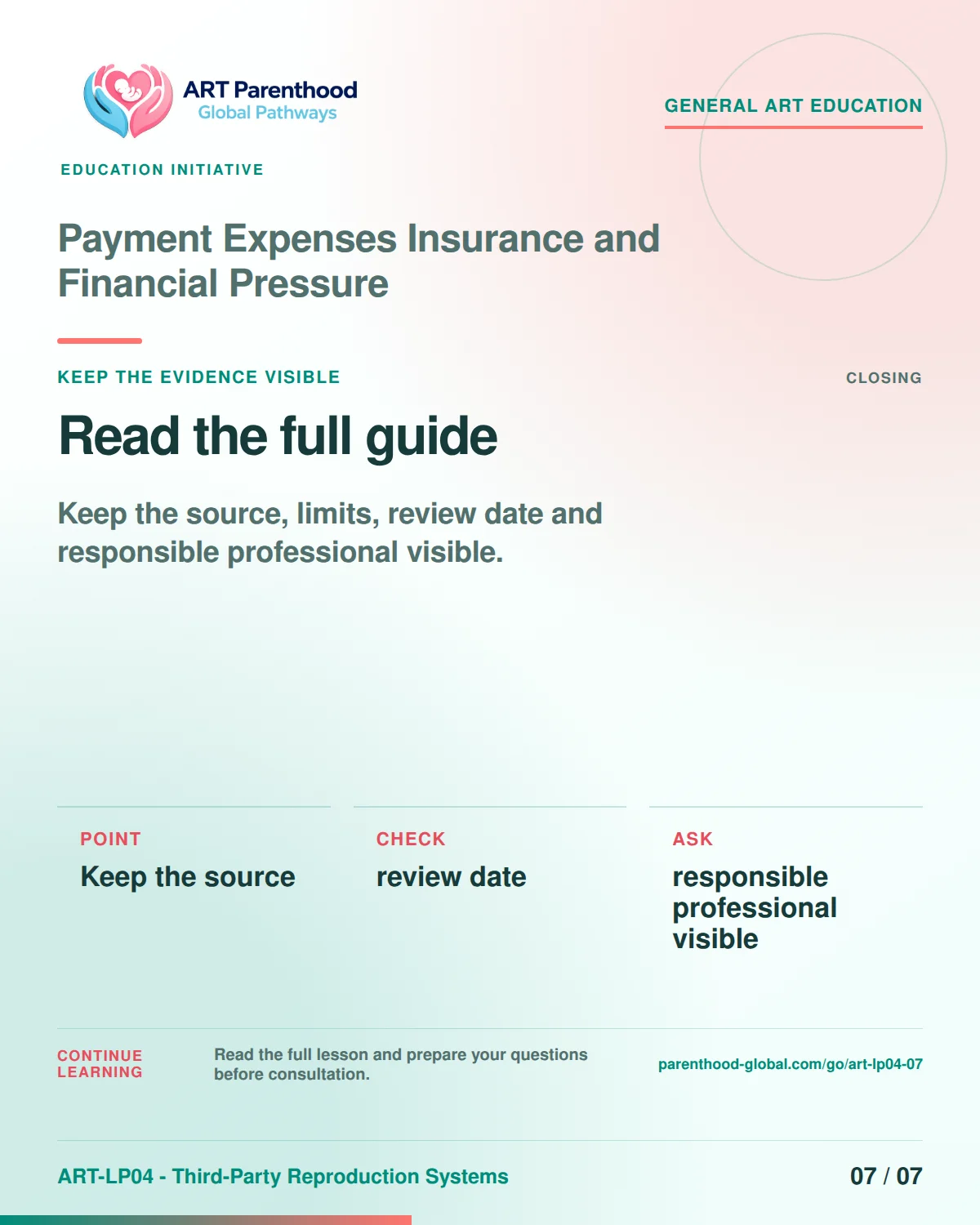
07 / 07Keep the evidence visible
Define the exact question
Map payment categories, documentation, timing, cancelled cycles, complications, taxes, insurance exclusions, independent expenses and jurisdiction limits across donation and surrogacy.
Precision starts by defining the object, method and decision separately. For payment expenses insurance and financial pressure, useful records include Examine undue-inducement theory, reimbursement versus benefit, escrow controls, insurance subrogation. Each item should state who produced it, when it was produced, what population or specimen it represents, and which conclusion it can support. A familiar label may hide different assays, laboratory policies, legal meanings or endpoints, so the reader should ask for the operational definition rather than infer one from the name.
Why the distinction changes decisions
Unclear money flows create surprise costs, nonpayment, inducement, conflicts and pressure to continue; lawful terminology and practice vary substantially by place.
The practical consequence is specific: misunderstanding payment expenses insurance and financial pressure can change which question is asked, which comparison appears favourable, or who seems to own the decision. Separate observed facts from interpretation and interpretation from choice. Record what remains unknown, what would change the conclusion and which excluded question belongs elsewhere: Giving tax, insurance, or legal advice; Setting compensation amounts; Building an intended-parent budget. This keeps uncertainty visible without turning it into either alarm or reassurance.
How the process should work
Create a transparent flow of payer, recipient, purpose, trigger, evidence, holder, dispute route and contingency, with independent legal and financial review where required.
Then test the method against one routine case and one discordant or incomplete case. Record where Examine undue-inducement theory, reimbursement versus benefit, escrow controls enter the sequence, who interprets them, what can delay the next step and which result would require the question to be reframed rather than forced into a yes-or-no answer.
Read measures without overreaching
Advanced interpretation should address Examine undue-inducement theory, reimbursement versus benefit, escrow controls, insurance subrogation, adverse incentives, price opacity, externalized medical risk and cross-border currency or tax issues.. The purpose is to show how the method works, where variation enters, which comparisons are defensible and what the evidence cannot establish. Keep Examine undue-inducement theory, reimbursement versus benefit, escrow controls, insurance subrogation, adverse incentives tied to their source, population and decision context; avoid universal thresholds, retrospective certainty and individual predictions from population averages.
Match evidence to the claim
Evidence must fit the exact claim in payment expenses insurance and financial pressure. Guidance can describe consensus or recommended process; a registry can describe observed outcomes; a systematic review can synthesize eligible studies; and a primary study can test a narrower question. Check version, population, endpoint, denominator, missing data, uncertainty and transferability before treating a source as decisive.
Trace each public statement to a stable claim ID and the source records that support it. Compare Examine undue-inducement theory, reimbursement versus benefit, escrow controls, insurance subrogation only when methods and populations are sufficiently alike. If a source addresses process but not effectiveness, safety but not legal effect, or a group average but not individual prediction, state that boundary directly.
Keep professional roles visible
For payment expenses insurance and financial pressure, professional roles are limited and complementary. An editorial reviewer checks scope discipline, plain-language accuracy, accessibility and whether wording overstates the evidence. An independent legal reviewer checks rights, documents, decision ownership and the limits of agreement language. A qualified local reviewer checks the named location, current rule, applicability and review date. None of these roles replaces the informed choice of the person whose body, gametes, embryos, records, legal position or family life is affected. Record disagreements and conflicts of interest instead of hiding them behind a collective recommendation.
Build a decision record
Confirm which payments are lawful, insured, taxable, capped or contingent, who bears uncovered care, and what happens after cancellation or complication.
A usable decision record for payment expenses insurance and financial pressure names the exact question, the affected person, the available options, the evidence and its limits, the professional responsible for interpretation, and the condition that would reopen the choice. It also records what is not yet known and whether the next step is reversible. The record should never convert a population estimate into a personal forecast, a laboratory category into a guarantee, a program policy into consent, or one jurisdiction's rule into universal law.
- Confirm which payments are lawful, insured, taxable, capped or contingent, who bears uncovered care, and what happens after cancellation or complication.
- Confirm the source and update date for payment, expenses, insurance.
- Record what financial, pressure, categories can and cannot decide.
- Route unresolved questions to editorial, legal, jurisdictional.
For Nerds: Technical Deep Dive
Examine undue-inducement theory, reimbursement versus benefit, escrow controls, insurance subrogation, adverse incentives, price opacity, externalized medical risk and cross-border currency or tax issues.
Mechanism, measurement and endpoint
Examine undue-inducement theory, reimbursement versus benefit, escrow controls, insurance subrogation, adverse incentives, price opacity, externalized medical risk and cross-border currency or tax issues. Advanced interpretation starts by defining construct, measurement and endpoint. The relevant technical vocabulary includes payment, expenses, insurance, financial, pressure, categories, documentation, timing, cancelled, cycles, complications, taxes. These terms describe different layers: biological mechanism, observable signal, operational category, decision threshold and patient-relevant outcome. A strong analysis does not move between those layers without evidence. It records specimen or document provenance, analytical method, timing, comparison population, missingness, uncertainty and the professional who owns interpretation. It also asks whether the source is guidance, regulation, registry data, systematic review or primary research, because each supports different inferences. For expenses, preserve the numerator, denominator, reference frame and failure modes. Test sensitivity, specificity, calibration, interobserver variation, selection bias, confounding and jurisdictional drift can each make a technically correct statement misleading in another context. A reviewer should verify current terminology and identify the evidence that would change the decision rather than adding unsupported precision.
- Map payment categories, documentation, timing, cancelled cycles, complications, taxes, insurance exclusions, independent expenses and jurisdiction limits across donation and surrogacy.
- Create a transparent flow of payer, recipient, purpose, trigger, evidence, holder, dispute route and contingency, with independent legal and financial review where required.
- Confirm which payments are lawful, insured, taxable, capped or contingent, who bears uncovered care, and what happens after cancellation or complication.
Expected ranges / examples
- Topic-specific interpretation sequence: payment -> expenses -> insurance -> financial -> pressure. A non-numeric process example showing why adjacent observations and decisions must not be treated as equivalent. Source: ASRM gamete and embryo donation.
Methods, categories and uncertainty
Create a transparent flow of payer, recipient, purpose, trigger, evidence, holder, dispute route and contingency, with independent legal and financial review where required. Advanced interpretation starts by defining construct, measurement and endpoint. The relevant technical vocabulary includes payment, expenses, insurance, financial, pressure, categories, documentation, timing, cancelled, cycles, complications, taxes. These terms describe different layers: biological mechanism, observable signal, operational category, decision threshold and patient-relevant outcome. A strong analysis does not move between those layers without evidence. It records specimen or document provenance, analytical method, timing, comparison population, missingness, uncertainty and the professional who owns interpretation. It also asks whether the source is guidance, regulation, registry data, systematic review or primary research, because each supports different inferences. For timing, preserve the numerator, denominator, reference frame and failure modes. Test sensitivity, specificity, calibration, interobserver variation, selection bias, confounding and jurisdictional drift can each make a technically correct statement misleading in another context. A reviewer should verify current terminology and identify the evidence that would change the decision rather than adding unsupported precision.
- Map payment categories, documentation, timing, cancelled cycles, complications, taxes, insurance exclusions, independent expenses and jurisdiction limits across donation and surrogacy.
- Create a transparent flow of payer, recipient, purpose, trigger, evidence, holder, dispute route and contingency, with independent legal and financial review where required.
- Confirm which payments are lawful, insured, taxable, capped or contingent, who bears uncovered care, and what happens after cancellation or complication.
Expected ranges / examples
- Topic-specific interpretation sequence: expenses -> insurance -> financial -> pressure -> categories. A non-numeric process example showing why adjacent observations and decisions must not be treated as equivalent. Source: ASRM gamete and embryo donation.
Limits, review and decision ownership
Confirm which payments are lawful, insured, taxable, capped or contingent, who bears uncovered care, and what happens after cancellation or complication. Advanced interpretation starts by defining construct, measurement and endpoint. The relevant technical vocabulary includes payment, expenses, insurance, financial, pressure, categories, documentation, timing, cancelled, cycles, complications, taxes. These terms describe different layers: biological mechanism, observable signal, operational category, decision threshold and patient-relevant outcome. A strong analysis does not move between those layers without evidence. It records specimen or document provenance, analytical method, timing, comparison population, missingness, uncertainty and the professional who owns interpretation. It also asks whether the source is guidance, regulation, registry data, systematic review or primary research, because each supports different inferences. For payment, preserve the numerator, denominator, reference frame and failure modes. Test sensitivity, specificity, calibration, interobserver variation, selection bias, confounding and jurisdictional drift can each make a technically correct statement misleading in another context. A reviewer should verify current terminology and identify the evidence that would change the decision rather than adding unsupported precision.
- Map payment categories, documentation, timing, cancelled cycles, complications, taxes, insurance exclusions, independent expenses and jurisdiction limits across donation and surrogacy.
- Create a transparent flow of payer, recipient, purpose, trigger, evidence, holder, dispute route and contingency, with independent legal and financial review where required.
- Confirm which payments are lawful, insured, taxable, capped or contingent, who bears uncovered care, and what happens after cancellation or complication.
Key takeaways
- Map payment categories, documentation, timing, cancelled cycles, complications, taxes, insurance exclusions, independent expenses and jurisdiction limits across donation and surrogacy.
- Unclear money flows create surprise costs, nonpayment, inducement, conflicts and pressure to continue; lawful terminology and practice vary substantially by place.
- Create a transparent flow of payer, recipient, purpose, trigger, evidence, holder, dispute route and contingency, with independent legal and financial review where required.
- Confirm which payments are lawful, insured, taxable, capped or contingent, who bears uncovered care, and what happens after cancellation or complication.
FAQ
What exactly is Payment Expenses Insurance and Financial Pressure?
Map payment categories, documentation, timing, cancelled cycles, complications, taxes, insurance exclusions, independent expenses and jurisdiction limits across donation and surrogacy.
Why does the distinction matter?
Unclear money flows create surprise costs, nonpayment, inducement, conflicts and pressure to continue; lawful terminology and practice vary substantially by place.
How should the review work?
Create a transparent flow of payer, recipient, purpose, trigger, evidence, holder, dispute route and contingency, with independent legal and financial review where required.
What belongs in the advanced evidence review?
Examine undue-inducement theory, reimbursement versus benefit, escrow controls, insurance subrogation, adverse incentives, price opacity, externalized medical risk and cross-border currency or tax issues.
What is outside this scope?
This package does not decide Giving tax, insurance, or legal advice; Setting compensation amounts; Building an intended-parent budget. Those questions require their own evidence, scope and responsible professional.
What should be recorded before a decision?
Confirm which payments are lawful, insured, taxable, capped or contingent, who bears uncovered care, and what happens after cancellation or complication.