

IP-LP04-09 · IP-LP04
Help intended parents decide which hospital, legal, clinical, and newborn tasks need named owners and deadlines. The lesson should leave them with a usable record of the relevant facts, uncertainties, and questions for the professionals who own the next decision. Use a bounded evidence record to prepare the next professional conversation.
Visual lesson summary
Review the lesson as a carousel.
Swipe or scroll through the key ideas, then continue with the detailed guidance below.
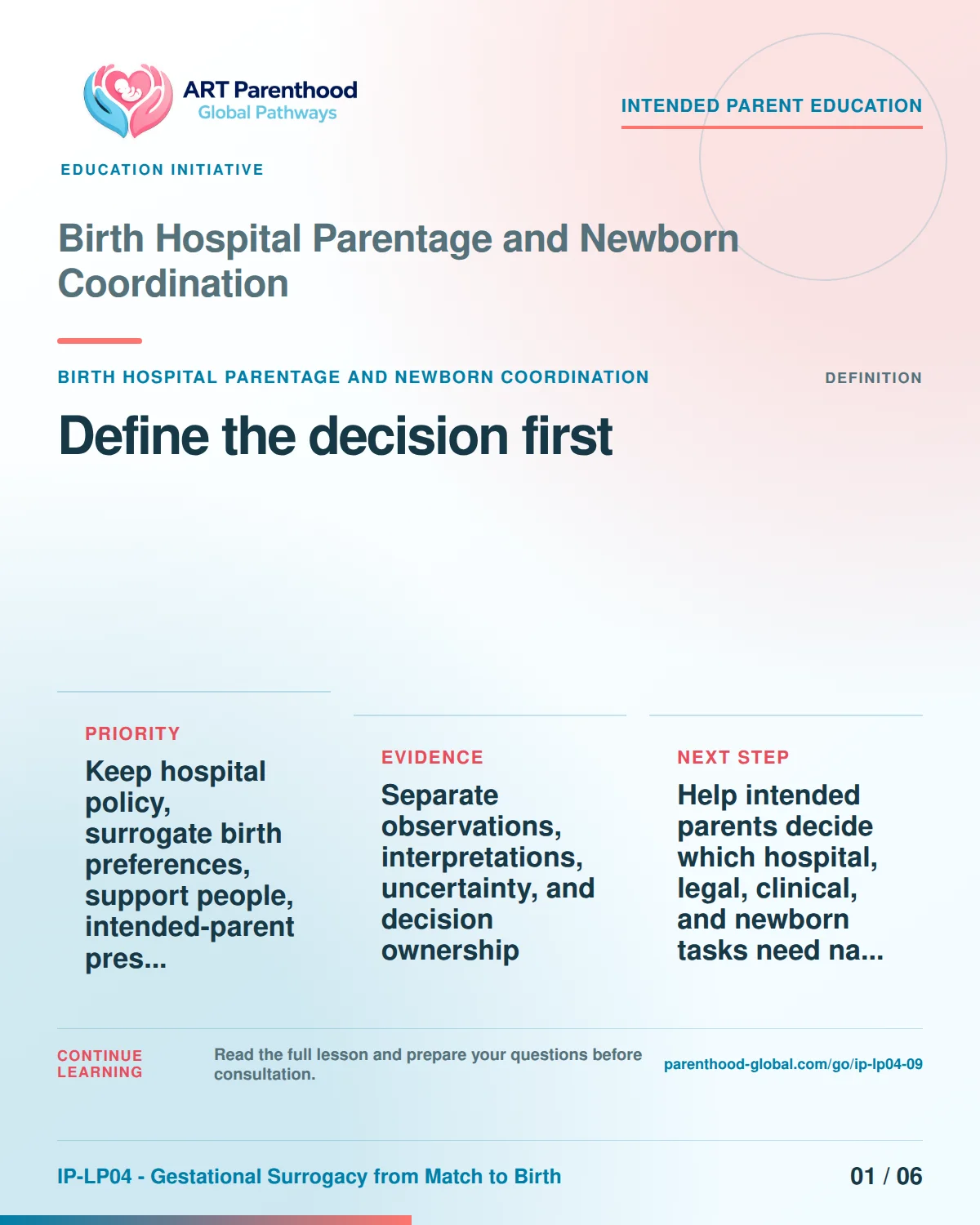
01 / 06Birth Hospital Parentage and Newborn Coordination 
02 / 06Why this matters 
03 / 06How the review should work 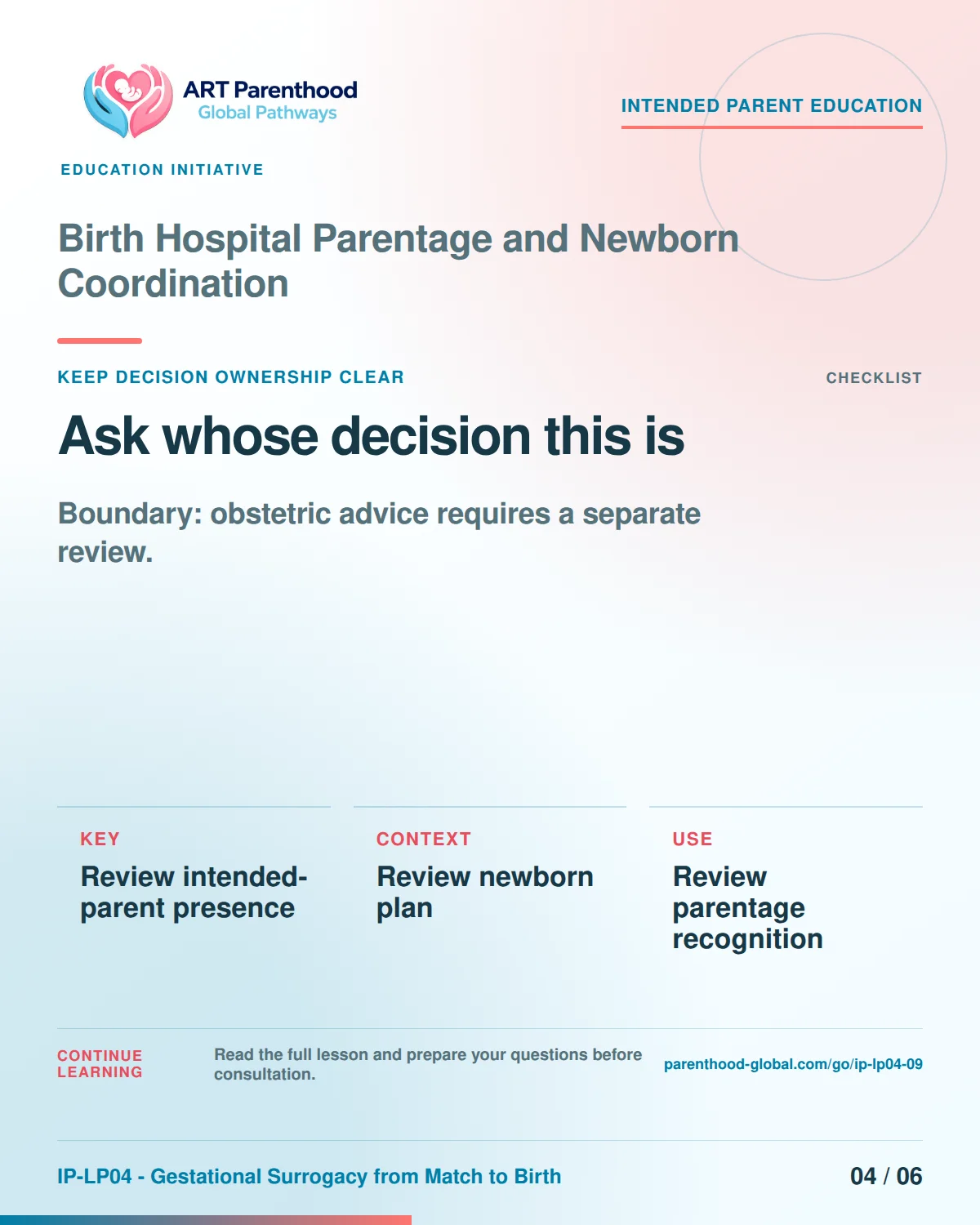
04 / 06Keep decision ownership clear 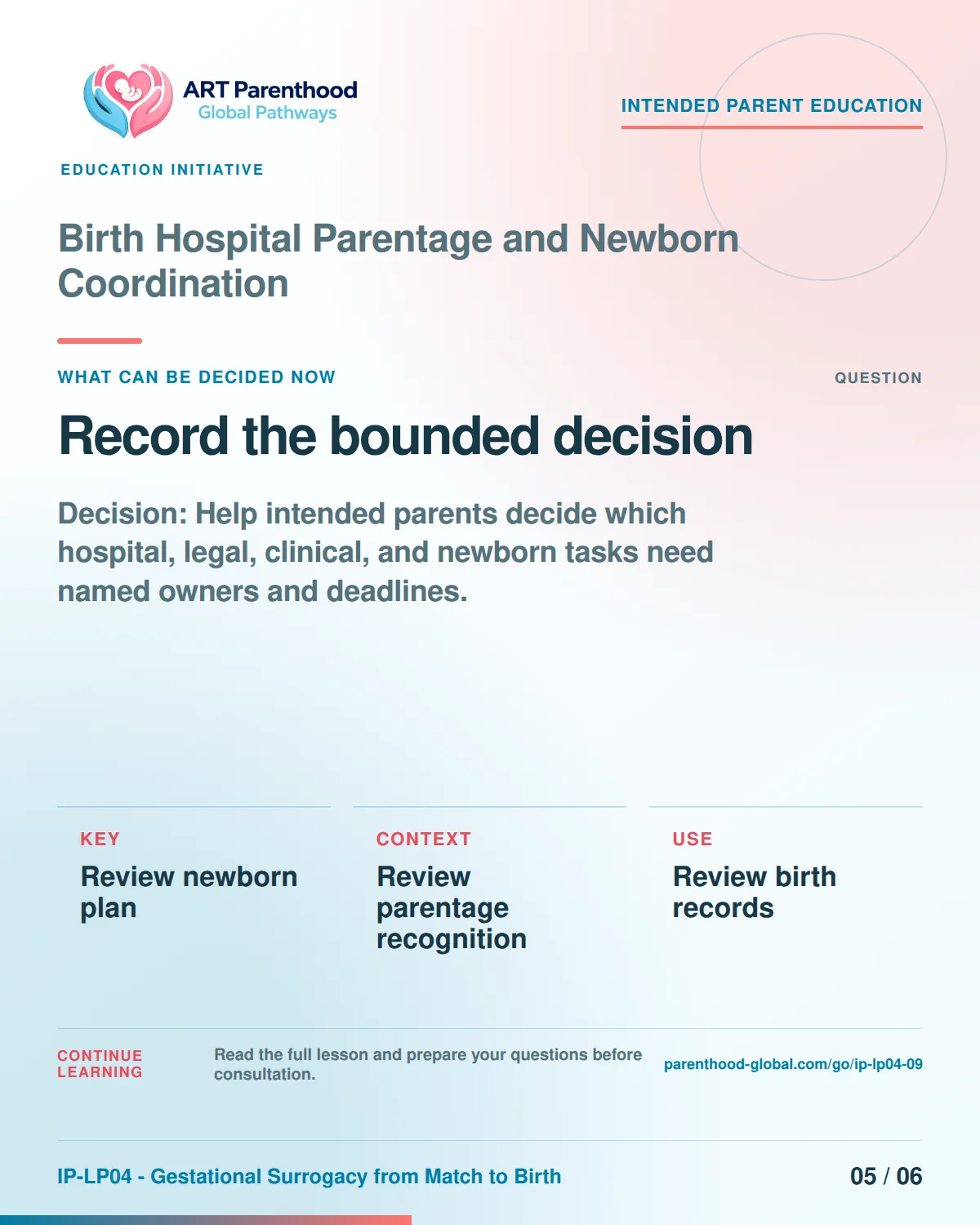
05 / 06What can be decided now 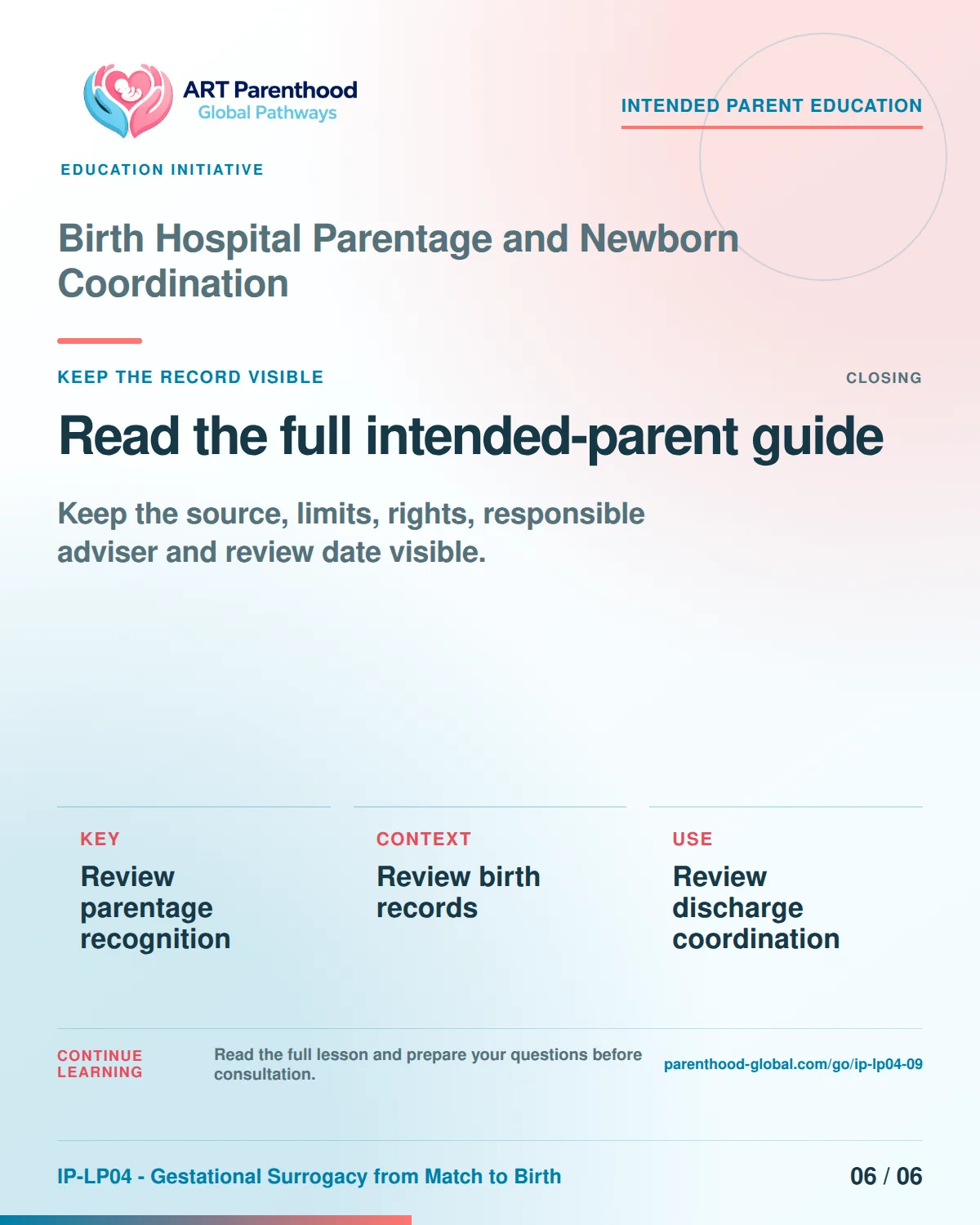
06 / 06Keep the record visible
Define the decision before collecting birth Hospital Parentage and Newborn.
Build a flexible plan for hospital policy, surrogate preferences, support people, intended-parent presence, emergencies, newborn care, parentage orders or recognition, records, discharge, and respectful separation of roles. The bounded task is to build evidence for the decision named in this lesson, not to turn every available fact into a single score. Begin by writing the question in one sentence and identifying the person or professional who can answer it. That prevents an intake form, profile, estimate, or laboratory update from silently becoming a recommendation it was never designed to provide. For birth Hospital Parentage and Newborn Coordination, review hospital policy and surrogate birth preferences.
A coordinator can confirm that a document or appointment exists, but cannot replace medical judgment, independent legal advice, psychological assessment, or the surrogate’s continuing consent. A signed plan also cannot predetermine later clinical decisions. This distinction is especially important in gestational-surrogacy autonomy, care, legal, and coordination decisions, where two accurate facts may still answer different questions. Record the observation, interpretation, limitation, and next question in separate fields so that later reviewers can see where judgment entered the pathway. For birth Hospital Parentage and Newborn Coordination, review support people.
- Verify hospital policy: source, date, subject, purpose, and limit
- Verify surrogate birth preferences: source, date, subject, purpose, and limit
- Verify support people: source, date, subject, purpose, and limit
- Verify intended-parent presence: source, date, subject, purpose, and limit
Why birth Hospital Parentage and Newborn Coordination can change the pathway
Confusing coordination with control can compromise the surrogate’s autonomy and patient safety, while weak legal, financial, and communication preparation can magnify conflict at time-sensitive stages. In this lesson, the immediate risk is misunderstanding birth hospital parentage and newborn coordination. The harm is not only factual misunderstanding. Premature certainty can trigger deposits, medication, matching, travel, disclosure, or contract steps before the condition that controls them has been reviewed. The opposite error also matters: one difficult result or unresolved term should not be treated as a final verdict when clarification, repeat review, another route, or a supported pause remains possible. For birth Hospital Parentage and Newborn Coordination, decide whether support people changes the next action.
The surrogate is the patient for her own care and retains bodily autonomy throughout. Intended parents can state preferences, fund agreed obligations, receive agreed updates, and prepare contingencies; they do not acquire authority over pregnancy care through matching, payment, or a coordination role. If a process asks intended parents to waive this separation, accept an unsupported guarantee, or proceed before the controlling review, treat that as a reason to pause and seek independent advice rather than as an administrative inconvenience. For birth Hospital Parentage and Newborn Coordination, review intended-parent presence.
- Separate an observation from its interpretation
- Separate program policy from professional judgment
- Keep reversible investigation ahead of material commitment
Build the birth Hospital Parentage and Newborn Coordination working record
Work through a surrogacy responsibility map that separates the surrogate’s clinical decisions from intended-parent duties, coordination, and legal preparation. Apply it specifically to build a flexible plan for hospital policy, surrogate preferences, support people, intended-parent presence, emergencies, newborn care, parentage orders or recognition, records, discharge, and respectful separation of roles. Put hospital policy, surrogate birth preferences, support people, and intended-parent presence in the first review group and newborn plan, parentage recognition, birth records, and discharge coordination in the second. For every item, capture the full document or report, source date, applicable person, observed fact, interpretation, uncertainty, professional owner, dependent decision, and trigger for an update or second opinion. For birth Hospital Parentage and Newborn Coordination, trace intended-parent presence and newborn plan.
Do not overwrite an earlier record when a later interpretation arrives. Preserve the original and add the new dated view, including what evidence or changed fact explains the difference. Mark missing information plainly as “not received,” “not assessed,” or “requires independent review.” This is safer than filling silence with reassurance and gives the next professional a usable chronology. For birth Hospital Parentage and Newborn Coordination, review newborn plan.
- Hospital Policy: capture the complete record and its decision boundary
- Surrogate Birth Preferences: capture the complete record and its decision boundary
- Support People: capture the complete record and its decision boundary
- Intended-Parent Presence: capture the complete record and its decision boundary
- Newborn Plan: capture the complete record and its decision boundary
- Parentage Recognition: capture the complete record and its decision boundary
- Birth Records: capture the complete record and its decision boundary
- Discharge Coordination: capture the complete record and its decision boundary
Read evidence limits in birth Hospital Parentage and Newborn Coordination
Check authority and applicability before reading a reassuring conclusion. Identify whether the source is a regulator, law, professional guideline, systematic review, laboratory report, policy, agreement, or marketing statement. Then compare its population or parties, endpoint, method, publication or effective date, jurisdiction, exclusions, and the facts of the proposed pathway. A high-quality source can still be the wrong source for this decision. For birth Hospital Parentage and Newborn Coordination, test source fit for parentage recognition.
A surrogacy gate should distinguish the surrogate’s decision rights from intended-parent duties, professional advice, shared expectations, and logistical handoffs. It should also name a safe route for disagreement or changed circumstances. Where a number is used, ask for its denominator, time horizon, endpoint, missing-data rules, and uncertainty. Where a legal or policy statement is used, ask for the named jurisdiction, effective date, assumptions, exclusions, and who is entitled to rely on it. Where consent is involved, confirm whose consent it is, what it covers, and whether it can change. For birth Hospital Parentage and Newborn Coordination, review parentage recognition.
- Supported: direct current evidence exists
- Conditional: a named dependency remains
- Unresolved: evidence or accountable interpretation is missing
Prepare the right professional conversation
Ownership for this lesson may involve the surrogate and her treating clinicians, each party’s independent lawyer, the intended parents, counsellors, escrow or insurance specialists, and the named coordinator for handoffs only. Coordination is useful for transmitting records, confirming appointments, and recording decisions, but it does not transfer professional authority or another participant’s consent to the coordinator or intended parents. Ask each reviewer to state both the conclusion and the boundary of what they have not assessed. For birth Hospital Parentage and Newborn Coordination, ask who owns birth records.
Bring a short question set rather than asking whether everything is “fine.” Ask: Which facts directly support the current interpretation? Which named records are incomplete, outdated, or outside your remit? What reasonable alternatives remain? What would change your recommendation? Which next action can occur now, and which must wait? Who will document the answer and how will the intended parents receive it? For birth Hospital Parentage and Newborn Coordination, review birth records.
- Request the complete underlying record
- Ask for method, applicability, and limitations
- Document the owner and escalation route
Make the bounded birth Hospital Parentage and Newborn Coordination decision
Help intended parents decide which hospital, legal, clinical, and newborn tasks need named owners and deadlines. Convert that purpose into a written gate: state the decision, evidence available, unresolved conditions, accountable reviewer, deadline, and what happens if a condition is not met. Record whether the current outcome is proceed, proceed conditionally, pause, seek another opinion, change route, or stop. For birth Hospital Parentage and Newborn Coordination, record whether discharge coordination supports action.
End by saving the complete versions of hospital policy, surrogate birth preferences, support people, intended-parent presence, newborn plan, parentage recognition, birth records, and discharge coordination, the questions asked, the answers received, and the date for reassessment. What can be decided now is the next bounded action supported by the record. What remains conditional should stay visible, assigned to an owner, and separated from reassurance, pressure, or assumptions about another person’s future choice. For birth Hospital Parentage and Newborn Coordination, review discharge coordination.
- Name the decision
- List unresolved conditions
- Assign the controlling reviewer
- Record the next action and review trigger
For Nerds: Technical Deep Dive
A technical audit of birth Hospital Parentage and Newborn Coordination using claim provenance, versioned evidence, dependency mapping, explicit ownership, interpretation limits, and source-to-claim checks.
Technical evidence model for birth Hospital Parentage and Newborn Coordination
For Nerds should examine independent representation, clinical consent, insurance and escrow controls, parentage timing, hospital records, conflict-of-laws issues, and evidence limits in surrogate-specific outcomes. For this topic, connect those tools to birth hospital parentage and newborn coordination. A surrogacy pathway is a multi-party dependency system, not a linear service order. Model each medical, legal, financial, psychological, hospital, parentage, and record step with a responsible owner, prerequisite, expiry date, jurisdiction, contingency, and escalation route. Separate contractual expectations from decisions that remain with the pregnant patient and clinical team. For cross-border arrangements, treat conflict of laws, parentage, nationality, immigration, insurance, and document issuance as separate dated opinions rather than one generic statement that the route is legal. For birth Hospital Parentage and Newborn Coordination, create stable identifiers for hospital policy, surrogate birth preferences, support people, intended-parent presence, newborn plan, parentage recognition, birth records, and discharge coordination. Each identifier should link to the original record, acquisition or effective date, person or specimen concerned, author or laboratory, method or governing framework, applicable jurisdiction, accountable reviewer, interpretation, interpretation limit, dependent decision, and update trigger. Keep observations and interpretations as separate versioned objects: a later opinion may supersede a decision, but it should not erase what was known or assumed when the earlier decision was made. Use explicit states such as not requested, requested, received, incomplete, under review, current, expired, disputed, and superseded. “Normal,” “cleared,” and “approved” are unsafe shorthand unless the actor, question, standard, date, and permitted next action are named. Also distinguish a process completion state from a substantive conclusion: receipt of hospital policy confirms that a document arrived; it does not confirm that the responsible reviewer found it applicable or sufficient. Map dependencies as a directed graph. The node for surrogate birth preferences may inform counselling without clearing support people; intended-parent presence may be required before a dependent action but still leave newborn plan unresolved. This model exposes hidden circularity—for example, a payment described as necessary to obtain a review that should have occurred before financial commitment. It also preserves third-party boundaries because consent, privacy, and bodily-autonomy nodes can only be changed by the person or authority that owns them.
- Assign stable claim and source IDs
- Classify prerequisites, inputs, preferences, consent, and forecasts
- Preserve method, date, jurisdiction, and interpretation limit
- Block dependent action until the controlling review is complete
Expected ranges / examples
- Evidence record fields: hospital policy, surrogate birth preferences, support people, intended-parent presence, newborn plan, parentage recognition, birth records, discharge coordination. These are example fields or checkpoints for the approved scope, not universal eligibility criteria, treatment thresholds, or outcome predictors. Source: GOV.UK - Care in surrogacy.
Timeline breakdown
- Assemble and classify the record: Before a material commitment. Intended parents obtain complete records, separate observations from interpretations, and assign each unresolved question to its professional owner.
- Clear the controlling decision gate: Before the dependent action starts. The accountable reviewer checks applicability, limitations, dependencies, changed facts, consent status, and the route if the condition is not met.
Claim-level audit and failure testing
Audit the evidence package for birth Hospital Parentage and Newborn Coordination at claim level. For every factual statement, record the source type, exact title, version or publication date, relevant page or section where available, population or parties, method, jurisdiction, endpoint, limitations, and the claim identifier it supports. A source should not be attached merely because it is authoritative or broadly related to fertility care. Directness and applicability matter: a laboratory manual cannot establish a legal right, an ethics opinion cannot determine insurance coverage, and a program page cannot substitute for independent advice. Stress-test the proposed decision from both directions. First assume the reassuring interpretation is incomplete: what record, denominator, exclusion, conflict, expiry, changed fact, or second opinion could alter it? Then assume the difficult interpretation is incomplete: what repeat measure, specialist review, alternate route, correction process, support, or passage of time could change the available choices? This symmetrical review reduces both optimism bias and unnecessary finality. For quality assurance, sample every teaching slide and video scene against the claim register. On-screen text must preserve the same uncertainty as the article; visual metaphors must not imply pregnancy, birth, genetic traits, safety, legality, or financial protection beyond the sourced statement. Confirm that the canonical generic disclaimer appears once per independently consumed output and nowhere inside core teaching prose. Finally, ask the editorial and jurisdictional reviewers to identify unsupported claims, jurisdiction drift, role confusion, and any point where intended-parent preference is presented as authority over a clinician, donor, surrogate, insurer, lawyer, or record custodian.
- Maintain claim, source, responsibility, decision, consent, and exception registers
- Preserve complete originals and versioned interpretations
- Red-team both reassuring and difficult conclusions
- Keep exclusions and adjacent lesson boundaries explicit
Country / jurisdiction examples
- England and Wales: Official UK materials illustrate that consent, parentage, donation, storage, and surrogacy questions can have formal statutory or administrative steps; the applicable route and current status require qualified local confirmation.
- United States: Federal regulation, professional guidance, and state law may govern different parts of an ART pathway, so a single national summary cannot establish all donor, surrogacy, insurance, parentage, or record consequences.
Key takeaways
- Keep hospital policy, surrogate birth preferences, support people, intended-parent presence in the same dated evidence record.
- Separate the observed fact from interpretation, uncertainty, and the dependent decision.
- Help intended parents decide which hospital, legal, clinical, and newborn tasks need named owners and deadlines.
- Authorize only the next bounded step and preserve what would change it.
FAQ
What belongs in a record for Birth Hospital Parentage and Newborn Coordination?
Include hospital policy, surrogate birth preferences, support people, intended-parent presence, newborn plan, parentage recognition, birth records, discharge coordination, plus the complete source, date, accountable owner, interpretation, limitation, and dependent decision. Keep summaries linked to underlying records.
Does one normal or reassuring item clear the pathway?
No. Each item answers a bounded question. Other medical, laboratory, legal, consent, financial, timing, and relationship dependencies may remain.
What should intended parents ask the responsible professional?
Ask what is directly observed, what is inferred, which method or rule applies, what remains uncertain, whether an update is needed, and what would change the recommendation.
When is a pause useful?
Pause when a controlling record is missing, opinions conflict, consent changes, facts or jurisdiction change, a source is stale, or the next commitment would outrun the evidence.
Can a coordinator make the professional decision?
A coordinator can organize records and handoffs. Diagnosis, treatment, laboratory interpretation, genetic counselling, legal advice, consent, and another participant’s bodily decisions remain with their proper owners.
What is the practical next step?
Help intended parents decide which hospital, legal, clinical, and newborn tasks need named owners and deadlines.