

SG-LP01-06 · SG-LP01
Prepare a prospective surrogate to state non-negotiable bodily boundaries, questions for independent counsel and clinicians, and circumstances in which she would decline an application or proposed match. The aim is not to persuade you to become a surrogate. It is to turn a broad readiness question into specific facts, responsibilities and boundaries that you can examine before an application creates expectations.
Visual lesson summary
Review the lesson as a carousel.
Swipe or scroll through the key ideas, then continue with the detailed guidance below.
01 / 06Bodily Autonomy and Continuing Consent 
02 / 06Why now? 
03 / 06Build the autonomy and continuing-consent check 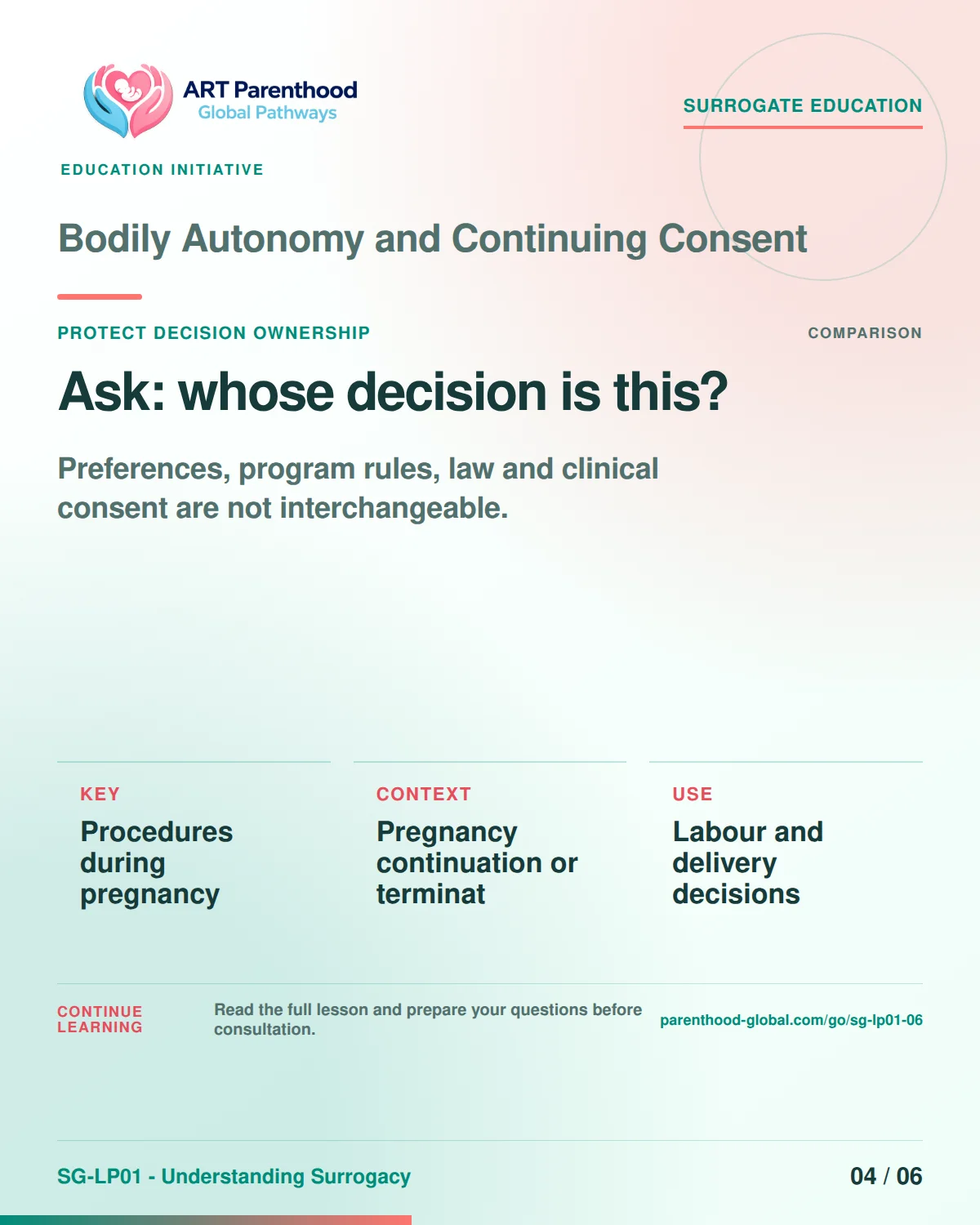
04 / 06Protect decision ownership 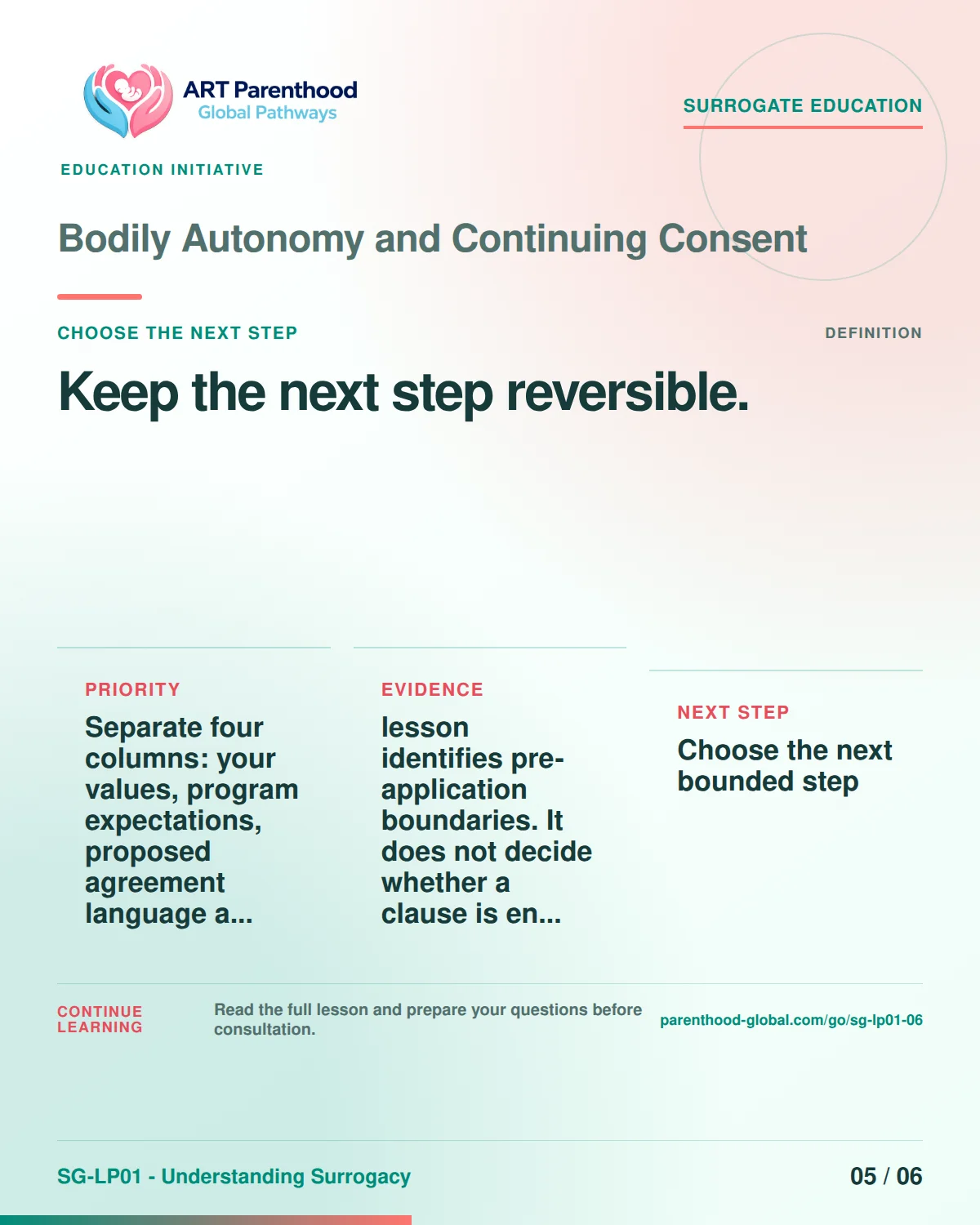
05 / 06Choose the next step 
06 / 06Keep the record
What a autonomy and continuing-consent check is meant to reveal
Teach bodily autonomy and continuing consent before application, distinguishing personal values from program expectations. Negotiated pregnancy terms belong in SG-LP03-08; real-time birth consent belongs in SG-LP05-03. This is not a test of generosity or commitment. It is a way to see the real effect of medication and monitoring choices, embryo-transfer consent, prenatal testing preferences, and procedures during pregnancy before an application creates momentum.
Start with the fact that the prospective surrogate is the decision-maker about whether to explore the role. Other people may have legitimate information, workload, safety or legal responsibilities, but their involvement does not erase her agency. The practical task is to make those responsibilities visible early enough for an unpressured choice.
A useful review names both the ordinary plan and the less convenient version. Ask what happens when medication and monitoring choices goes as expected, then ask what changes if embryo-transfer consent becomes harder, prenatal testing preferences is unavailable, or procedures during pregnancy cannot be kept private. Specific questions expose assumptions that reassurance alone will miss.
- Include medication and monitoring choices in the written review.
- Include embryo-transfer consent in the written review.
- Include prenatal testing preferences in the written review.
- Include procedures during pregnancy in the written review.
- Include pregnancy continuation or termination questions in the written review.
Why this belongs before an application
Agreement expectations can be mistaken for advance permission over future care, obscuring that the surrogate remains the patient and consent must be voluntary and contemporaneous.
Once profiles, records, matching conversations or financial expectations begin, stopping can feel harder even when it remains possible. Early planning protects a genuine no, not only a smoother yes. It also lets the reader distinguish a solvable gap—such as confirming prenatal testing preferences—from a boundary that makes the role unsuitable now.
Do not measure readiness by how confidently someone speaks. A careful person may have more questions because she has considered pregnancy continuation or termination questions, labour and delivery decisions, and medication and monitoring choices. The useful signal is whether she can identify missing facts, ask independently, state limits and tolerate an answer that changes the plan.
- A pause can be a responsible decision, not a failed application.
- Support should expand choices rather than reward compliance.
- New information may legitimately change an earlier preference.
Build the autonomy and continuing-consent check
Separate four columns: your values, program expectations, proposed agreement language and the clinician’s consent conversation. For each scenario, ask who decides, what information is required, whether refusal is possible and what happens if views change.
Write names and actions, not labels such as “good support” or “we will manage.” For medication and monitoring choices, record who supplies information and who decides. For embryo-transfer consent, record the primary plan and backup. For prenatal testing preferences, record what must be confirmed before sharing records or accepting a next step.
- Medication and monitoring choices: record owner, backup, evidence and pause point.
- Embryo-transfer consent: record owner, backup, evidence and pause point.
- Prenatal testing preferences: record owner, backup, evidence and pause point.
- Procedures during pregnancy: record owner, backup, evidence and pause point.
- Pregnancy continuation or termination questions: record owner, backup, evidence and pause point.
- Labour and delivery decisions: record owner, backup, evidence and pause point.
Keep decision ownership clear
This lesson identifies pre-application boundaries. It does not decide whether a clause is enforceable, prescribe a medical choice, replace independent legal advice or cover real-time labour consent, which requires its own later discussion.
- Ask who is accountable for the statement.
- Ask whether it is a fact, recommendation, preference, practice or legal rule.
- Ask what happens if the surrogate disagrees or changes her mind.
- Ask where independent advice can be obtained.
Stress-test the plan without predicting the future
Choose one ordinary scenario and one disruption scenario. In the ordinary version, trace medication and monitoring choices, embryo-transfer consent, and prenatal testing preferences through the people, records and decisions involved. In the disruption version, assume procedures during pregnancy changes suddenly and examine the effect on pregnancy continuation or termination questions and labour and delivery decisions. The purpose is to locate single points of failure, not to estimate a personal probability.
- Capacity assessment: confirm purpose, owner and update point.
- Material-risk disclosure: confirm purpose, owner and update point.
- Alternatives including no treatment: confirm purpose, owner and update point.
- Voluntariness check: confirm purpose, owner and update point.
- Documented consent conversation: confirm purpose, owner and update point.
- Independent legal advice: confirm purpose, owner and update point.
Choose a proportionate next step
State non-negotiable bodily boundaries, questions for independent counsel and clinicians, and circumstances in which she would decline an application or proposed match.
- Proceed only with the next reversible step you actually choose.
- Delay when a material question lacks an owner or reliable answer.
- Decline when the proposal conflicts with a non-negotiable boundary.
- Reassess whenever material medical, legal, household or financial facts change.
For Nerds: Technical Deep Dive
This technical layer examines how to document autonomy and continuing-consent check without turning it into a score, prediction or substitute for independent advice. It separates evidence, decision ownership, uncertainty, voluntariness and jurisdiction-specific interpretation.
Represent readiness as evidence, owners and update triggers
A useful autonomy and continuing-consent check separates constructs that public checklists often collapse. “Readiness” is not a single observable trait. It combines available information, voluntariness, values, practical capacity, support reliability and the ability to revise a decision. The record should therefore identify the decision owner, evidence source, uncertainty and update trigger for each item. Add depth on informed-consent elements, capacity and voluntariness, advance preferences versus contemporaneous consent, coercion and undue influence, and jurisdictional limits on purported control of medical decisions. In practice, named artifacts such as capacity assessment, material-risk disclosure, alternatives including no treatment, voluntariness check, documented consent conversation, independent legal advice create an audit trail, but they do not prove that consent is free or that a predicted resource will be available. Relational autonomy is relevant because choices are made within households and economic circumstances; it does not give partners, intended parents, programs or clinicians a veto over the surrogate’s bodily decisions. A reviewer should look for hidden proxies: partner enthusiasm used as proof of consent, a signed form used as proof of understanding, or program acceptance used as proof of clinical safety. The technically sound approach keeps these judgments separate and revisits them when material information changes. This matters because a pre-application preference is not contemporaneous consent to a later intervention, and a logistical plan is not a forecast of pregnancy or recovery.
- Capacity assessment should name its owner, purpose and update trigger.
- Material-risk disclosure should name its owner, purpose and update trigger.
- Alternatives including no treatment should name its owner, purpose and update trigger.
Use guidance without creating false certainty
Evidence in this area has limits. Professional guidance can define ethical safeguards and recommended processes, while an official pathway can describe one jurisdiction’s care and legal context. Neither predicts an individual outcome or makes a rule global. For medication and monitoring choices, embryo-transfer consent, prenatal testing preferences, procedures during pregnancy, pregnancy continuation or termination questions, labour and delivery decisions, the reviewer should ask whether the statement is descriptive, normative, clinical, legal or personal. Legal propositions need a named jurisdiction and current local verification; clinical propositions need the current guidance version and individual assessment; psychological observations should avoid turning normal ambivalence into pathology. Scenario analysis should compare consequences and control, not attach invented probabilities. A strong record includes a plain-language question, the source consulted, the responsible professional, the answer date, any conflict of interest and the condition that would reopen the issue. It also records a safe “no data yet” state when information is unavailable. That prevents false precision and makes disagreement visible. The result is not a score. It is a transparent map of what is known, whose judgment applies, which burdens remain, and whether the next proposed step is proportionate and reversible.
- Classify each statement as clinical, legal, ethical, process-based or personal.
- Record jurisdiction, version date and conflicts of interest where relevant.
- Keep uncertainty explicit rather than inventing thresholds or probabilities.
Key takeaways
- State non-negotiable bodily boundaries, questions for independent counsel and clinicians, and circumstances in which she would decline an application or proposed match.
- Use a autonomy and continuing-consent check to expose assumptions and assign unanswered questions to the right person.
- Application is a reversible step, not consent to screening, matching, an agreement or medical treatment.
- A safe plan preserves the option to pause, decline or change direction when material facts change.
FAQ
What should I do first?
Start the autonomy and continuing-consent check, then assign each unresolved question to the person accountable for answering it.
Does completing the worksheet mean I am ready?
No. It organizes a decision but does not establish medical eligibility, legal safety or psychological readiness.
Can my partner or family decide for me?
They can state what support they can provide and how the plan affects them. They cannot consent to medical care for a capable adult surrogate.
What if a program gives a different answer?
Ask whether the answer is a program practice, clinical judgment or legal requirement, who is accountable for it, and whether independent review is available.
Is it acceptable to pause after applying?
An application is not consent to later screening, matching, an agreement or treatment. Ask about any specific process or legal consequence before acting.
When should I seek independent advice?
Seek it before relying on a statement that materially affects bodily autonomy, health, privacy, legal rights, finances or the safety of your household.
Sources and further reading
- ACOG - Informed Consent and Shared Decision Making (2021)
- ASRM Ethics Committee - Consideration of the gestational carrier (2023)
- ASRM - Recommendations for practices using gestational carriers (2022)
- UK DHSC - Having a child through surrogacy (updated 2025)
- WHO - Sexual and reproductive health and rights statement (2024)