

SG-LP05-01 · SG-LP05
Prepare a prospective surrogate to communicate priorities and non-negotiable privacy needs, choose support people, and agree how changes will be explained without treating preferences as consent to future procedures. The safest way to approach building a flexible birth preference plan is to separate evidence, professional roles, personal boundaries and location-dependent rules before momentum turns an unanswered question into an assumed obligation.
Visual lesson summary
Review the lesson as a carousel.
Swipe or scroll through the key ideas, then continue with the detailed guidance below.
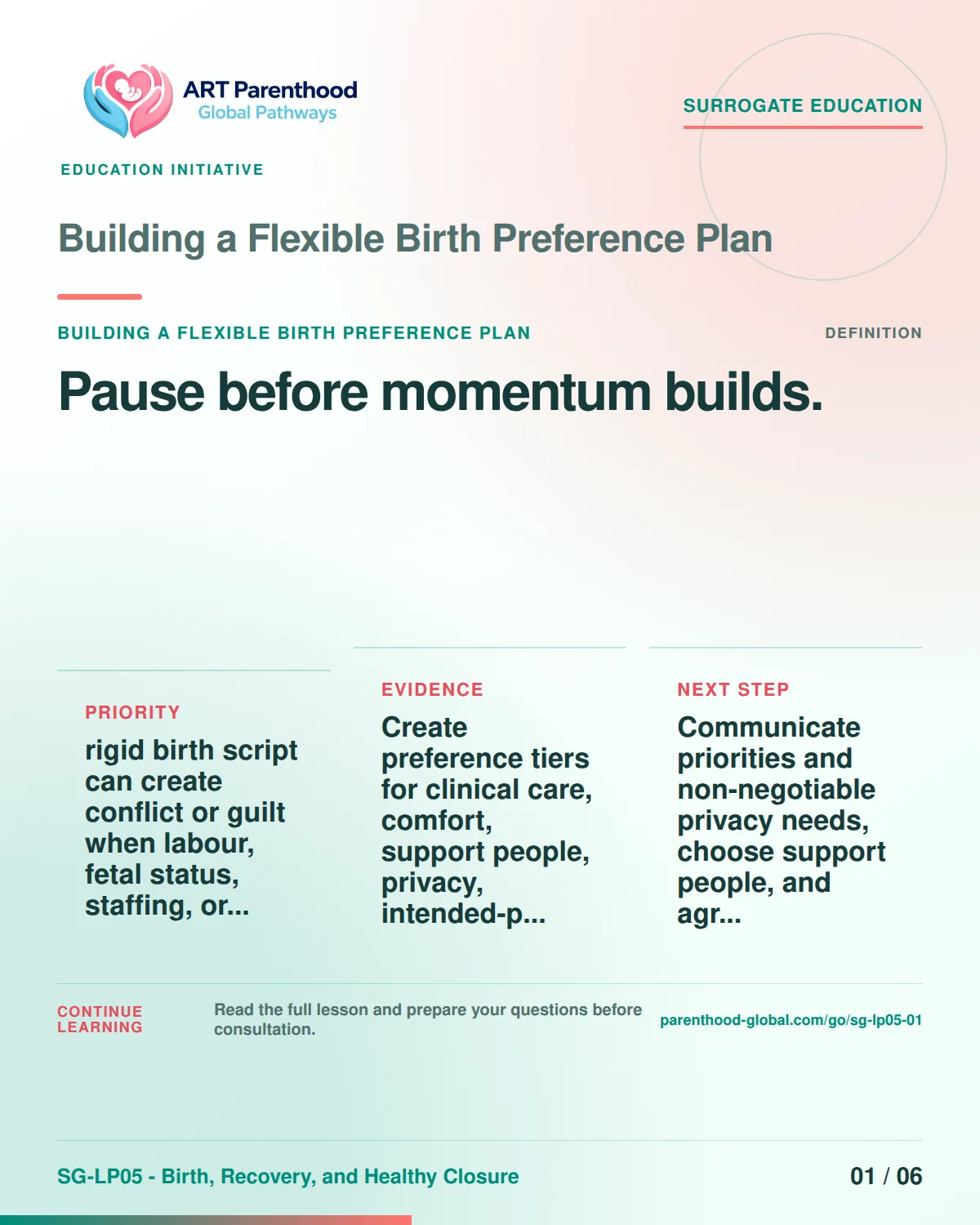
01 / 06Building a Flexible Birth Preference Plan 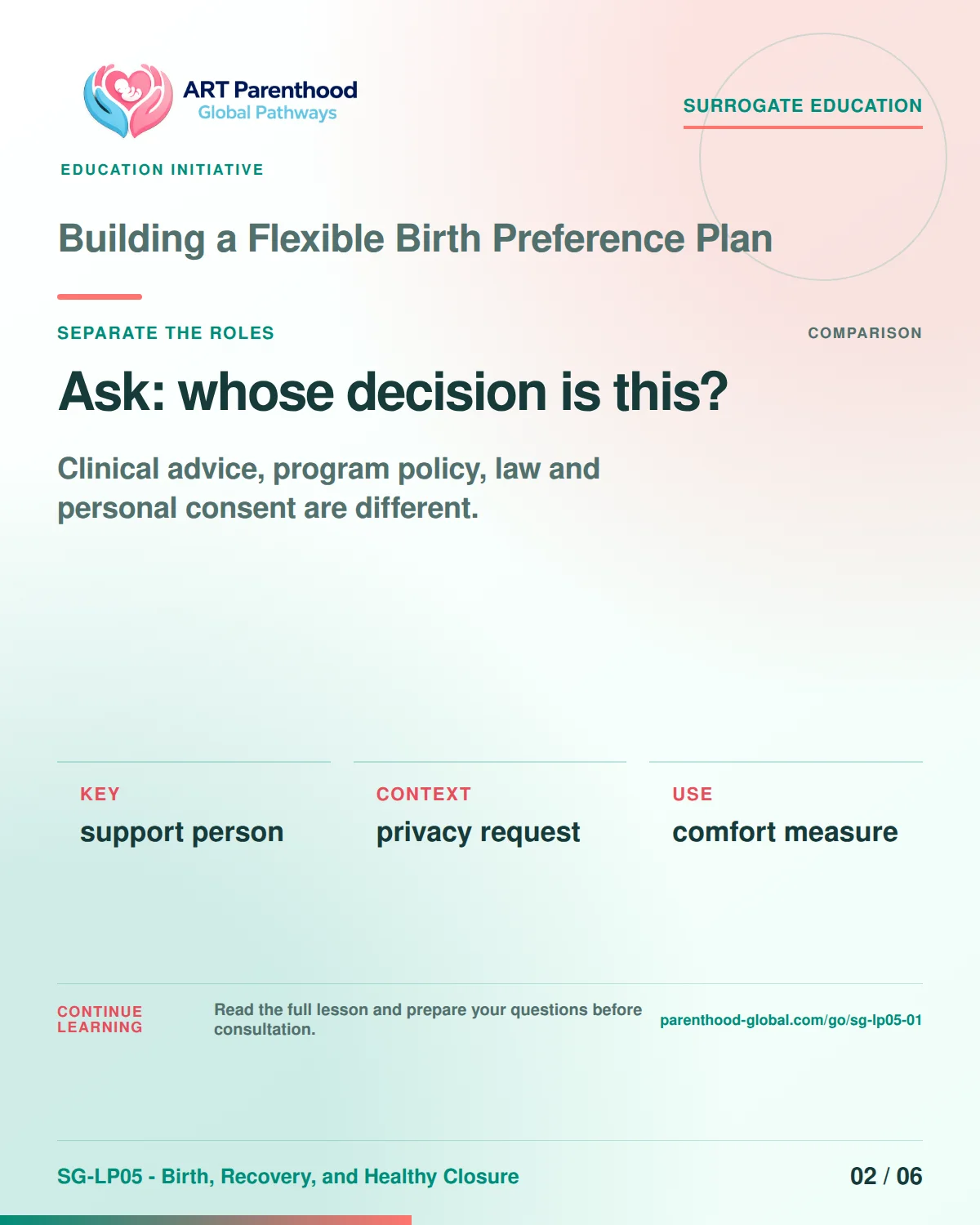
02 / 06Separate the roles 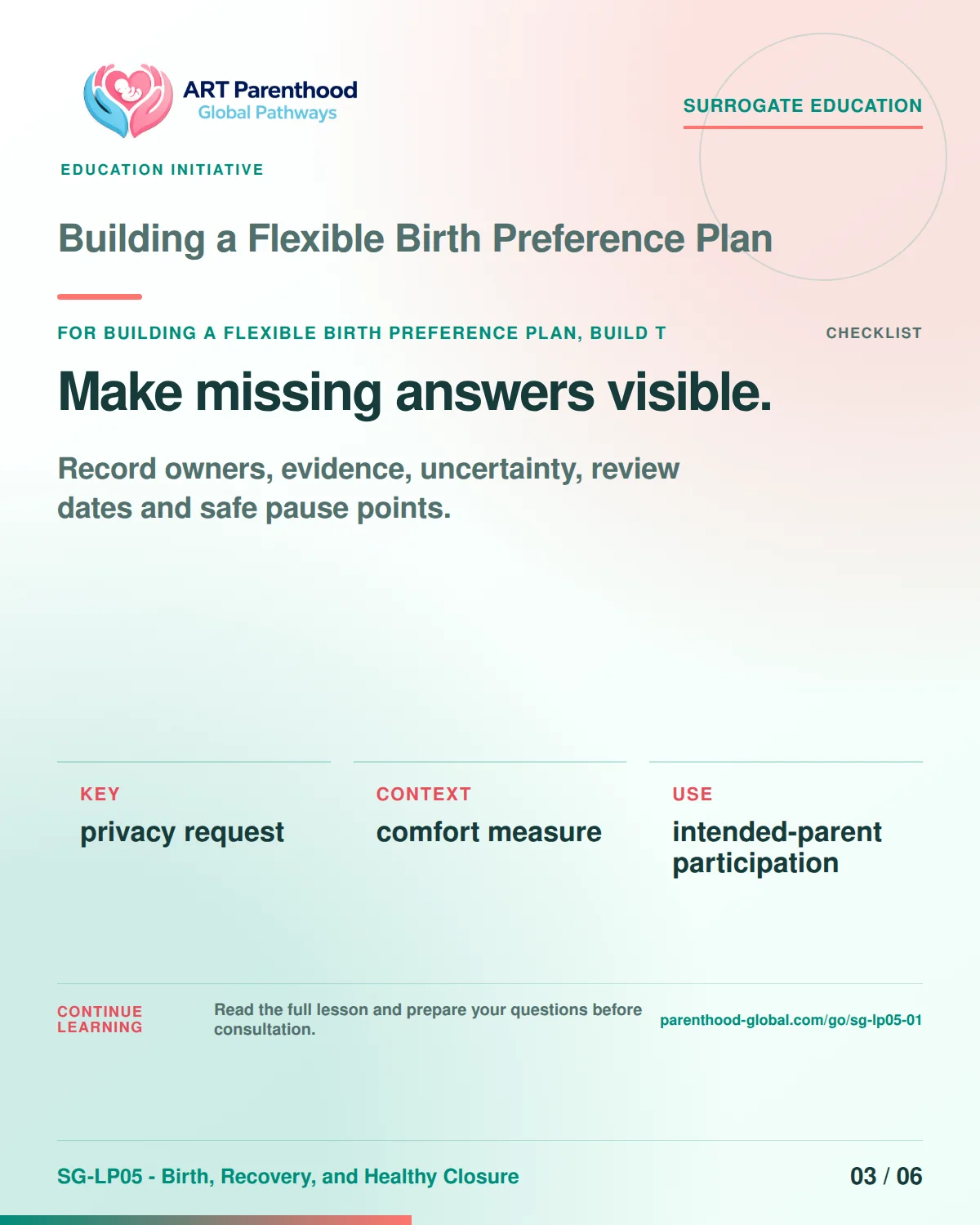
03 / 06For building a flexible birth preference plan, build t 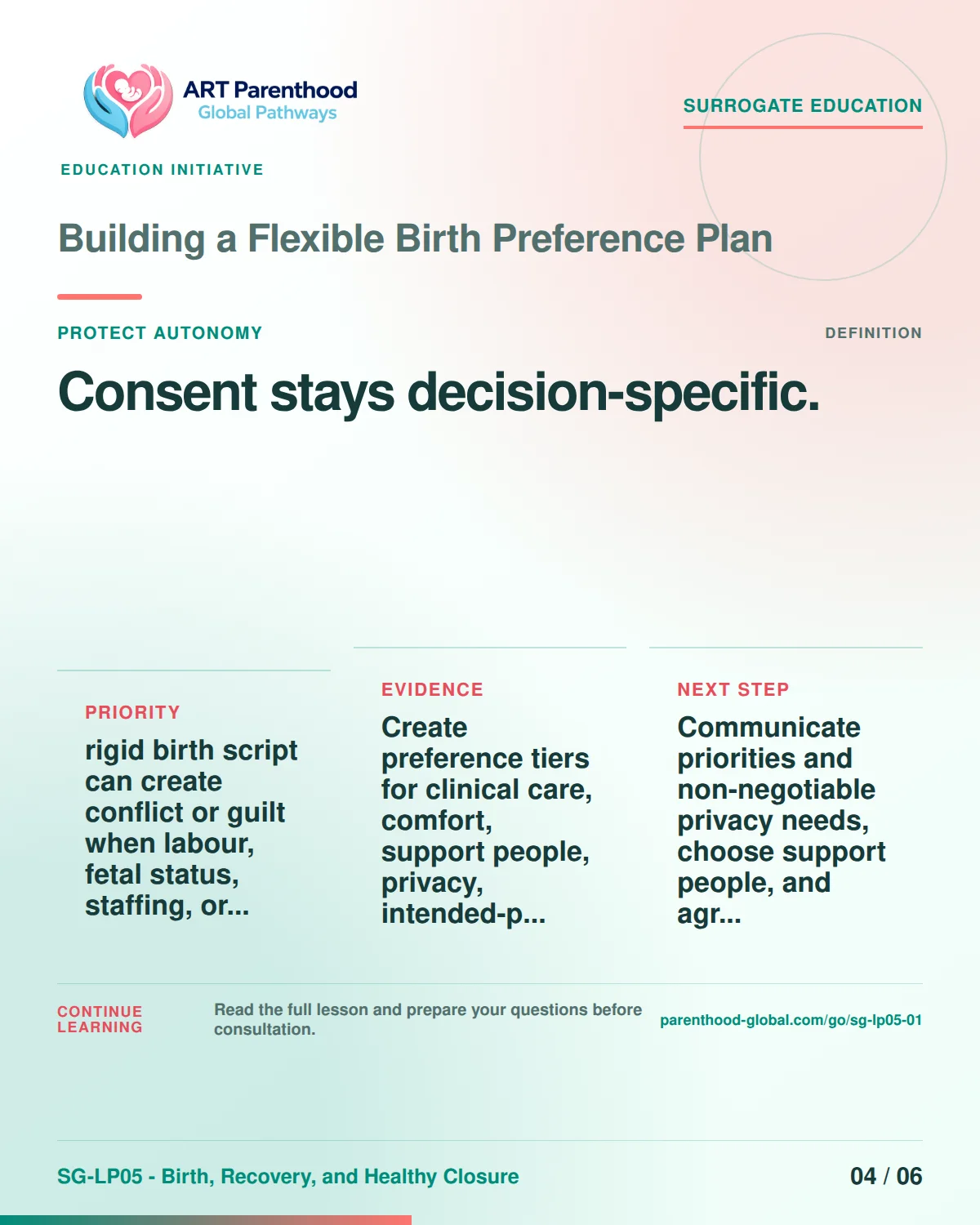
04 / 06Protect autonomy 
05 / 06Choose the next step 
06 / 06Keep the record
What building a flexible birth preference plan includes
documenting the surrogate’s clinical preferences, support people, comfort, privacy, intended-parent participation, and how plans may change for safety, with clear boundaries between the surrogate’s decision, clinical judgment, program practice, agreement expectations, and location-dependent law. For building a flexible birth preference plan, begin with the surrogate’s lived decision rather than pathway momentum. Identify the request, the clinical or legal owner, what is missing, what the surrogate can decide privately and which step can wait without creating a safety risk. The flexible birth-preference plan gives that discussion a practical shape. It includes clinical preference, support person, privacy request, comfort measure, intended-parent participation, contingency update. Each item should name its source, the person responsible for interpreting it and the point at which it must be reviewed again.
Why the distinction protects the surrogate
A rigid birth script can create conflict or guilt when labour, fetal status, staffing, or the surrogate’s needs change. The burden in birth, recovery and closure is concrete: labour, surgery, postpartum recovery, household support, follow-up, expenses, records, privacy and changing relationships. Missing ownership can shift that work or cost to the surrogate and make a freely chosen pause feel harder than it should. A polished checklist is therefore useful only when it exposes uncertainty instead of hiding it. “Unknown,” “not yet reviewed” and “I do not consent” are legitimate entries, not defects to be corrected.
Build a usable flexible birth-preference plan
Create preference tiers for clinical care, comfort, support people, privacy, intended-parent participation, photography, and contingencies; confirm that the surrogate can revise preferences in real time. For building a flexible birth preference plan, build the flexible birth-preference plan in four passes. First, gather the named materials: clinical preference, support person, privacy request, comfort measure, intended-parent participation, contingency update. Second, place each item under the correct owner—surrogate, clinician, counsellor, independent lawyer, insurer or coordinator. Third, mark the evidence as confirmed, incomplete, disputed or location-dependent. Fourth, write an action: obtain a record, ask a focused question, arrange support, seek independent review, pause or decline. Do not replace a missing answer with an assumption merely to keep the pathway moving.
Stress-test the building a flexible birth preference plan record against an ordinary day, a last-minute disruption and a clinically urgent scenario. Ask what changes if an appointment moves at short notice, a finding needs confirmation, a professional disagrees, privacy expectations change, a household support person becomes unavailable or urgent care is needed. The answer should identify a clinical route for symptoms, an independent route for rights or agreement questions, a practical backup for household work and a direct route to stop non-urgent activity. No notification or payment process should delay urgent assessment.
- clinical preference: record the source, decision owner, review date, uncertainty and next action.
- support person: record the source, decision owner, review date, uncertainty and next action.
- privacy request: record the source, decision owner, review date, uncertainty and next action.
- comfort measure: record the source, decision owner, review date, uncertainty and next action.
- intended-parent participation: record the source, decision owner, review date, uncertainty and next action.
- contingency update: record the source, decision owner, review date, uncertainty and next action.
Protect autonomy when roles or expectations conflict
Communicate priorities and non-negotiable privacy needs, choose support people, and agree how changes will be explained without treating preferences as consent to future procedures. Birth or newborn handover does not end the surrogate’s status as a patient or her right to recovery care, privacy and current consent. Decision ownership is therefore part of safety, not administrative etiquette. The surrogate can ask for plain-language explanations, private time with her clinician or lawyer, access to her own records and a written account of unresolved issues. She can also refuse unnecessary disclosure or decline a proposed next step. Clinicians decide what they can safely offer, not whether she must accept it. Lawyers explain rights and legal consequences, not medical necessity. Coordinators manage communication, not consent. Intended parents may receive information only through an agreed and lawful route.
Use the record to choose the next reversible step
Before advancing in birth, recovery and closure, review the flexible birth-preference plan aloud as a sequence: what is known, what remains uncertain, whose judgment applies, what support is funded or confirmed, what may change and how the surrogate can pause. Check that the six named items—clinical preference, support person, privacy request, comfort measure, intended-parent participation, contingency update—are not merely listed but linked to an owner, date and next action. Remove any clause or note that claims to predict an outcome. Add a review date whenever a clinical result, policy, agreement, insurance term or legal rule may become stale.
Add depth on birth-plan evidence, shared decision-making, obstetric contingency planning, trauma-informed care, support-person effects, and distinctions between preferences, consent, and clinical necessity. Use the technical depth to clarify building a flexible birth preference plan, not to manufacture a threshold, legal certainty or outcome prediction that the evidence cannot support. A document can show what was recorded, but cannot prove understanding, voluntariness or a future outcome. Apply current individual and location-specific review before choosing a reversible next step.
For Nerds: Technical Deep Dive
Add depth on birth-plan evidence, shared decision-making, obstetric contingency planning, trauma-informed care, support-person effects, and distinctions between preferences, consent, and clinical necessity.
Represent evidence, ownership and update triggers
A technically useful flexible birth-preference plan should model evidence and responsibility, not reduce a person to an eligibility score. Begin with clinical preference, support person, privacy request, comfort measure, intended-parent participation, contingency update. For every building a flexible birth preference plan item, retain its creator, date, completeness, applicable jurisdiction, qualified interpreter and the event that requires a new review. Add depth on birth-plan evidence, shared decision-making, obstetric contingency planning, trauma-informed care, support-person effects, and distinctions between preferences, consent, and clinical necessity. In building a flexible birth preference plan, clinical advice, ethical safeguards, program policy, insurance interpretation, legal rules and the surrogate’s preference answer different questions and must not be collapsed. A building a flexible birth preference plan clinical record can document history or a finding, but cannot establish voluntariness, predict the pathway or authorize a different decision. Counselling can document current themes and support needs relevant to building a flexible birth preference plan; it cannot certify obedience, eliminate distress or guarantee future coping. An agreement may allocate responsibilities around building a flexible birth preference plan, but cannot convert an intended-parent or program preference into authority over current medical care. A program decision about building a flexible birth preference plan determines only what that program will offer under its current rules; it is not a universal judgment of health, character or worth. The technical model for building a flexible birth preference plan must include labour, surgery, postpartum recovery, household support, follow-up, expenses, records, privacy and changing relationships. Each burden needs an owner, funding route where relevant and a realistic backup. Classify each building a flexible birth preference plan item as confirmed, incomplete, disputed or location-dependent; attach a concrete verification, review or pause action to every non-confirmed item. For building a flexible birth preference plan, the action may be obtaining the original record, private clinical or legal interpretation, written insurance confirmation, funded practical support, a safer escalation route or a pause. The building a flexible birth preference plan record is a decision aid. It is not a diagnosis, legal opinion, probability forecast or proof that consent remains informed and voluntary.
- clinical preference needs a source, responsible interpreter and update trigger.
- support person must remain separate from the surrogate’s continuing clinical consent.
- privacy request should expose uncertainty instead of converting it into a pass-fail score.
Use guidance without creating false certainty
Evidence limits should be explicit when reviewing building a flexible birth preference plan. Guidance can support safeguards for building a flexible birth preference plan; it cannot forecast this surrogate’s pregnancy, relationship, recovery, financial experience or legal result. Evidence used for building a flexible birth preference plan may not represent every surrogate or program. Selection, prior obstetric history, access to care, location, reporting practice and missing follow-up can change apparent risks and outcomes. Legal examples are even more location-bound. The official England and Wales pathway can illustrate why independent advice, records and sequencing matter, but a rule or procedure from that pathway cannot be assumed elsewhere. Apply a “whose decision is this?” audit to clinical preference, support person, privacy request, comfort measure, intended-parent participation, contingency update. Label every building a flexible birth preference plan statement as clinical, legal, ethical, administrative, financial, relational or personal before deciding who can interpret or act on it. For building a flexible birth preference plan, record the current source version, jurisdiction, responsible reviewer, material conflicts and the condition that reopens the decision. Keep absence of evidence separate from evidence of absence. In building a flexible birth preference plan, missing records are not negative evidence, testing depends on timing and method, favourable assessment leaves residual uncertainty and a signed document cannot determine a later emergency response. Scenario testing for building a flexible birth preference plan should compare burden, control, reversibility and escalation routes without invented probabilities. Ask how building a flexible birth preference plan changes if health information changes, household support fails, professionals disagree, privacy is breached, money is delayed or urgent care is needed. A technically sound building a flexible birth preference plan record states what is known, who decides, what remains uncertain, how the surrogate’s workload is covered and whether the next step remains proportionate, voluntary and reversible.
- Classify each statement as clinical, legal, ethical, administrative, relational or personal.
- Record source version, jurisdiction, decision owner, conflicts and the condition that reopens review.
- Use scenarios to compare consequences and control without inventing probabilities or guarantees.
Key takeaways
- For building a flexible birth preference plan, build the decision record with evidence, owners, review dates and update triggers.
- Keep the surrogate’s consent separate from program practice and agreement language.
- Treat missing or disputed information as a reason to verify or pause, not to guess.
- Use current medical, psychological and local legal review for material decisions.
FAQ
Who owns the final decision?
The surrogate owns decisions about her body, consent and optional disclosure. Clinicians determine what care they can safely offer, and qualified lawyers explain legal effects. A program or intended-parent preference does not replace either role.
What belongs in the flexible birth-preference plan?
Include clinical preference, support person, privacy request, comfort measure, intended-parent participation, contingency update. Add the source, responsible person, review date, uncertainty and next action for every item so the document works as a decision record rather than a decorative checklist.
Does a signed form settle the issue?
No. A form records a moment and may document information or preferences, but it cannot prove continuing understanding, remove the need for current clinical consent or make every provision enforceable in every location.
What if information is incomplete?
Mark it incomplete and identify who can answer it. Do not guess or allow urgency to convert missing information into agreement. A pause, records request or independent opinion may be the proportionate next step.
What should trigger independent review?
Seek an independent route when the issue affects bodily autonomy, medical risk, privacy, legal rights, insurance, significant money, household safety or pressure. Use urgent clinical services immediately for concerning symptoms.
Can I change my mind?
A surrogate may decline non-urgent next steps and ask for new information or advice. Exact contractual or legal consequences vary by location, so current independent legal review is needed for an existing agreement.