

ED-LP01-01 · ED-LP01
Egg donation means providing eggs that may be used in assisted reproductive technology, usually through an IVF-related process that involves more than one decision point. For a potential donor, the safest first step is understanding what screening, consent, medication, monitoring, retrieval, privacy review, and follow-up can actually involve before deciding whether to apply or continue.
Visual lesson summary
Review the lesson as a carousel.
Swipe or scroll through the key ideas, then continue with the detailed guidance below.
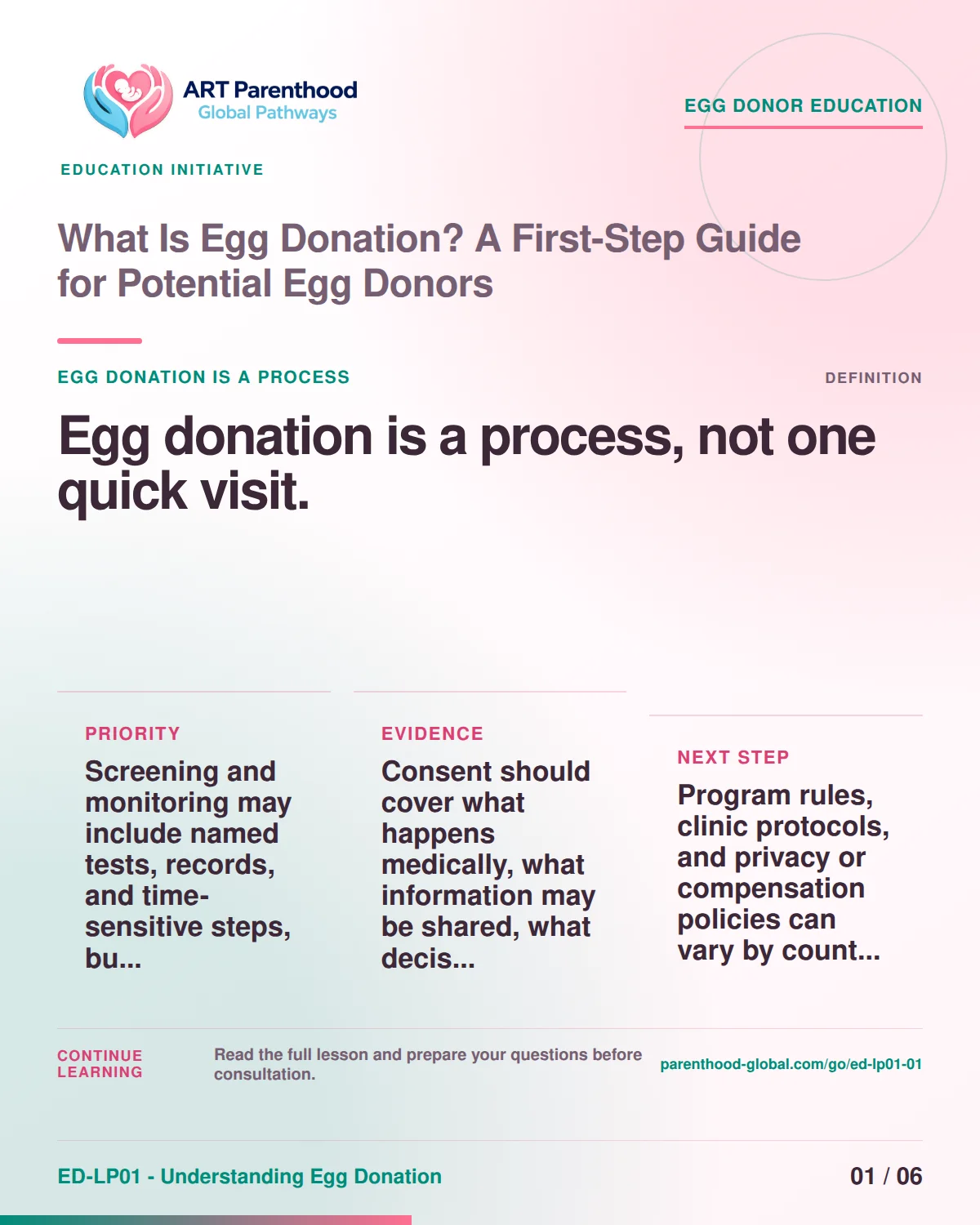
01 / 06Egg donation is a process 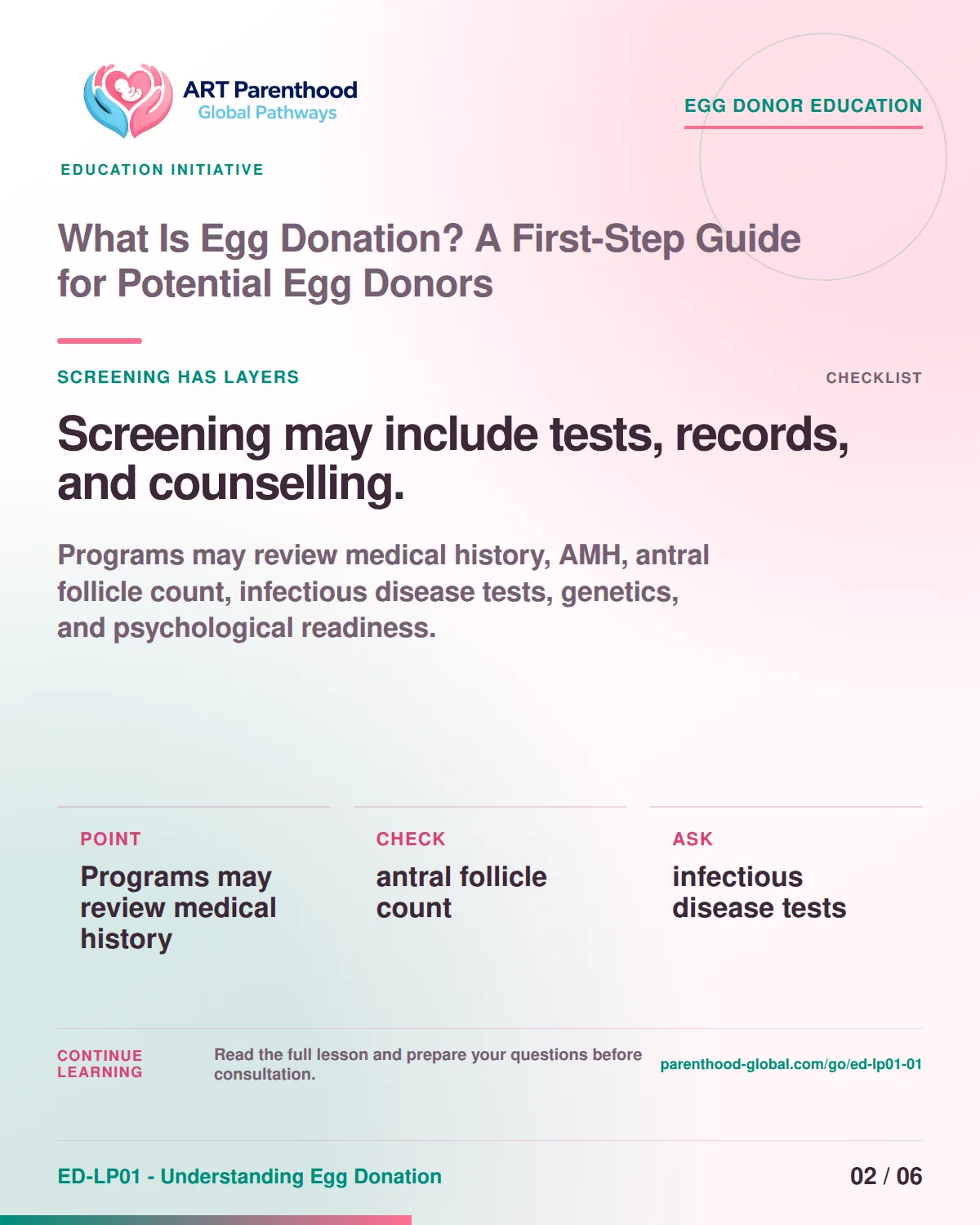
02 / 06Screening has layers 
03 / 06Numbers need context 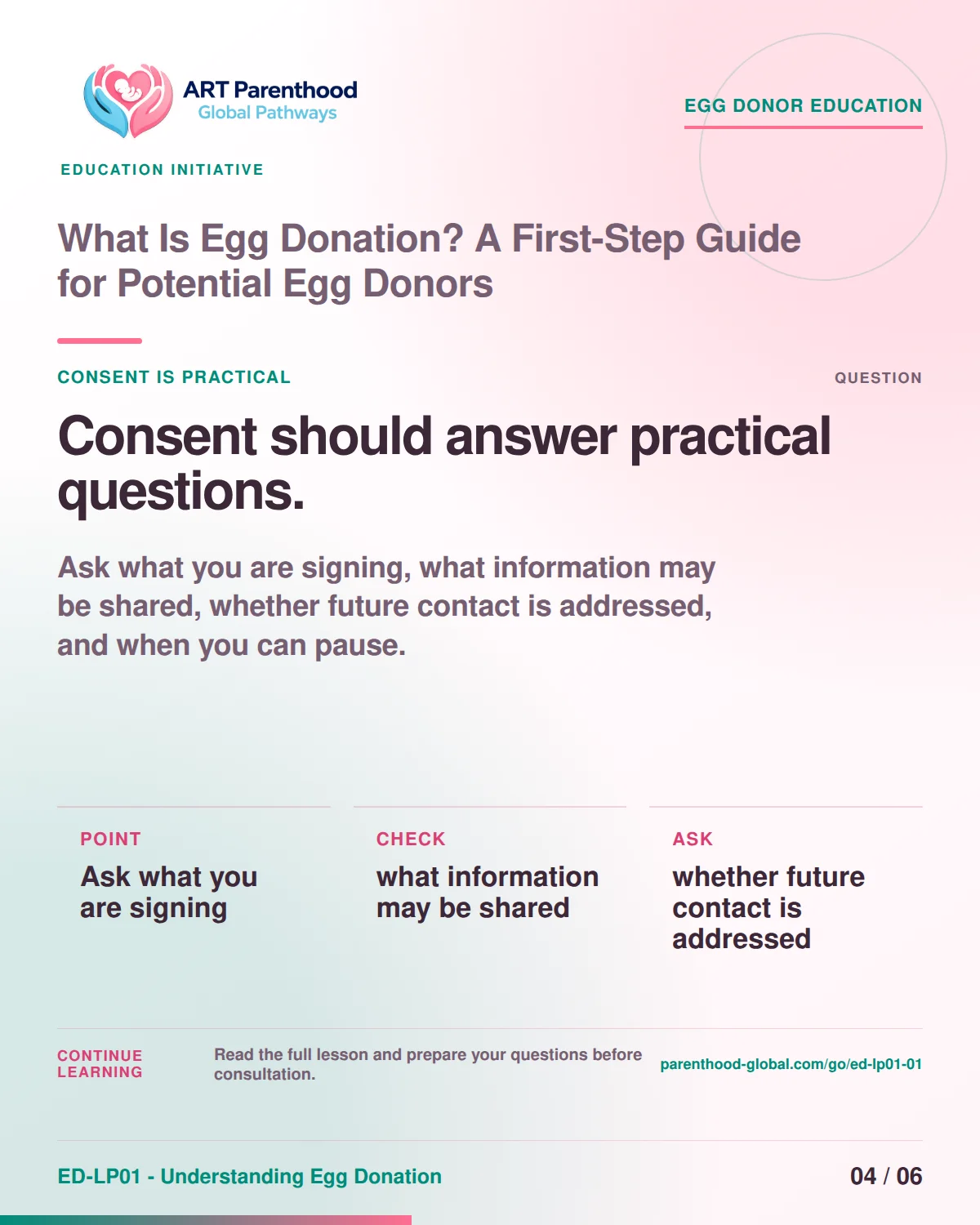
04 / 06Consent is practical 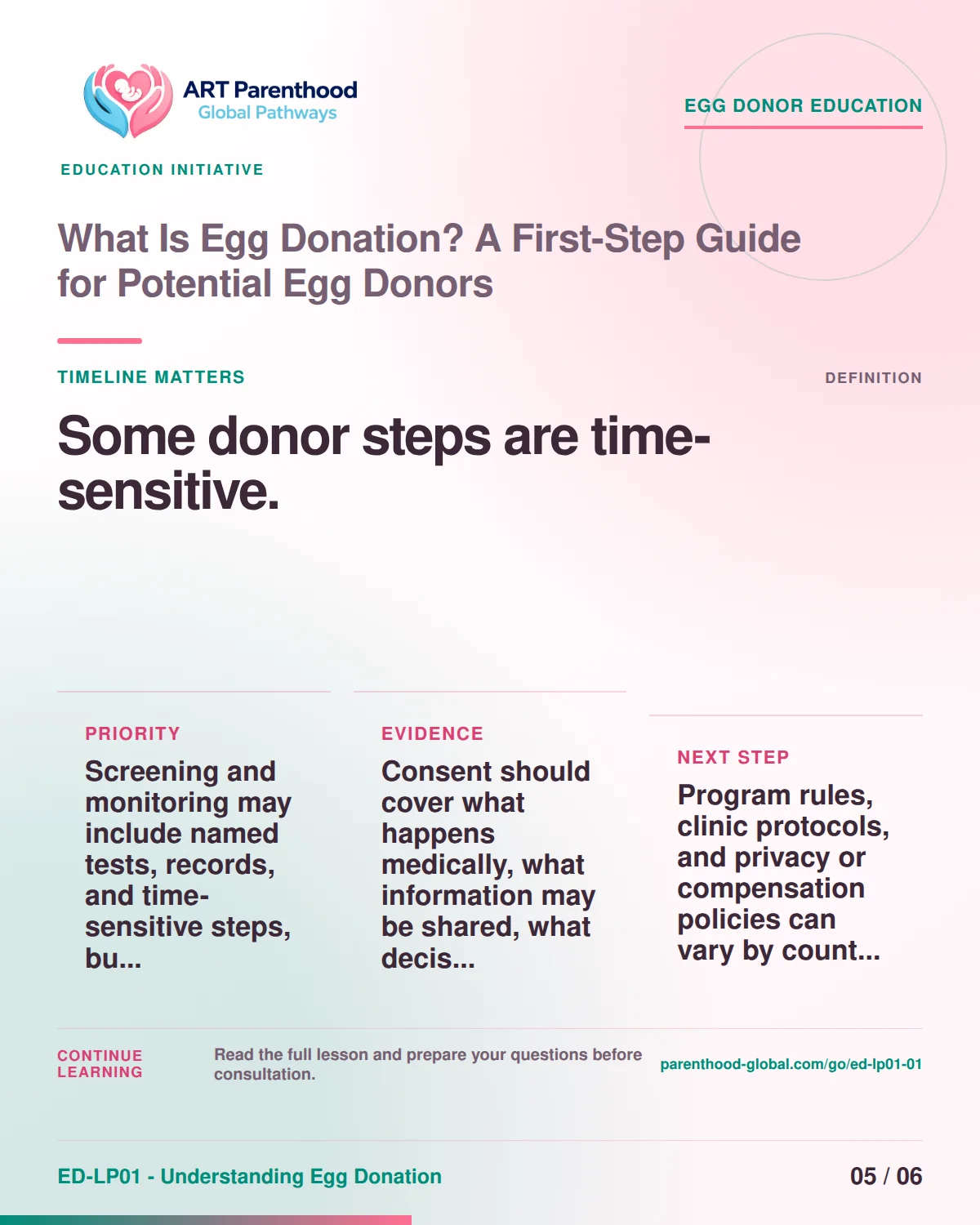
05 / 06Timeline matters 
06 / 06Bring better questions
What egg donation usually means in practice
Egg donation is part of assisted reproductive technology, and it is usually connected to an IVF process rather than a single stand-alone appointment. A donor pathway may begin with an application or inquiry, but it can quickly expand into health-history review, screening tests, medication teaching, monitoring visits, a retrieval procedure, and follow-up instructions.
That matters because a donor is not only offering eggs. A donor is also stepping into a structured medical and administrative process with time commitments, privacy questions, and consent decisions. Even when a program presents the process simply, the underlying steps can still be medically detailed and emotionally significant.
A strong educational starting point is understanding the sequence: what gets reviewed first, which parts are screening only, which parts begin a treatment cycle, and which questions should be answered before any medication or signature moves the process forward.
What a potential donor should ask before applying or proceeding
Potential donors often want to know whether they qualify, but an even better early question is how the program evaluates, explains, and documents each step. Ask who reviews your medical history, who explains abnormal or borderline results, whether a psychological consultation is part of the process, and how privacy or future-contact questions are handled in writing.
It is also reasonable to ask what happens if you start screening and then want to pause, what follow-up is available after retrieval, and whether compensation rules, travel arrangements, or record sharing differ by state, country, or program policy. Clear answers protect both your time and your consent.
If a program gives only verbal reassurance, rushes signatures, or treats detailed questions as a problem, slow down. A responsible donor process should make room for written information, realistic expectations, and qualified answers from the right professionals rather than pressure from sales language or social-media simplicity.
- Who interprets AMH, ultrasound findings, and other screening results for me?
- What documents explain privacy, future contact, compensation terms, and follow-up?
- At what point would medication begin, and what choices remain open before then?
- If something changes medically or emotionally, who helps me decide what to do next?
Tests, documents, and timing points you may hear about
Programs may discuss AMH, antral follicle count, infectious disease testing, genetic carrier screening, psychological consultation, medication teaching, trigger medication, and retrieval timing. Those details are useful because they show that egg donation is organized around both medical safety and informed consent, not just enthusiasm or availability.
The ReproductiveFacts third-party reproduction booklet gives a few public examples that are helpful for orientation but still need professional verification before publication or personal decision-making. It says egg donors should be legal adults and are preferably between 21 and 34 years old, that infectious disease tests should be negative within 30 days before donation, and that egg retrieval usually occurs about 34 to 36 hours after the trigger medication. These examples show how real donor programs use age, timing, and screening windows, but they are not universal promises of eligibility and should not be treated as a diagnosis or legal conclusion.
For a potential donor, the practical question is what each item changes. AMH and antral follicle count may help a clinician think about ovarian response, but they do not answer every question about safety or future fertility. Infectious disease screening can be essential for donor eligibility, but rules may depend on current regulation and local program policy. Trigger timing can be very exact because retrieval scheduling is coordinated, yet the exact plan still depends on your own cycle response and clinic protocol.
- AMH and antral follicle count are commonly discussed because they may help estimate ovarian response, not because they can predict every outcome by themselves.
- Infectious disease screening and genetic carrier screening are separate review layers and may have different purposes, timelines, and follow-up questions.
- Psychological consultation is not just a formality; it can help clarify expectations, boundaries, support needs, and how you feel about privacy or future contact questions.
- Trigger medication and retrieval timing are coordinated steps, so ask which parts of the schedule are fixed and what happens if a change or pause becomes necessary.
- Consent forms should explain what is being authorized, what information may be shared, and who answers questions before the process moves forward.
For Nerds: Technical Deep Dive
This advanced section is for readers who want more than a basic introduction. It explains how donor screening data, consent records, time-sensitive cycle steps, and privacy or counselling review fit together in real egg-donation workflows, while staying clear about what each number, document, or timing example can and cannot decide on its own.
How donor screening data are used in real cycle planning
In donor screening, the clinically useful question is not whether one result is good or bad in the abstract. The real question is how different results work together when a program decides whether a donor candidate can safely move into a cycle and how that cycle should be managed. Programs may look at age, medical history, reproductive history, AMH, antral follicle count, infectious disease testing, genetic carrier screening, complete blood count, blood type and Rh status, medication teaching readiness, and psychological consultation. The ReproductiveFacts third-party reproduction booklet offers several public examples that are useful for orientation: it says donors should be legal adults and are preferably between 21 and 34 years old, that infectious disease tests should be negative within 30 days before donation, and that retrieval usually happens about 34 to 36 hours after trigger medication. Those examples help an advanced reader understand that donor workups use both eligibility preferences and tightly coordinated timing, but they still do not function as stand-alone yes or no rules. A preferred age range is not the same thing as a universal legal rule, and a normal-appearing AMH value is not the same thing as a guarantee about ovarian response, mature oocyte count, or long-term reproductive health. Likewise, an antral follicle count depends on timing, imaging quality, and the person interpreting the scan. Infectious disease screening is essential for safety and compliance, but the exact panel, specimen timing, and re-screening rules may depend on current regulation and program policy. Trigger timing is often presented as one precise number, yet the scheduling decision still depends on follicle growth, hormone response, anesthesia planning, and clinic workflow. Advanced readers should therefore treat donor data as a coordinated planning set: what result changes the plan, which result needs repeat testing or counselling, and which item is being used for safety, for eligibility, for logistics, or for documentation. That framing is much more accurate than turning one value into an identity judgment about whether someone is or is not a suitable donor.
- AMH and antral follicle count are planning inputs for likely ovarian response; they are not stand-alone predictions of mature egg yield, embryo quality, or a recipient's ultimate outcome.
- Infectious disease screening has both medical-safety and compliance implications, which is why specimen timing and exact panel requirements need current regulatory and program review rather than memory alone.
- Genetic carrier screening can identify variants that may require counselling or matching review, but the meaning of a result depends on the condition, inheritance pattern, and recipient-side decision context.
- A trigger-to-retrieval interval such as 34 to 36 hours illustrates how coordinated a donor cycle can become, but the clinic still has to integrate monitoring data, anesthesia timing, and individual response.
Expected ranges / examples
- Preferred donor age example: 21-34 years. Used in ASRM patient education as a preferred donor age example. It should be presented as a program-orientation example that still requires current medical, legal, and program-specific verification rather than as a universal rule. Source: ReproductiveFacts.org - Third-Party Reproduction booklet.
- Infectious disease timing example: negative within 30 days before donation. Used in ASRM patient education to illustrate time-sensitive donor screening. Publication should confirm current regulatory applicability, specimen timing, and whether the statement is being framed as a general U.S. example or a universal rule. Source: ReproductiveFacts.org - Third-Party Reproduction booklet.
- Trigger to retrieval timing example: 34-36 hours after trigger medication. Used in ASRM patient education to show that retrieval scheduling is coordinated and time-sensitive. It should be explained as a common timing example that still varies with clinic protocol and cycle response. Source: ReproductiveFacts.org - Third-Party Reproduction booklet.
Timeline breakdown
- Application and initial record review: Varies by program. The donor candidate usually completes health-history forms, family-history questions, and early program intake before any cycle-specific medication plan is created.
- Screening completion: Some steps are time-sensitive; infectious disease testing may need to be current within 30 days before donation in the cited public example. Medical, laboratory, genetic, and psychological screening results are gathered and reviewed to decide whether the candidate can move forward and whether additional counselling or follow-up is needed.
- Stimulation and monitoring: Protocol-specific and adjusted from monitoring data. If the donor moves into a cycle, medication teaching, ultrasound monitoring, and bloodwork help the clinical team decide when trigger medication should be given and whether the response remains safe and appropriate.
- Trigger and retrieval: About 34-36 hours between trigger medication and retrieval in the cited public example. The retrieval schedule is coordinated around time-sensitive physiology, clinical monitoring, and procedure logistics, which is why donors should ask what happens if symptoms change or scheduling problems arise.
Consent, privacy, and documentation are part of the safety system
Advanced readers sometimes focus on lab values and forget that donor documentation is also doing real clinical and ethical work. A donor pathway can generate a stack of records: medical-history questionnaires, family-history forms, infectious disease results, genetic carrier screening reports, psychological consultation notes or recommendations, medication-teaching instructions, anesthesia or procedure consent, privacy disclosures, contact-preference records, and compensation or reimbursement documents where lawful. These are not decorative paperwork. Each one is meant to capture something specific: whether a program has enough history to screen responsibly, whether a donor has had a chance to understand what happens next, whether a result needs counselling, and whether future information sharing has been described clearly enough to support consent. That matters because a donor may be healthy, motivated, and still poorly informed if the record set is incomplete or rushed. A signed consent form proves only that a document was signed; it does not prove the explanation was complete, that the donor understood future-contact implications, or that jurisdiction-specific compensation limits were explained correctly. Privacy language can clarify what information is shared now, what may be stored, and what may become relevant later, but it cannot guarantee that a donor will never face future identity, medical-update, or contact questions. Psychological consultation can surface support needs, expectations, and emotional boundaries, but it is not a moral judgment on whether someone is generous enough to donate. For a public lesson, the safest expert-grade stance is to teach readers that records, consent, counselling, and privacy review are core parts of donor safety and autonomy. Potential donors should ask which documents they receive before medication begins, which records may be shared with intended parents or stored long term, whether future medical updates are addressed, and who explains the legal meaning of compensation, privacy, or contact terms in their own jurisdiction. That is how documentation becomes practical education instead of a vague warning about paperwork.
- A medical-history questionnaire and family-history form help a program screen responsibly, but they still depend on accurate explanation, current information, and appropriate follow-up when something is unclear.
- Genetic carrier screening reports and counselling notes can clarify whether more discussion is needed, yet they do not by themselves decide the ethical, legal, or personal meaning of moving forward.
- Procedure consent, privacy disclosures, and compensation documents can define what has been explained or authorized, but they do not replace a donor's right to ask questions or request qualified review before agreeing.
- Psychological consultation may help identify expectations, support needs, or pressure points, and it should be framed as part of informed decision-making rather than a perfunctory hoop.
Key takeaways
- Egg donation usually involves screening, consent, medication, monitoring, retrieval, and follow-up rather than a single appointment.
- Useful donor education should name the tests, documents, and timing points that shape real decisions.
- No single age example, lab result, or scheduling detail can replace individualized medical, legal, or psychological guidance.
FAQ
Does learning about egg donation mean I am agreeing to donate?
No. Reading, asking questions, or starting an application should not be treated as final consent. Ask each program when consent becomes binding, when medication would begin, and what choices remain open at each step.
Will one test or age number tell me whether I can donate?
Usually not. Programs may review age preferences, medical history, ovarian reserve markers, infectious disease screening, genetics, and psychological readiness together. Ask which results are screening only, which results may change the plan, and who interprets them.
Why should I ask about privacy and future contact so early?
Because those questions are part of informed consent, not an afterthought. Ask what information is shared now, what records are stored, whether future medical updates or contact preferences are addressed, and which answers depend on local law or program policy.