

ED-LP01-06 · ED-LP01
Clarify what the donor contributes and controls without assigning responsibility for fertilization, pregnancy, birth, parenting, or recipient outcomes. A sound decision rests on written information, clear role ownership, realistic support, and freedom to pause.
Visual lesson summary
Review the lesson as a carousel.
Swipe or scroll through the key ideas, then continue with the detailed guidance below.
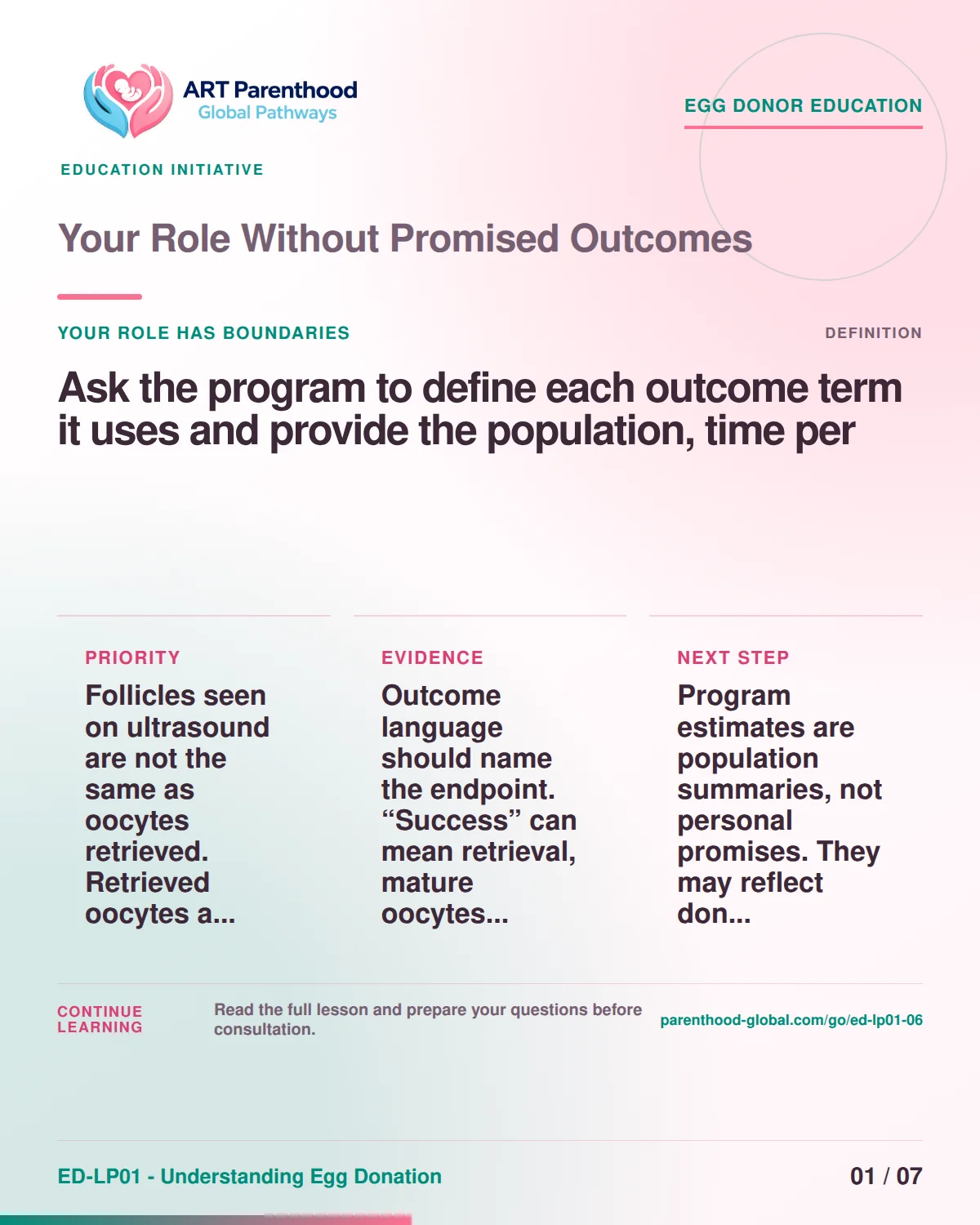
01 / 07Your role has boundaries 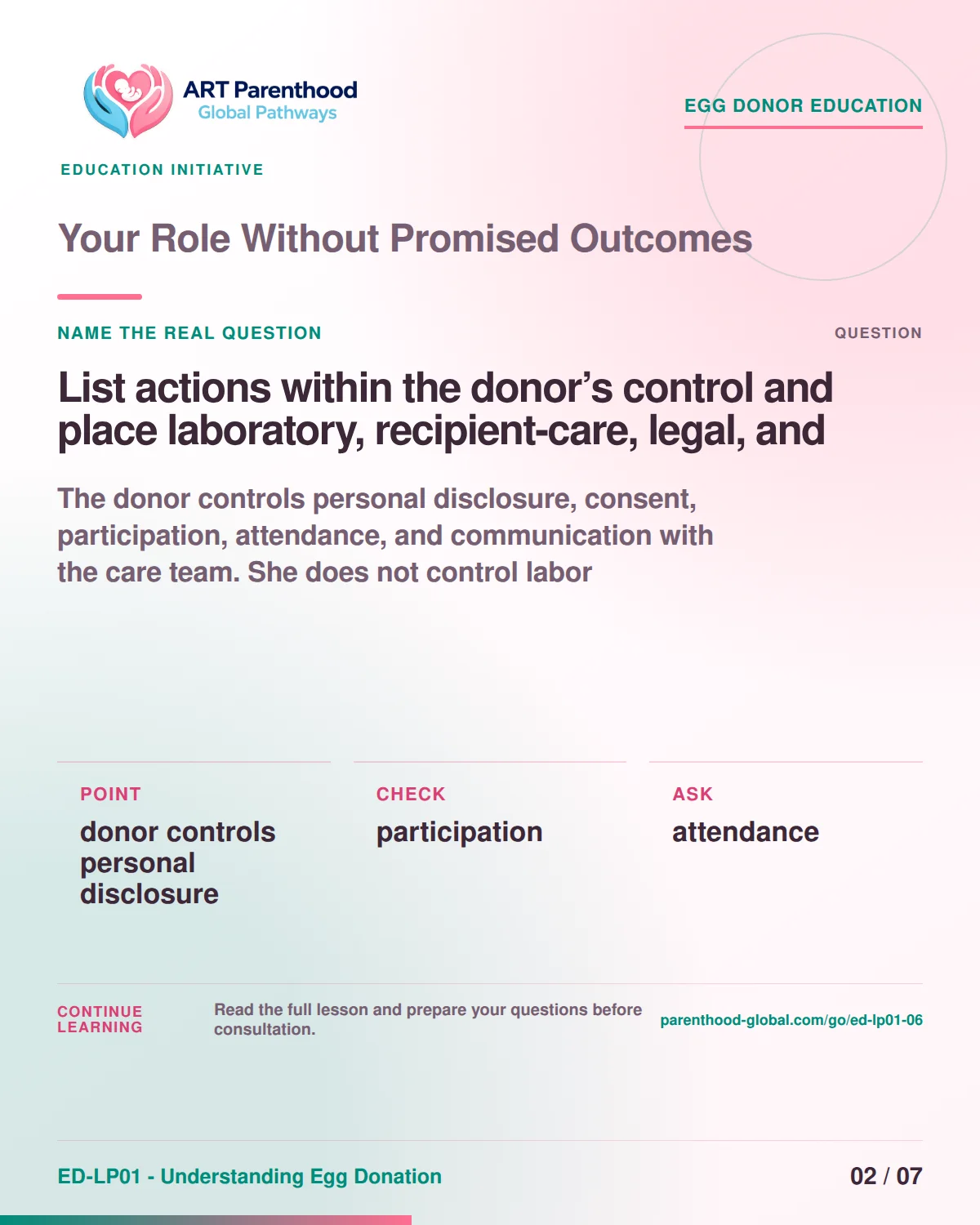
02 / 07Name the real question 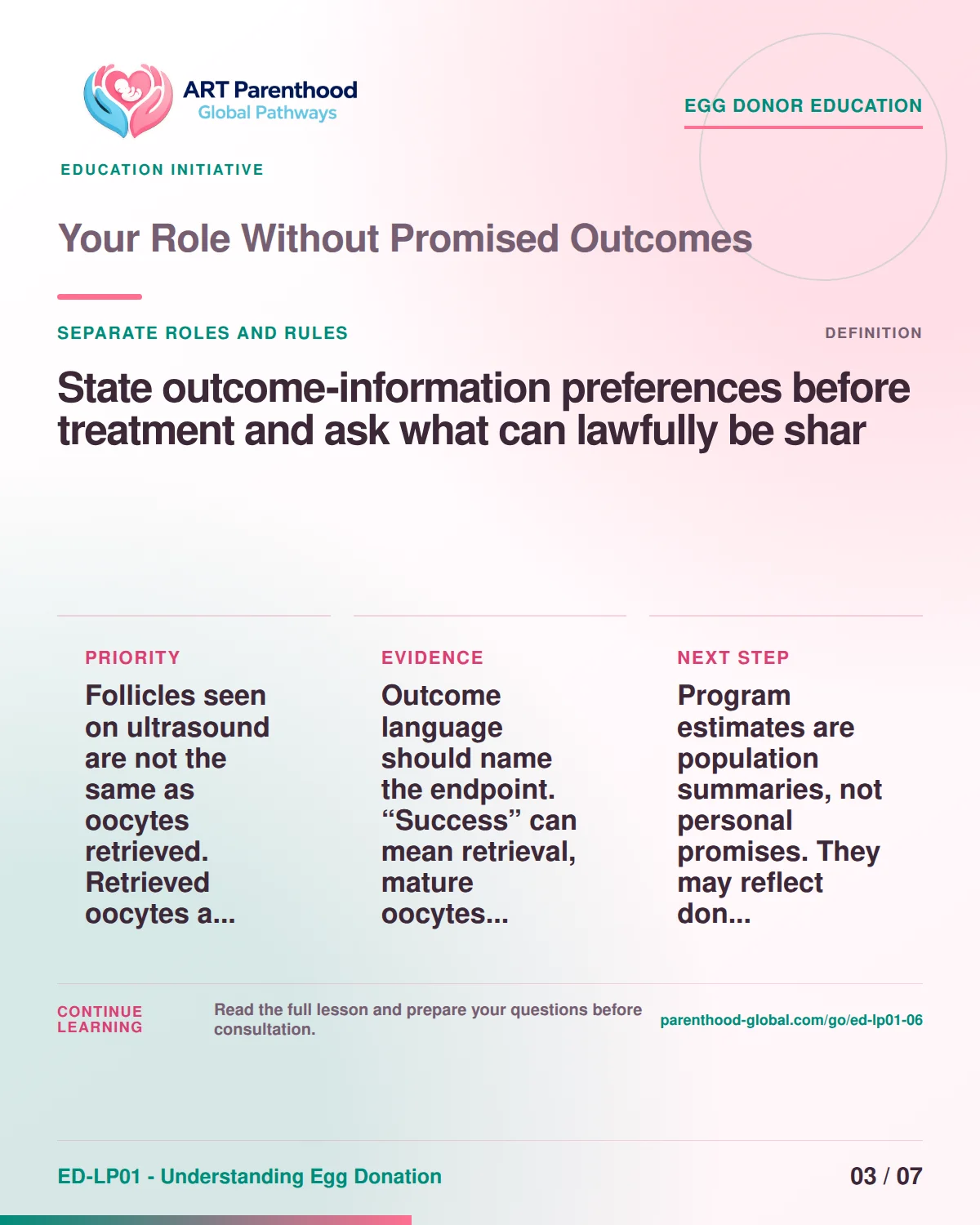
03 / 07Separate roles and rules 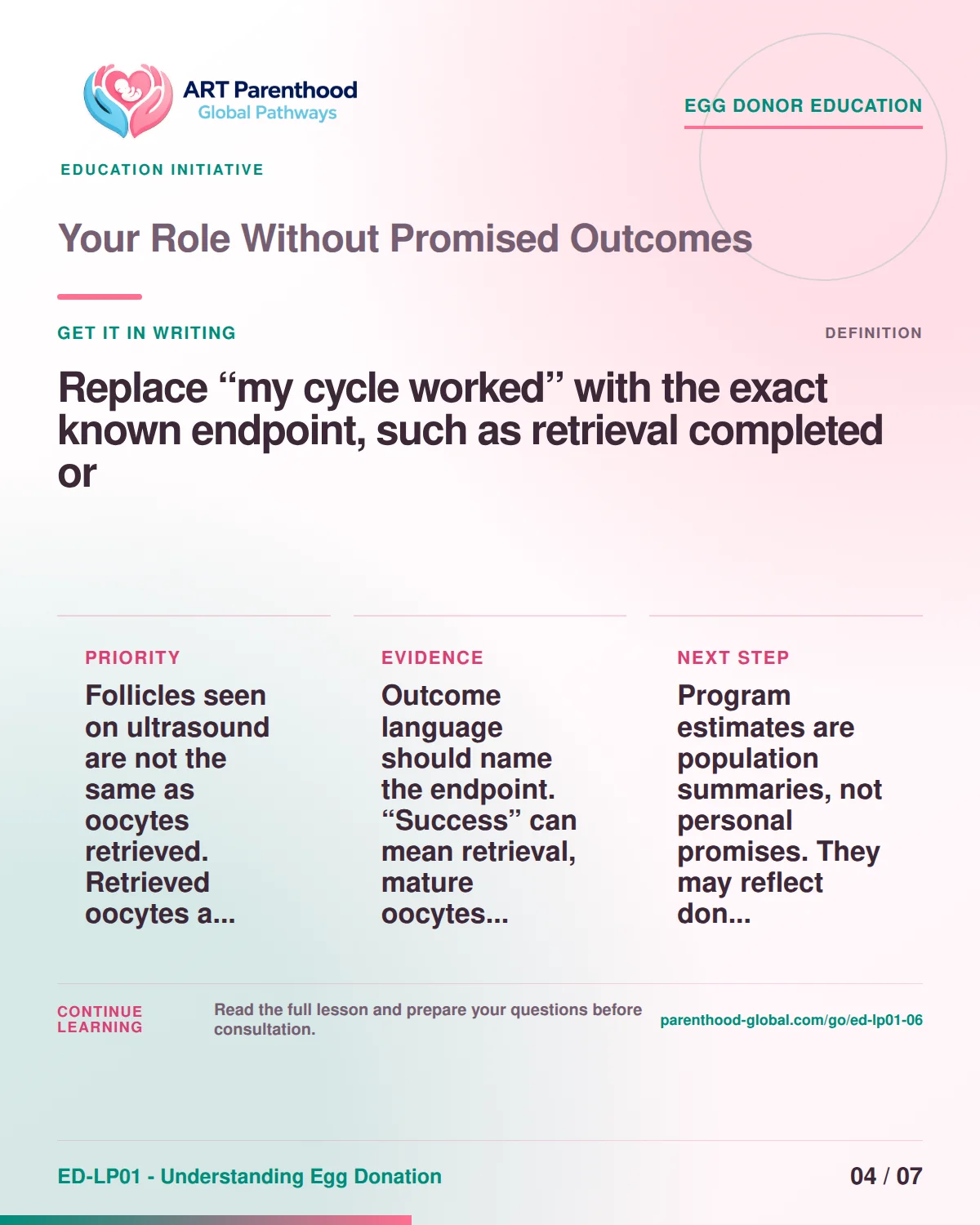
04 / 07Get it in writing 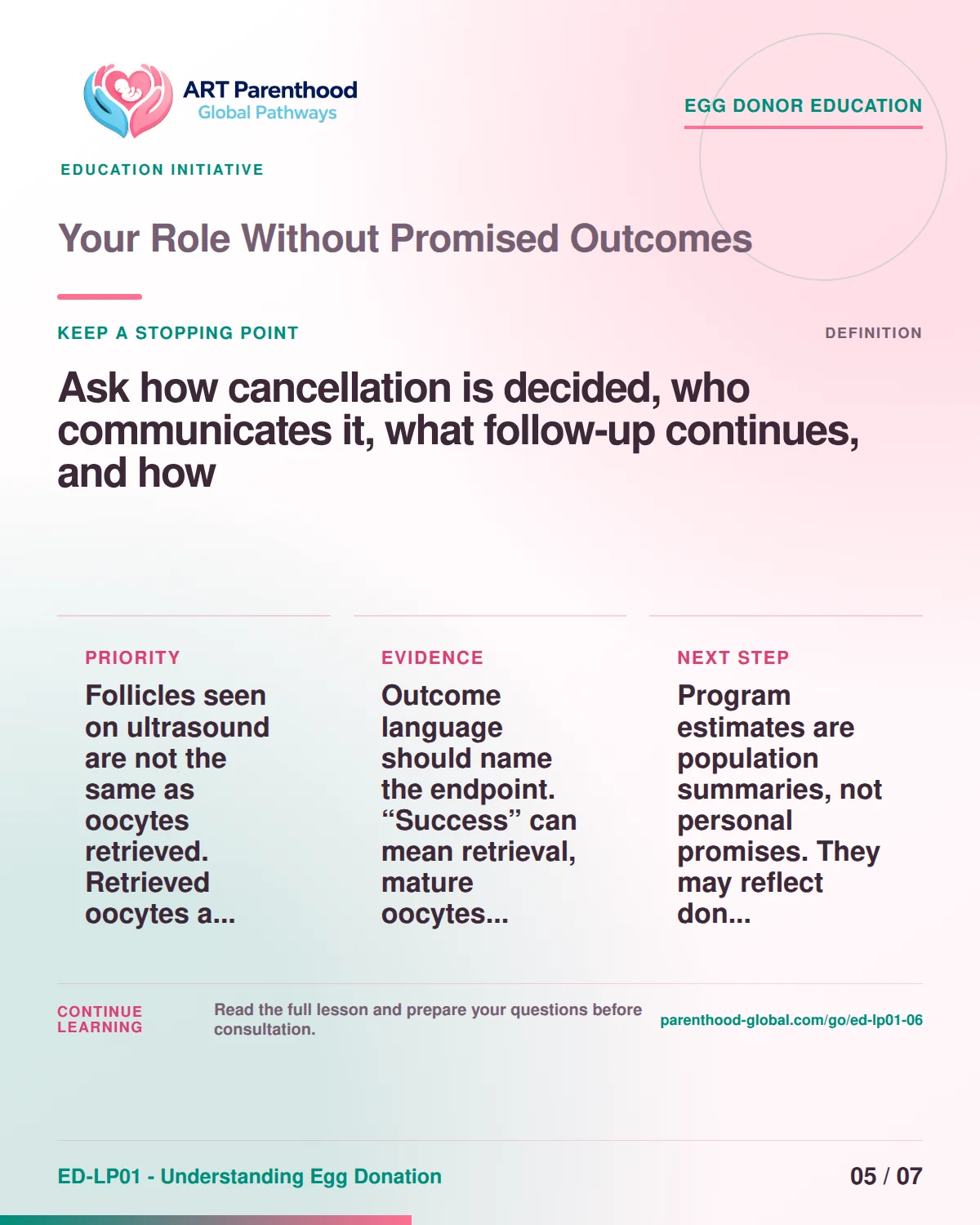
05 / 07Keep a stopping point 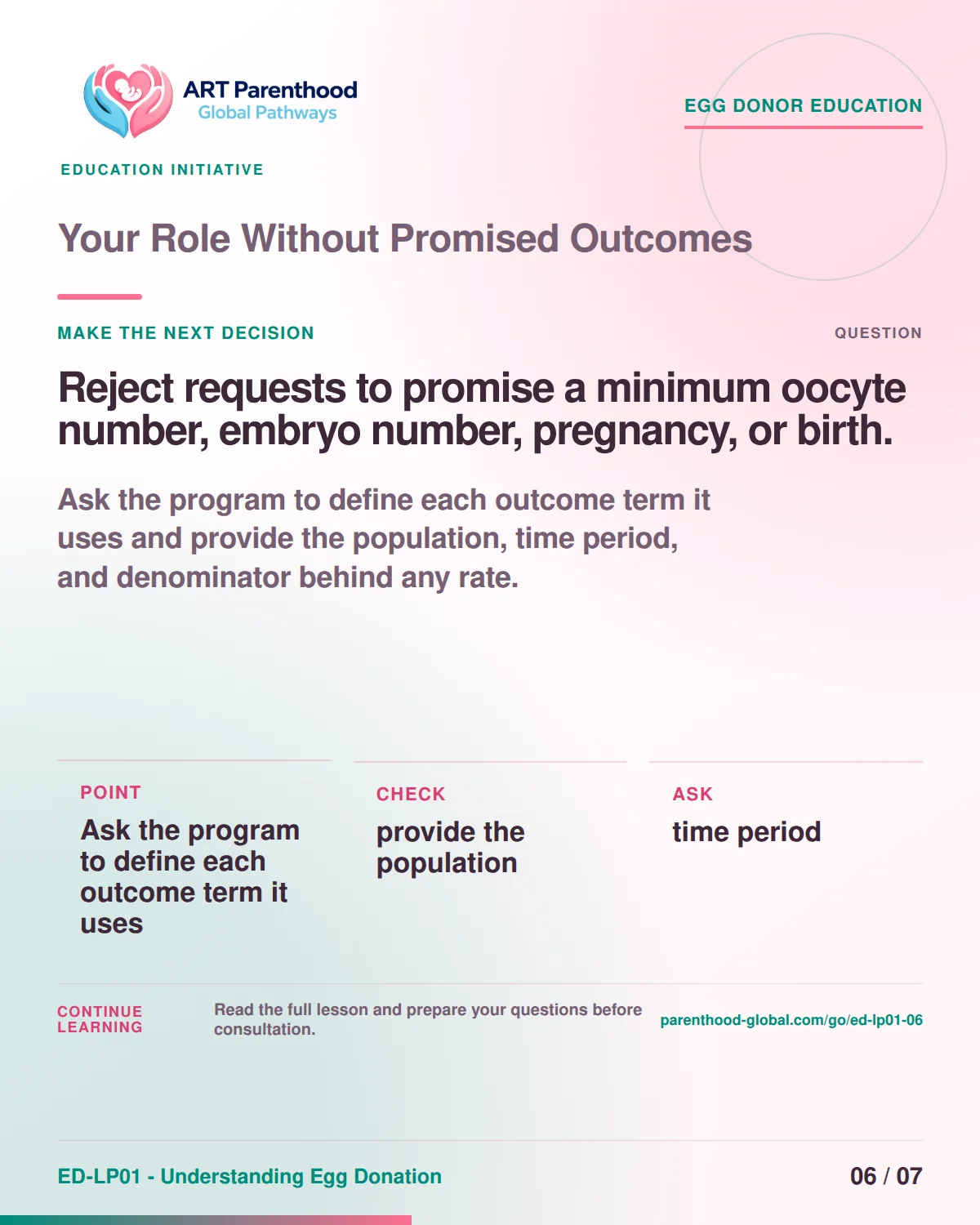
06 / 07Make the next decision 
07 / 07Read, ask, then decide
Start with the donor’s decision
Define the donor's role in providing oocytes through a consented clinical process and separate it from recipient care, embryology outcomes, and legal parenthood. For a prospective donor, the practical test is whether the program can connect this point to a named document, responsible professional, and decision point. Ask what is standard policy, what depends on personal assessment, and what can change later. Keep the answer in writing so reassurance can be compared with the documents that actually govern care. A concrete next step is to ask the program to define each outcome term it uses and provide the population, time period, and denominator behind any rate.
Why this deserves an early answer
Clear role boundaries reduce misplaced responsibility, saviour narratives, outcome pressure, and confusion about information a donor may receive. This matters before an application because screening can create privacy, time, travel, and emotional costs even when no treatment follows. A useful answer identifies who decides, what evidence is reviewed, how uncertainty is communicated, and what route exists when the donor disagrees or needs more time. A concrete next step is to list actions within the donor’s control and place laboratory, recipient-care, legal, and parenting decisions under the responsible party.
How the process should make it visible
Trace controllable actions, clinic responsibilities, recipient decisions, biological uncertainty, and questions about notification without predicting a result. The donor does not have to solve the issue alone. The clinic owns clinical explanation and safe care; an independent lawyer owns jurisdiction-specific legal interpretation; a counsellor can examine pressure and meaning; the donor retains the final participation decision. A concrete next step is to state outcome-information preferences before treatment and ask what can lawfully be shared, by whom, and when.
Turn the issue into written questions
Program estimates are population summaries, not personal promises. They may reflect donor selection, recipient age and health, sperm factors, laboratory practice, embryo testing, transfer choices, and reporting rules. Avoid turning a population recommendation into a personal verdict. Program criteria, professional guidance, and legal rules operate at different levels. The donor should ask which level supports a statement and what limitation prevents it from becoming a guarantee, diagnosis, or universal rule. A concrete next step is to replace “my cycle worked” with the exact known endpoint, such as retrieval completed or a stated number of mature oocytes reported.
- Ask the program to define each outcome term it uses and provide the population, time period, and denominator behind any rate.
- List actions within the donor’s control and place laboratory, recipient-care, legal, and parenting decisions under the responsible party.
- State outcome-information preferences before treatment and ask what can lawfully be shared, by whom, and when.
- Replace “my cycle worked” with the exact known endpoint, such as retrieval completed or a stated number of mature oocytes reported.
Notice pressure and missing ownership
A cycle can be cancelled for safety, response, timing, or operational reasons. Cancellation is not evidence that the donor failed, and continuation is not proof that a baby will result. A good process makes stopping points visible. It states what can be decided now, what must wait for screening or medical review, and what remains uncertain even after a cycle. That structure protects informed choice better than optimistic language or an unexplained checklist. A concrete next step is to ask how cancellation is decided, who communicates it, what follow-up continues, and how payment and expenses are handled.
Keep each professional in the right role
Recipient medical details remain private unless disclosure is authorized and relevant to the donor’s informed participation. Empathy does not create a right to another person’s diagnosis or outcome. Records are part of safety. Date the question, identify the person or entity answering it, retain the applicable version, and note any promised follow-up. If a later form conflicts with the answer, pause and resolve the conflict before relying on either one. A concrete next step is to reject requests to promise a minimum oocyte number, embryo number, pregnancy, or birth.
Build a decision record you can use
The donor should decide in advance whether she wants permitted updates about retrieval or later outcomes and understand that law, consent, clinic policy, and recipient privacy may limit them. The relevant boundary is not whether other people are disappointed; it is whether the donor has accurate information, freedom from coercion, and a safe clinical route. Consequences may be explained, but they should not be exaggerated or used to punish a changed decision. A concrete next step is to seek counselling if hoped-for gratitude, contact, outcome news, or family meaning is central to the decision.
- Ask how cancellation is decided, who communicates it, what follow-up continues, and how payment and expenses are handled.
- Reject requests to promise a minimum oocyte number, embryo number, pregnancy, or birth.
- Seek counselling if hoped-for gratitude, contact, outcome news, or family meaning is central to the decision.
- Keep recipient privacy and donor safety separate: request the information needed for consent without seeking unrelated personal details.
Choose continue, pause, or decline
Whether role boundaries match expectations and what outcome information, if any, the donor wants and may lawfully receive. The result should be a decision the donor can explain in her own words: what she understands, what remains unresolved, what support exists, and which event would trigger a pause. That is more useful than a generic declaration that she feels ready. A concrete next step is to keep recipient privacy and donor safety separate: request the information needed for consent without seeking unrelated personal details.
For Nerds: Technical Deep Dive
An advanced donor-centred analysis of your role without promised outcomes, including consent, evidence, document, role, process, and jurisdiction limits that require professional review.
Mechanisms, documents, and interpretation limits
Distinguish oocyte yield, maturity, fertilization, blastocyst formation, transfer, implantation, clinical pregnancy, and live birth as separate conditional endpoints. The donor controls personal disclosure, consent, participation, attendance, and communication with the care team. She does not control laboratory performance, recipient treatment, embryo transfer, pregnancy, or birth. Follicles seen on ultrasound are not the same as oocytes retrieved. Retrieved oocytes are not all mature, mature oocytes do not all fertilize, and embryos do not all reach transfer or birth. Outcome language should name the endpoint. “Success” can mean retrieval, mature oocytes, fertilization, blastocyst formation, implantation, clinical pregnancy, ongoing pregnancy, or live birth. Program estimates are population summaries, not personal promises. They may reflect donor selection, recipient age and health, sperm factors, laboratory practice, embryo testing, transfer choices, and reporting rules. A cycle can be cancelled for safety, response, timing, or operational reasons. Cancellation is not evidence that the donor failed, and continuation is not proof that a baby will result. Recipient medical details remain private unless disclosure is authorized and relevant to the donor’s informed participation. Empathy does not create a right to another person’s diagnosis or outcome. The donor should decide in advance whether she wants permitted updates about retrieval or later outcomes and understand that law, consent, clinic policy, and recipient privacy may limit them. Genetic contribution is biologically meaningful without automatically defining legal parenthood, a promised relationship, or responsibility for another family’s future decisions. Ask the program to define each outcome term it uses and provide the population, time period, and denominator behind any rate. List actions within the donor’s control and place laboratory, recipient-care, legal, and parenting decisions under the responsible party. State outcome-information preferences before treatment and ask what can lawfully be shared, by whom, and when. Replace “my cycle worked” with the exact known endpoint, such as retrieval completed or a stated number of mature oocytes reported. Ask how cancellation is decided, who communicates it, what follow-up continues, and how payment and expenses are handled. Reject requests to promise a minimum oocyte number, embryo number, pregnancy, or birth. Seek counselling if hoped-for gratitude, contact, outcome news, or family meaning is central to the decision. Keep recipient privacy and donor safety separate: request the information needed for consent without seeking unrelated personal details. A review-grade reading separates normative standards from enforceable rules. ASRM guidance is professional guidance in the United States; FDA requirements concern donor eligibility and tissue establishments within their regulatory scope; HFEA material describes the United Kingdom framework; ESHRE recommendations support European good practice but do not erase national law. A program should therefore name the jurisdiction, governing document, effective date, and entity responsible for applying it. Terms such as consent, eligibility, withdrawal, compensation, anonymity, and adverse event can carry different operational or legal meanings. Evidence also has selection limits. Donor programs often study people who passed screening, completed treatment, and remained reachable. That can under-represent people excluded before treatment, people who withdrew, cycles cancelled by the program, and complications treated elsewhere. Counts need denominators: applicants, screened donors, started cycles, retrievals, oocytes, recipients, transfers, pregnancies, or births are not interchangeable. A statistic without the population, endpoint, time period, and missing-data explanation should not drive an individual decision. Document analysis should identify the issuing entity, version, effective date, incorporated policies, hierarchy among conflicting documents, amendment route, and the consequence of organizational closure. Clinical review should identify who prescribes, who monitors, who has after-hours responsibility, how handoff works during travel, and how safety care continues after cancellation. Psychological review should examine voluntariness without treating reasonable doubt as pathology. Legal review should identify where a general statement becomes jurisdiction-dependent and must not imply a universal right or obligation.
- Ask the program to define each outcome term it uses and provide the population, time period, and denominator behind any rate.
- List actions within the donor’s control and place laboratory, recipient-care, legal, and parenting decisions under the responsible party.
- State outcome-information preferences before treatment and ask what can lawfully be shared, by whom, and when.
- Replace “my cycle worked” with the exact known endpoint, such as retrieval completed or a stated number of mature oocytes reported.
- Ask how cancellation is decided, who communicates it, what follow-up continues, and how payment and expenses are handled.
- Reject requests to promise a minimum oocyte number, embryo number, pregnancy, or birth.
Timeline breakdown
- Before application or treatment commitment: Before sensitive records, travel, medicines, or binding documents. The donor obtains the current program information, identifies the responsible clinical and administrative entities, records unresolved questions, and decides whether enough is known to proceed to individualized review.
- When circumstances, information, or preferences change: At any later decision point, with immediate clinical contact after medicines begin. The donor revisits consent and practical feasibility, asks which permissions or plans can change, and uses the named clinical route promptly when a medication or safety question is involved.
Key takeaways
- Ask the program to define each outcome term it uses and provide the population, time period, and denominator behind any rate.
- List actions within the donor’s control and place laboratory, recipient-care, legal, and parenting decisions under the responsible party.
- State outcome-information preferences before treatment and ask what can lawfully be shared, by whom, and when.
- Replace “my cycle worked” with the exact known endpoint, such as retrieval completed or a stated number of mature oocytes reported.
FAQ
How do I know whether I am ready to address your role without promised outcomes?
Clarify what the donor contributes and controls without assigning responsibility for fertilization, pregnancy, birth, parenting, or recipient outcomes.
What should I ask the program in writing?
List actions within the donor’s control and place laboratory, recipient-care, legal, and parenting decisions under the responsible party. Ask for the current policy or document, the responsible entity, and any jurisdiction limit rather than relying only on verbal reassurance.
Who should answer my medical or legal questions?
The clinic should answer individualized clinical questions, an independent lawyer should interpret local legal documents, and a qualified counsellor can explore pressure and meaning.
Can I pause if my circumstances or preferences change?
A pause can be valid. If medication has started or symptoms are present, contact the clinical team promptly for individualized safety instructions rather than changing treatment alone.
What should I keep for my records?
Keep dated questions and answers, applicable document versions, signed forms, amendments, clinical contacts, payment or expense records, and unresolved review items.