
ED-LP01-02 · ED-LP01
People consider egg donation for many reasons, and that mix can include generosity, compensation, curiosity, a wish to help, or a desire to explore a reproductive option that feels meaningful. A thoughtful first step is not deciding immediately; it is understanding how motivation, privacy, time, and support fit together before you commit to anything.
Visual lesson summary
Review the lesson as a carousel.
Swipe or scroll through the key ideas, then continue with the detailed guidance below.
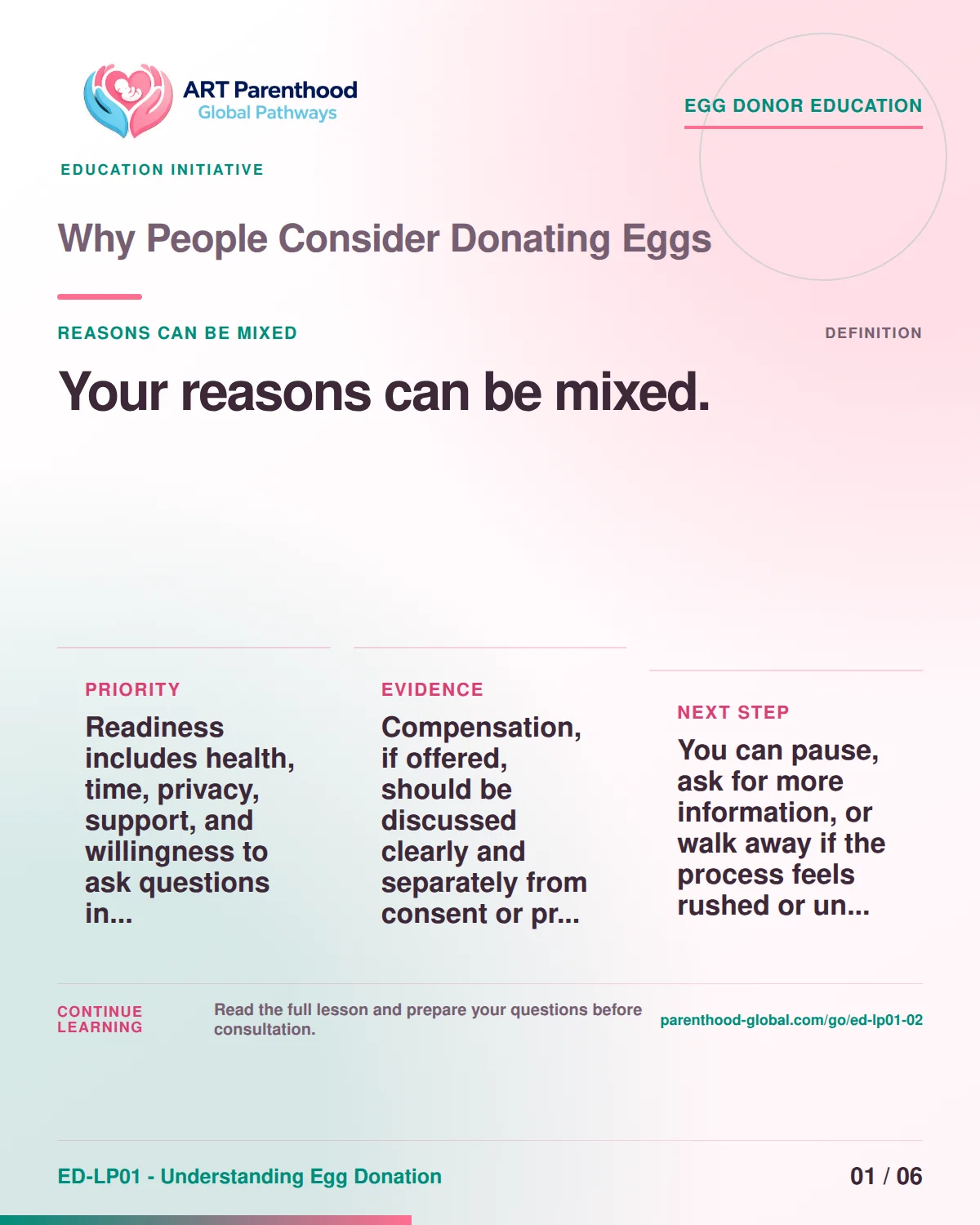
01 / 06Reasons Can Be Mixed 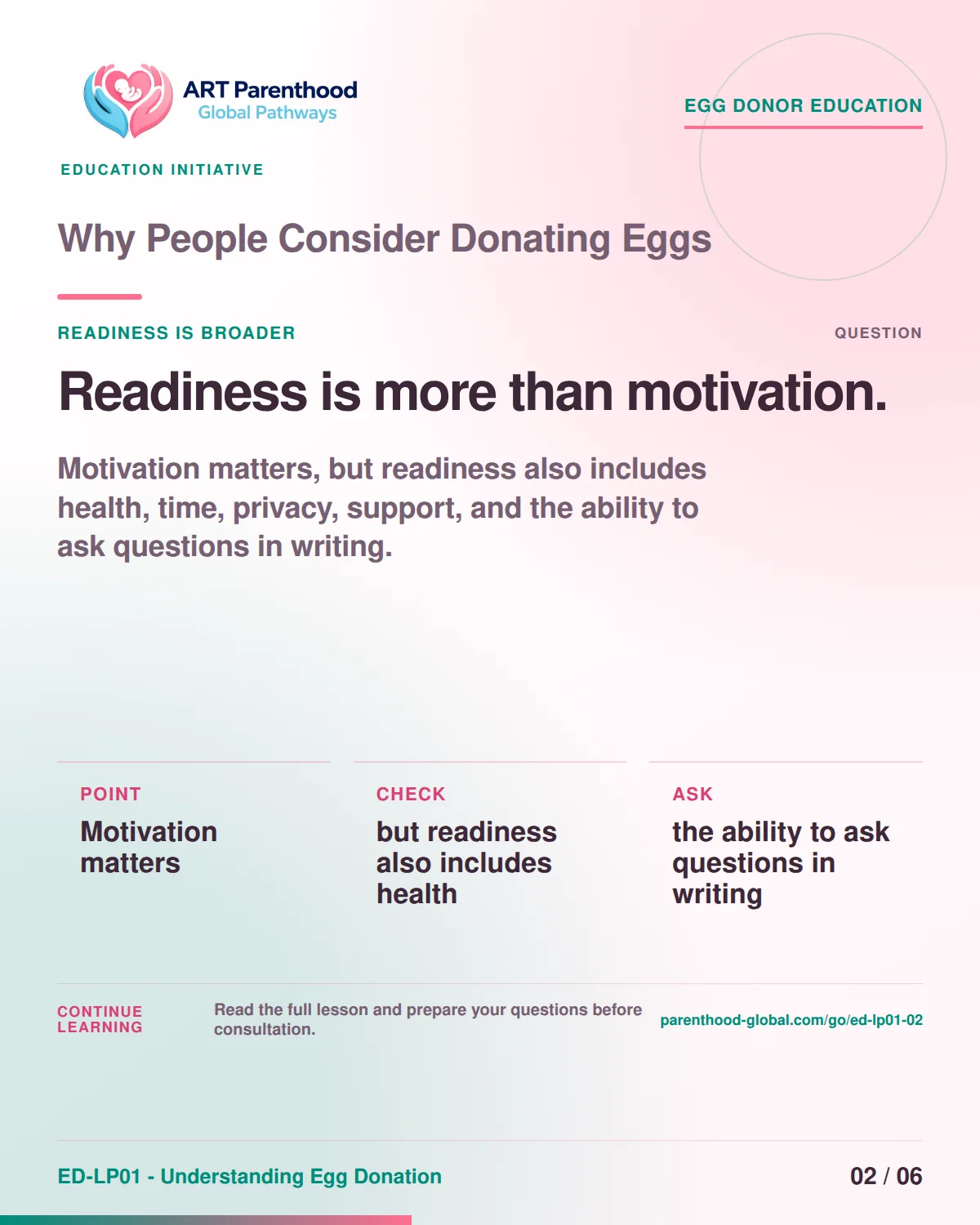
02 / 06Readiness Is Broader 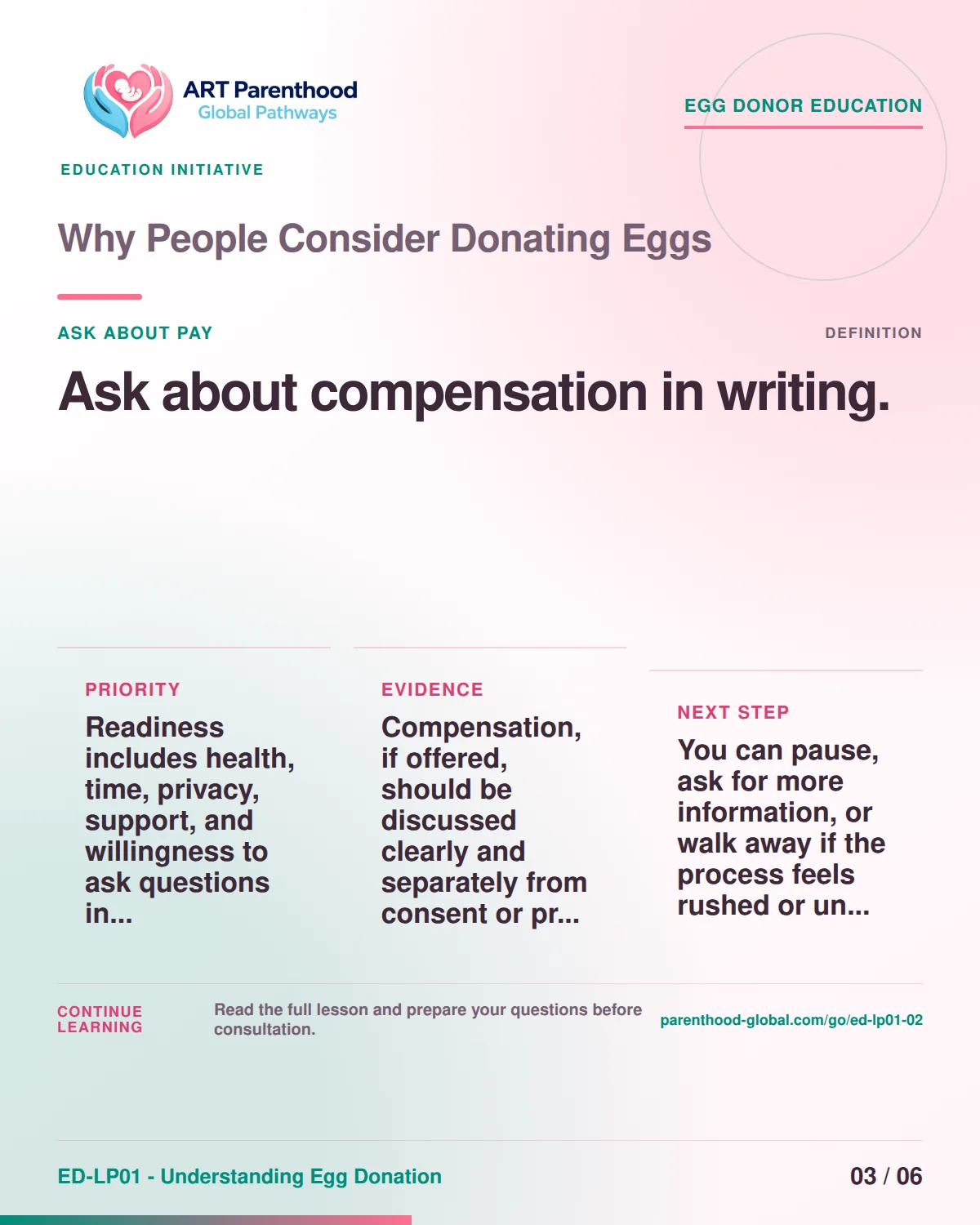
03 / 06Ask About Pay 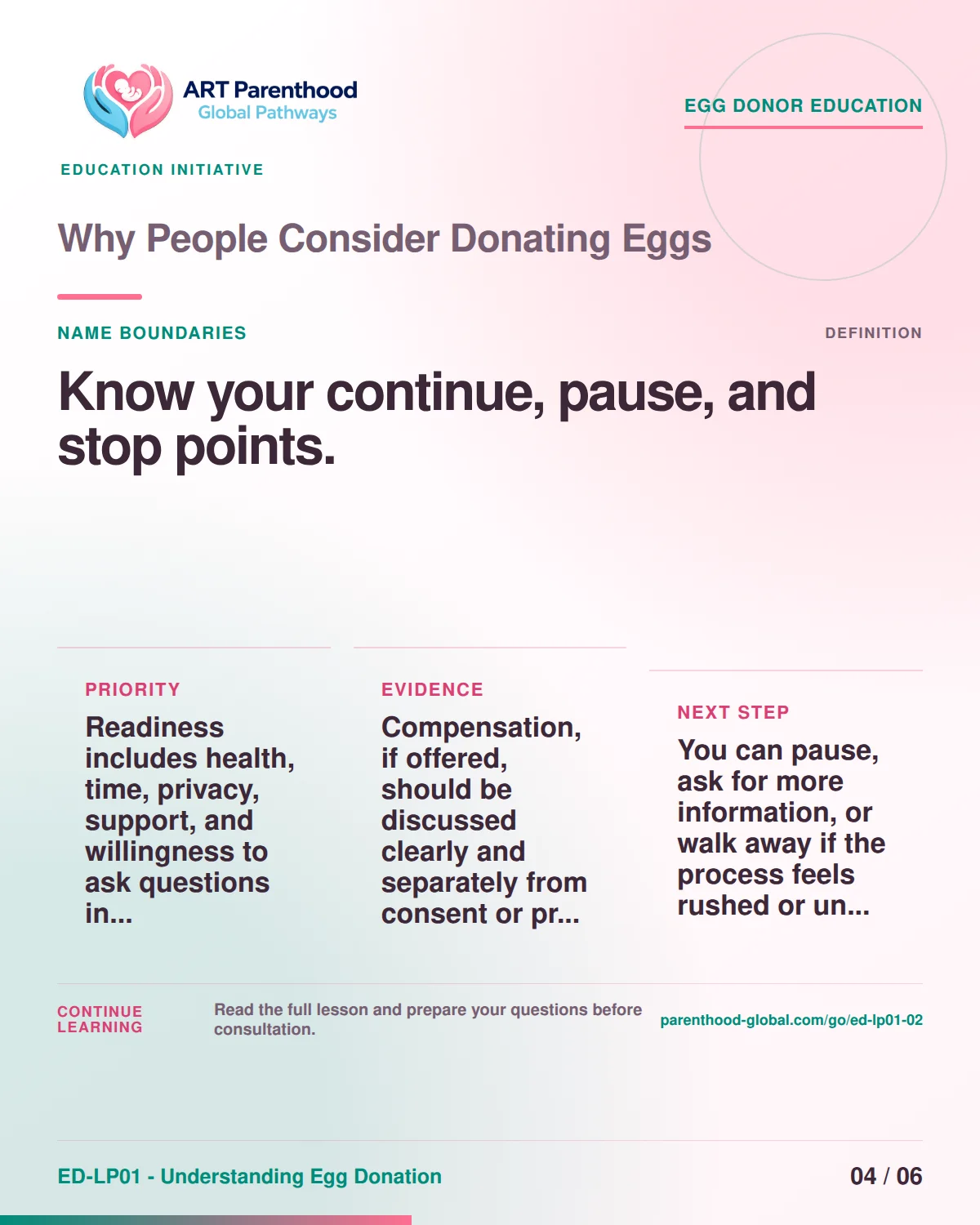
04 / 06Name Boundaries 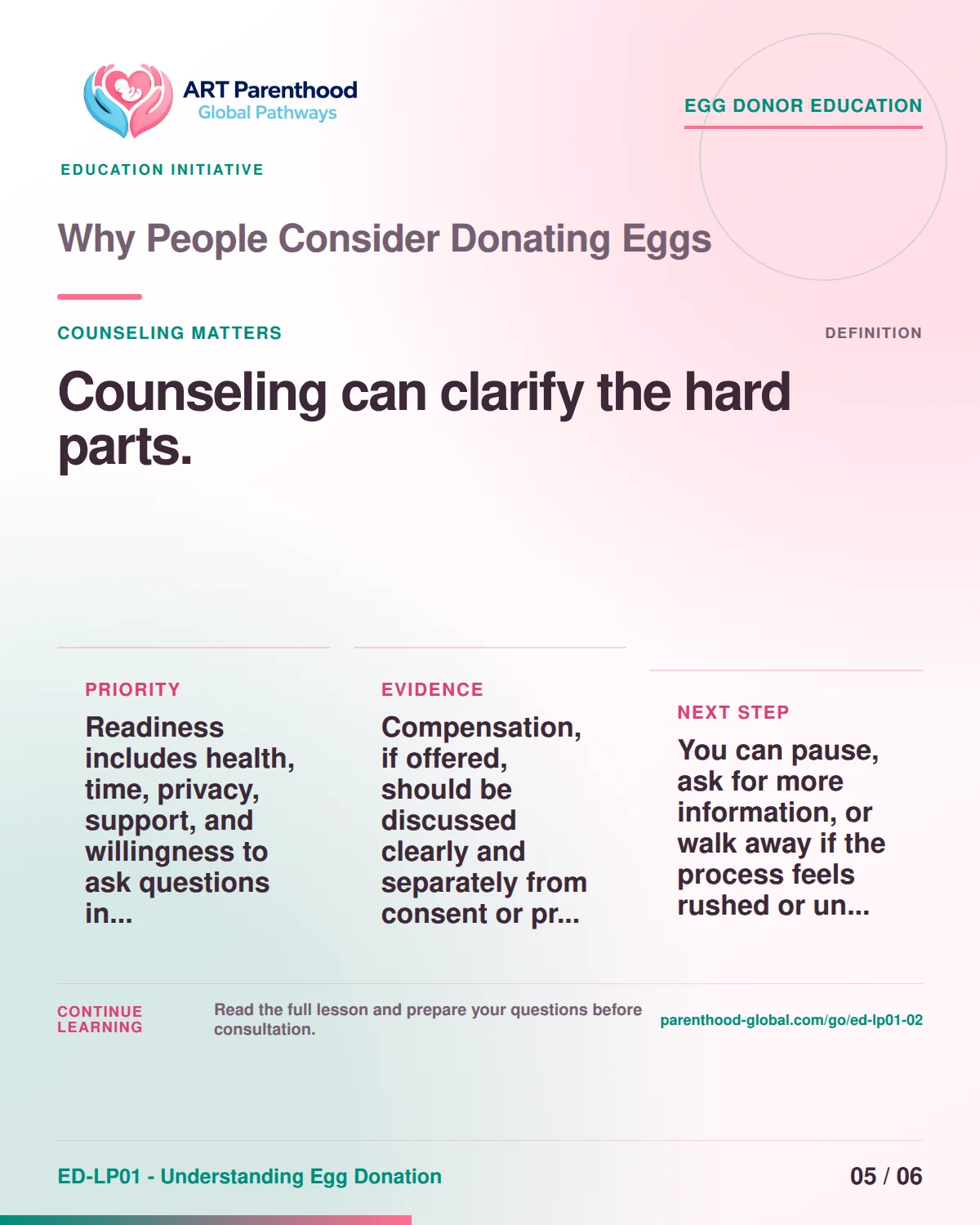
05 / 06Counseling Matters 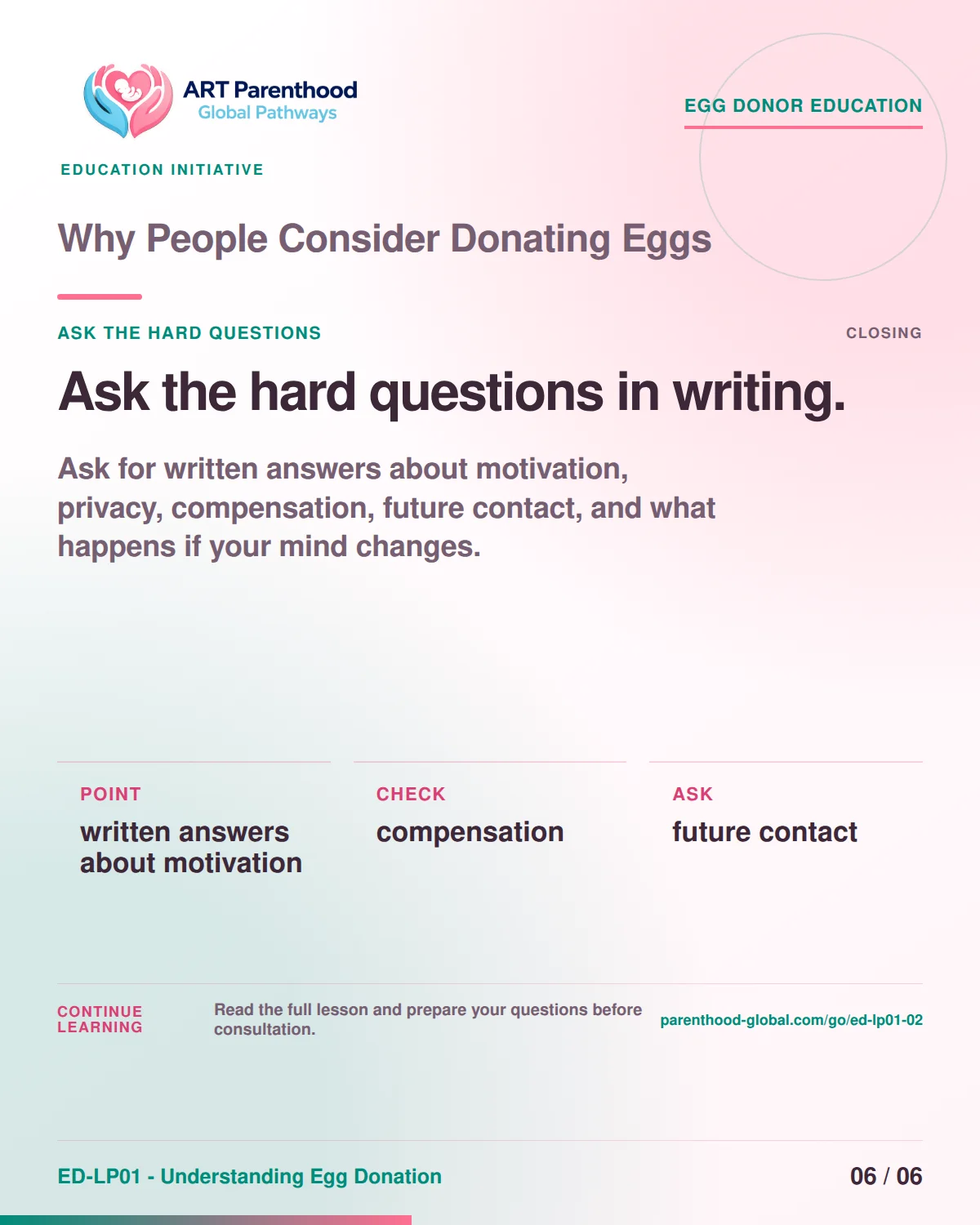
06 / 06Ask The Hard Questions
Motivation is only one part of readiness
A person can have a sincere reason for considering egg donation and still need more information before any decision is responsible. Donating eggs is not just a feeling; it is a medical and administrative process with appointments, records, privacy decisions, and a final consent step that should be voluntary.
That is why motivation should be understood alongside health, time, support, and the practical realities of the program. A reason that feels meaningful can still coexist with uncertainty, and uncertainty is a sign to slow down rather than push through.
What potential donors should ask themselves
Potential donors often benefit from writing down a few plain questions before speaking with a program: What would make me continue? What would make me pause? How do I feel about compensation and expenses being discussed in writing? What do I want explained about privacy and future contact?
These questions matter because they expose pressure early. If you feel rushed, or if the answers are vague, the issue is not that you are difficult; the issue is that your consent is not yet fully informed.
- Ask for written information about compensation and expense coverage.
- Ask who explains privacy, future contact, and donor-information rules.
- Ask whether counseling or a mental-health review is part of the process.
Questions that belong in the room
A donor process usually becomes safer when the conversation becomes more specific. Instead of only asking whether you qualify, ask which documents you will sign, whether a psychometric questionnaire or mental-health review is used, how compensation and travel costs are handled, and who answers your questions if the process changes.
Those are the details that turn motivation into a real decision. A donor questionnaire can help a program understand motivation and support needs, but it does not replace a calm conversation about coercion risk, future contact, record access, or how program language may feel once you are actually under time pressure.
- Motivation questionnaire: helps surface reasons, pressure, and expectations.
- Psychometric test or mental-health review: explores support, boundaries, and coercion risk.
- Compensation schedule and travel reimbursement policy: should be written and clear.
- Privacy notice and future-contact form: explain how information may be used now and later.
- Consent form: should separate general interest from final permission to proceed.
For Nerds: Technical Deep Dive
This advanced section goes beyond simple encouragement and treats donor motivation as a consent issue, a counseling issue, and a records issue. It names the documents and review steps that help programs distinguish honest mixed motivation from pressure, confusion, or a poorly explained compensation promise, and it shows why the consent conversation must stay written, specific, and jurisdiction-aware.
How motivation becomes a consent question
A serious donor pathway treats motivation as part of informed consent rather than as a moral score. Programs may ask about why a person is considering donation, what support they have, whether compensation feels transparent rather than dominant, and whether there is any sign that money, praise, family pressure, or a partner's opinion is doing the work that a fully informed choice should do. That is why a psychometric screen or mental-health consultation is not merely symbolic. It can reveal whether the donor understands the medical sequence, the privacy implications, the possibility of a changed plan, and the emotional meaning of future contact. A donor may be altruistic and still want reimbursement and clarity; those are not conflicting ideas. The risk comes when a donor is rushed past written information or when a program frames compensation as a reason not to ask harder questions. Public education should name the actual documents: motivation questionnaire, compensation schedule, privacy notice, consent form, contact-preference form, and counseling note. Each one can clarify a different part of the process, but none of them alone proves readiness. The U.S. example is a clinic-driven and state-law-sensitive environment where screening is expected to be written and counseling-heavy. The U.K. example shows how disclosure rules can change the long-term meaning of donation, so a donor's willingness to proceed should include thinking about future contact and records, not just today's payment or praise.
- Motivation should be reviewed as a consent issue, not a virtue test.
- Compensation clarity matters because vague payment talk can hide pressure.
- Counseling helps separate real willingness from rushed agreement.
Expected ranges / examples
- U.S. donor-screening context: screening and counseling are written and program specific. The U.S. example emphasizes that the donor pathway combines clinical screening with legal and counseling review instead of relying on one verbal conversation. Source: ReproductiveFacts.org - Third-Party Reproduction booklet.
- U.K. donor-information context: 1 April 2005 and age 18 for identifying information access. The U.K. example shows why future contact and identity rules matter before consent and why the same donation can carry different long-term implications by jurisdiction. Source: HFEA - Donation.
Country / jurisdiction examples
- United States: In the U.S., donor screening is framed as a clinical and counseling process with state-law-sensitive consent and compensation wording, so a donor should ask for the exact written rule rather than rely on a verbal summary.
- United Kingdom: In the U.K., donor-conceived people can request identifying information from the HFEA once they are 18 if the donor registered after 1 April 2005, which means future-contact expectations are part of the consent conversation from the start.
Timeline breakdown
- Motivation review: Before application or before matching. The donor writes down reasons, questions, and boundaries and receives written information about compensation, privacy, and support.
- Counseling and document review: Before final consent. A mental-health professional or counselor reviews pressure, future contact, and emotional readiness while the donor reads written documents.
- Final decision: Before medication or retrieval planning. The donor can still pause or decline if the written answers do not feel clear, because consent should remain voluntary and specific.
Key takeaways
- Mixed reasons are common and do not make a person unsuitable on their own.
- Readiness includes practical capacity, privacy comfort, support, and written clarity.
- Written answers matter because they protect informed consent when decisions become time-sensitive.
FAQ
Is it bad if compensation matters to me?
No. Compensation can be one part of the picture, but it should be discussed clearly and separately from whether you understand the medical, legal, and emotional parts of donation.
Do I need to know my final answer right now?
No. You can use the early stage to learn what the process asks of you, what feels comfortable, and what still needs a clearer written explanation.
What if I feel rushed?
Slow down. A donor process should leave room for questions, written answers, and a voluntary decision without pressure.