
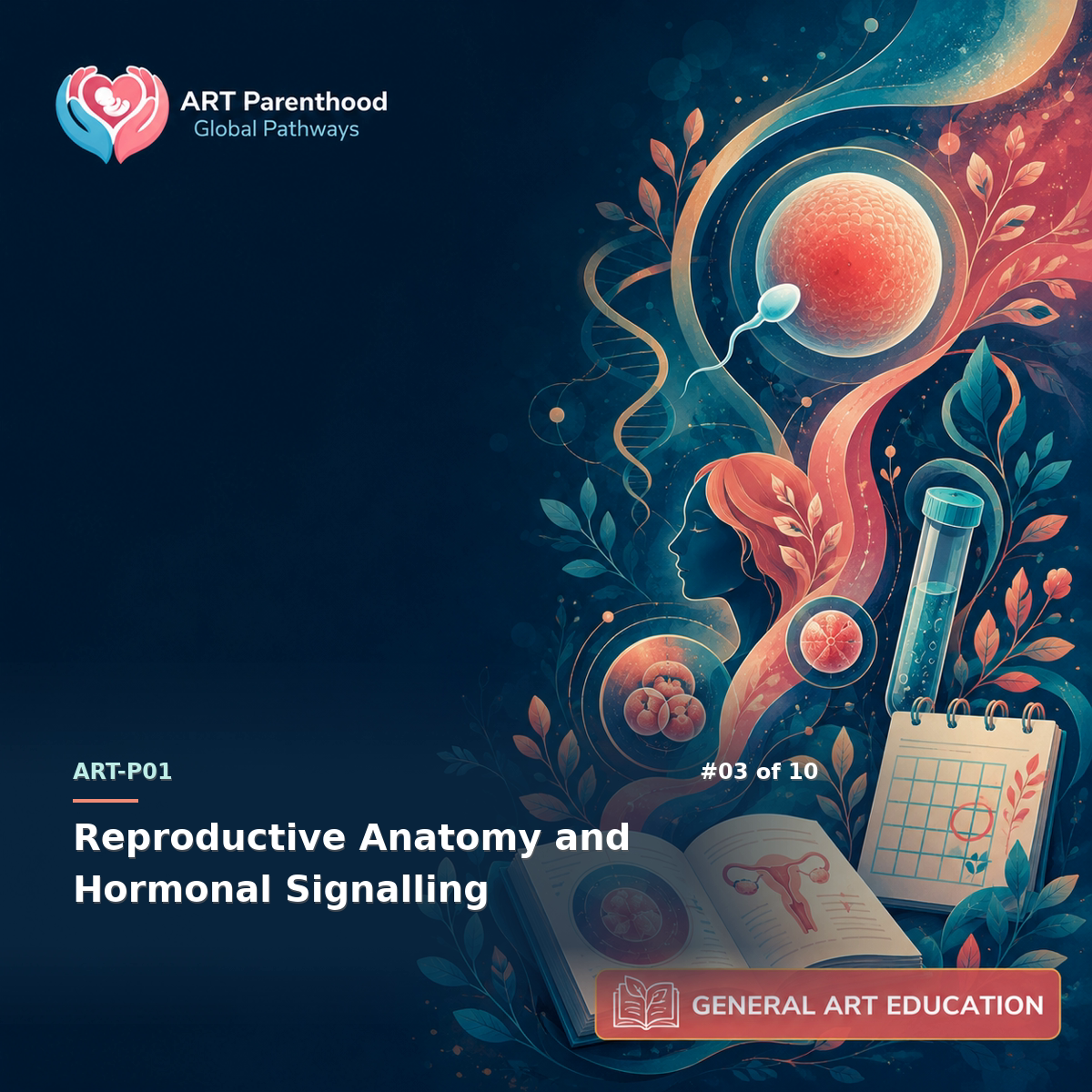
ART-LP01-03 · ART-LP01
Build a functional map of reproductive organs and hormonal feedback so later tests and treatment steps have biological context without becoming a personal anatomy assessment. The useful starting point is to separate structures, processes, measurements and outcomes, then connect only the claims that biology and evidence can support.
Visual lesson summary
Review the lesson as a carousel.
Swipe or scroll through the key ideas, then continue with the detailed guidance below.
01 / 07Anatomy and Hormonal Signalling 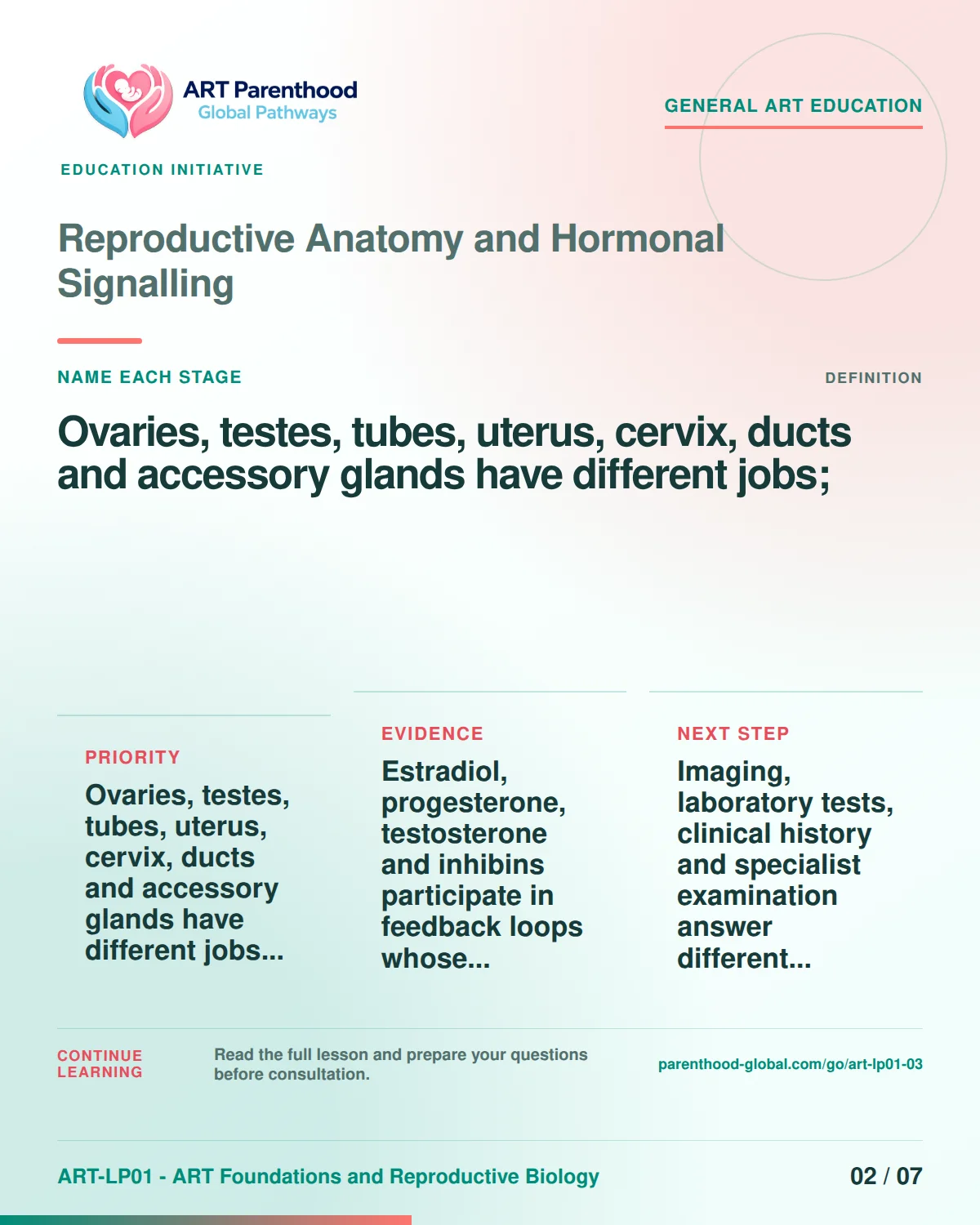
02 / 07Name each stage 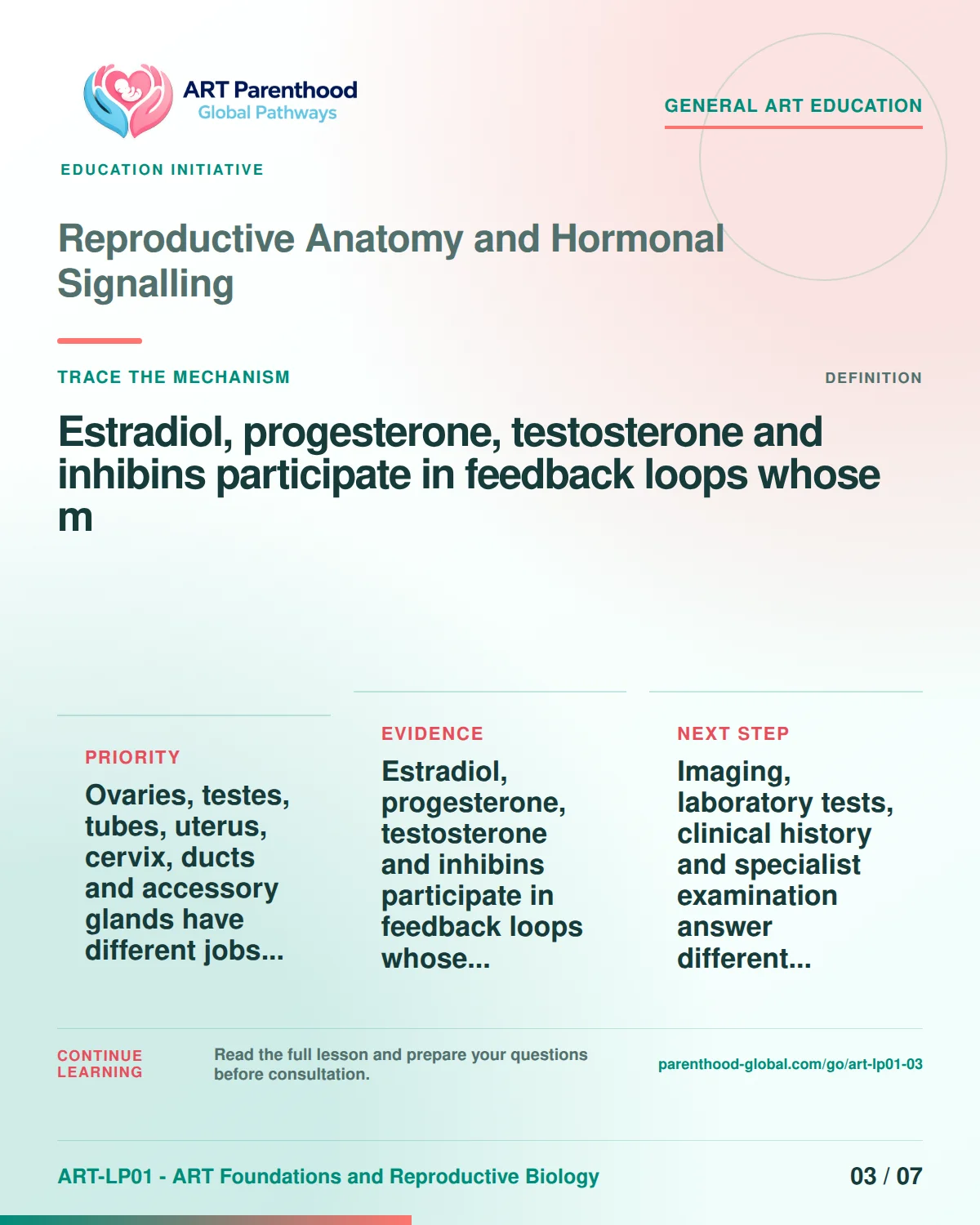
03 / 07Trace the mechanism 
04 / 07Read the measure 
05 / 07Keep the limit visible 
06 / 07Ask the next question 
07 / 07Use the full guide
Build the functional map
A functional map starts in the hypothalamus, where gonadotropin-releasing hormone is released in pulses. Those pulses reach the anterior pituitary and influence secretion of luteinizing hormone and follicle-stimulating hormone. LH and FSH then act on ovarian follicles or testicular cells, while gonadal steroids and inhibins send feedback upstream. This is a loop, not a one-way command chain. Pulse pattern, cycle phase, age, medicines, pregnancy, illness and laboratory method can all change what a measured concentration means.
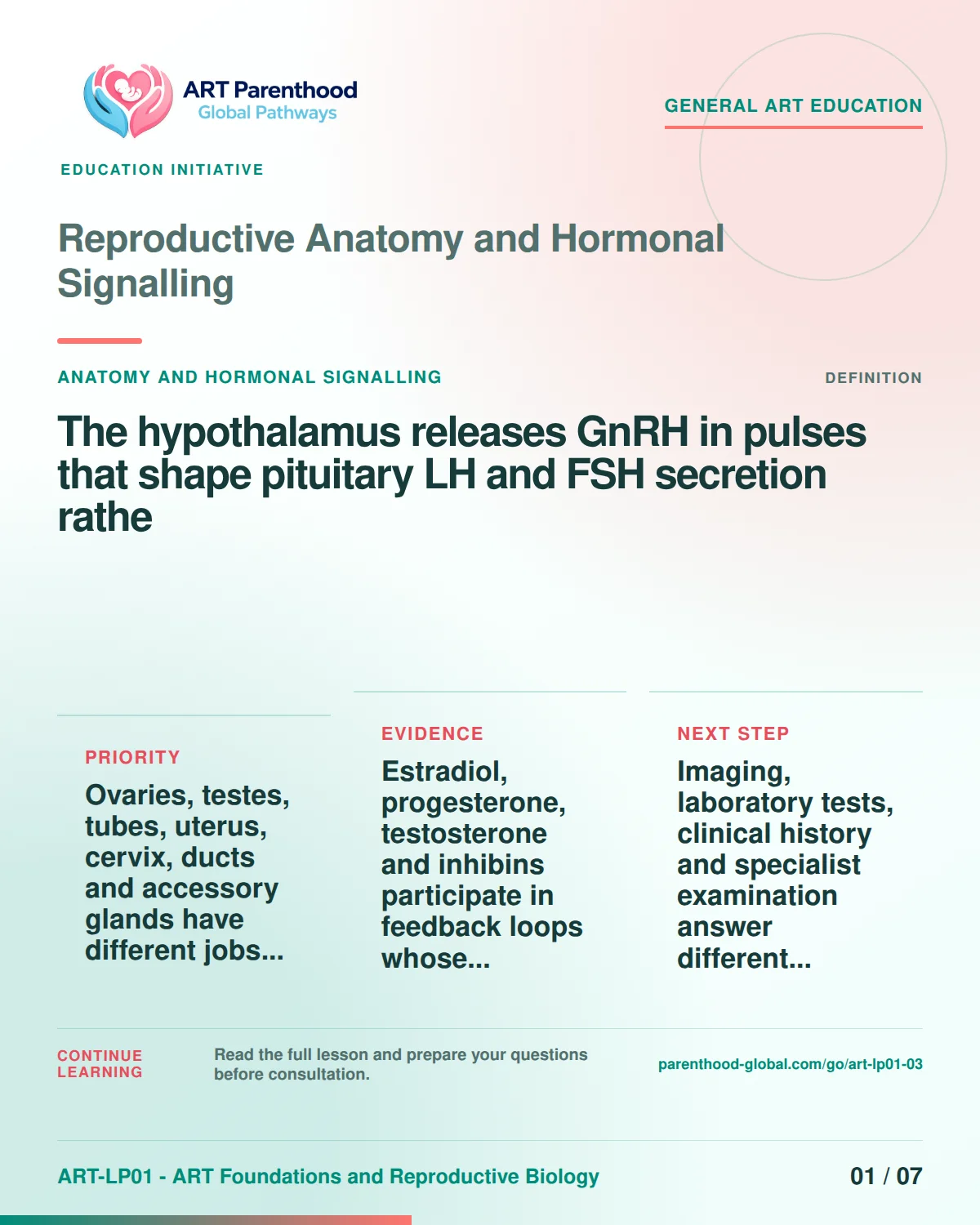
The hypothalamus releases GnRH in pulses that shape pituitary LH and FSH secretion rather than acting as a continuous on switch. Keep this observation tied to its collection time, method and biological stage; the next inference requires evidence that directly answers the clinical question. When a test is proposed, ask which organ, signal, physical route or feedback question it is intended to examine.
Follow the biological sequence
In the ovary, follicles contain the developing oocyte and supporting granulosa and theca cells. FSH supports granulosa-cell function, while LH contributes to theca androgen production and later ovulatory events. Estradiol production reflects coordinated cellular activity; after ovulation, the corpus luteum produces progesterone that supports a secretory endometrium. These labels describe population physiology. They do not let a reader infer egg competence, ovulation, implantation or treatment response from one isolated number.
Ovaries, testes, tubes, uterus, cervix, ducts and accessory glands have different jobs; a problem at one stage cannot be located from symptoms alone. Keep this observation tied to its collection time, method and biological stage; the next inference requires evidence that directly answers the clinical question. When a test is proposed, ask which organ, signal, physical route or feedback question it is intended to examine.
Separate observations from inferences
Physical routes matter as much as signals. The fimbrial end of a uterine tube helps collect the ovulated cumulus-oocyte complex; tubal cilia and smooth-muscle activity support transport. The uterus contains a muscular myometrium and a hormonally responsive endometrium. The cervix is both a passage and a mucus-producing barrier. Ultrasound may show structure, but it cannot by itself prove tubal patency, microscopic endometrial function or the future behavior of an embryo.
Estradiol, progesterone, testosterone and inhibins participate in feedback loops whose meaning depends on timing, context and the question being asked. Keep this observation tied to its collection time, method and biological stage; the next inference requires evidence that directly answers the clinical question. When a test is proposed, ask which organ, signal, physical route or feedback question it is intended to examine.
Connect the science to ART
In testes, seminiferous tubules support sperm production. Sertoli cells organize the germ-cell environment and respond principally to FSH; Leydig cells respond to LH and produce testosterone. Sperm then mature through the epididymis and travel through the vas deferens before mixing with secretions from seminal vesicles, prostate and other glands. Production, maturation, transport, ejaculation and semen composition are distinct stages, so a finding at the end of the route does not automatically identify its cause.
Read counts and reports precisely
ART interventions engage selected parts of this map. Ovarian stimulation changes follicular recruitment and monitoring; oocyte retrieval bypasses tubal pickup; insemination changes sperm placement; IVF moves fertilization and early culture into a laboratory; embryo transfer places an embryo into the uterine cavity. These interventions do not make the rest of the system irrelevant. Anatomy, endocrine response, gamete biology, endometrial timing and general health still shape clinical planning and uncertainty.
Know what the evidence cannot decide
A useful clinical question names the suspected level. History can reveal timing, prior surgery, medicines and symptoms. Hormone testing samples a changing signalling system. Ultrasound examines visible structure and dynamic follicular or endometrial features. Tests of tubal patency address a route rather than hormone production. Semen analysis describes an ejaculate rather than the entire male reproductive axis. Specialist review combines those pieces instead of asking one test to do every job.
Turn the map into better questions
Normal variation is not noise to be erased. Cycle length, hormone trajectories and organ anatomy vary within and between people. Reference intervals depend on method and population, and a value inside a range does not establish fertility. A value outside a range is not a self-contained diagnosis. The defensible decision is to ask what question the result answers, when it was collected, what comparison is appropriate, and which additional evidence would change management.
- The hypothalamus releases GnRH in pulses that shape pituitary LH and FSH secretion rather than acting as a continuous on switch.
- Ovaries, testes, tubes, uterus, cervix, ducts and accessory glands have different jobs; a problem at one stage cannot be located from symptoms alone.
- Estradiol, progesterone, testosterone and inhibins participate in feedback loops whose meaning depends on timing, context and the question being asked.
- Imaging, laboratory tests, clinical history and specialist examination answer different parts of an anatomical or hormonal question.
For Nerds: Technical Deep Dive
Cover pulsatile GnRH, LH and FSH actions, steroid and inhibin feedback, follicular recruitment, seminiferous-tubule function, and the limits of mapping population physiology to one cycle.
Mechanism and feedback
Pulsatile GnRH preserves gonadotroph responsiveness, whereas continuous exposure can produce receptor desensitization. Pulse frequency and amplitude are associated with different LH and FSH patterns, but peripheral blood sampling rarely captures hypothalamic dynamics directly. In the ovary, two-cell/two-gonadotropin physiology links LH-responsive theca androgen synthesis with FSH-supported granulosa aromatization. Inhibin B and inhibin A contribute phase-dependent feedback; activins and follistatins add local and systemic regulation. The mid-cycle LH surge follows a switch from predominantly negative to sustained positive estradiol feedback, yet clinical timing uses multiple observations rather than a universal hormone threshold. Pulsatile GnRH preserves gonadotroph responsiveness, whereas continuous exposure can produce receptor desensitization. Pulse frequency and amplitude are associated with different LH and FSH patterns, but peripheral blood sampling rarely captures hypothalamic dynamics directly. In the ovary, two-cell/two-gonadotropin physiology links LH-responsive theca androgen synthesis with FSH-supported granulosa aromatization. Inhibin B and inhibin A contribute phase-dependent feedback; activins and follistatins add local and systemic regulation. The mid-cycle LH surge follows a switch from predominantly negative to sustained positive estradiol feedback, yet clinical timing uses multiple observations rather than a universal hormone threshold.
- The hypothalamus releases GnRH in pulses that shape pituitary LH and FSH secretion rather than acting as a continuous on switch.
- Ovaries, testes, tubes, uterus, cervix, ducts and accessory glands have different jobs; a problem at one stage cannot be located from symptoms alone.
- Estradiol, progesterone, testosterone and inhibins participate in feedback loops whose meaning depends on timing, context and the question being asked.
Expected ranges / examples
- Stage-specific interpretation example: GnRH -> LH -> FSH -> estradiol. A mechanism sequence used to keep adjacent biological stages and observations from being treated as interchangeable outcomes. Source: OpenStax Anatomy and Physiology 2e.
What the measurement captures
The male axis also requires layered interpretation. LH stimulates Leydig-cell testosterone production, while FSH and intratesticular testosterone support Sertoli-cell functions and spermatogenesis. Serum testosterone is not a direct measure of intratesticular concentration or sperm output. Seminiferous-tubule production precedes epididymal maturation and ductal transport, so obstruction can coexist with preserved endocrine function. Seminal vesicle and prostate secretions contribute most ejaculate volume; volume therefore cannot be equated with sperm production. Feedback through testosterone, estradiol and inhibin B is biologically informative but not a substitute for history, examination and semen assessment. The male axis also requires layered interpretation. LH stimulates Leydig-cell testosterone production, while FSH and intratesticular testosterone support Sertoli-cell functions and spermatogenesis. Serum testosterone is not a direct measure of intratesticular concentration or sperm output. Seminiferous-tubule production precedes epididymal maturation and ductal transport, so obstruction can coexist with preserved endocrine function. Seminal vesicle and prostate secretions contribute most ejaculate volume; volume therefore cannot be equated with sperm production. Feedback through testosterone, estradiol and inhibin B is biologically informative but not a substitute for history, examination and semen assessment.
- The hypothalamus releases GnRH in pulses that shape pituitary LH and FSH secretion rather than acting as a continuous on switch.
- Ovaries, testes, tubes, uterus, cervix, ducts and accessory glands have different jobs; a problem at one stage cannot be located from symptoms alone.
- Estradiol, progesterone, testosterone and inhibins participate in feedback loops whose meaning depends on timing, context and the question being asked.
Expected ranges / examples
- Stage-specific interpretation example: GnRH -> LH -> FSH -> estradiol. A mechanism sequence used to keep adjacent biological stages and observations from being treated as interchangeable outcomes. Source: OpenStax Anatomy and Physiology 2e.
Inference limits and reporting
Measurement introduces another layer. Immunoassays and mass-spectrometry methods differ in analytical performance; reference intervals can be assay-, age- and sex-specific. Cycle-day labels are approximations when cycles vary, and exogenous hormones can make endogenous values difficult to interpret. Ultrasound resolves gross anatomy and dynamic features but not receptor signalling, microscopic tubal function or gamete competence. Hysterosalpingography or related procedures test patency under particular conditions, not every component of tubal physiology. A high-quality report therefore states specimen timing, method, units, relevant medicines, comparison interval and the precise inference that remains supportable. Measurement introduces another layer. Immunoassays and mass-spectrometry methods differ in analytical performance; reference intervals can be assay-, age- and sex-specific. Cycle-day labels are approximations when cycles vary, and exogenous hormones can make endogenous values difficult to interpret. Ultrasound resolves gross anatomy and dynamic features but not receptor signalling, microscopic tubal function or gamete competence. Hysterosalpingography or related procedures test patency under particular conditions, not every component of tubal physiology. A high-quality report therefore states specimen timing, method, units, relevant medicines, comparison interval and the precise inference that remains supportable.
- The hypothalamus releases GnRH in pulses that shape pituitary LH and FSH secretion rather than acting as a continuous on switch.
- Ovaries, testes, tubes, uterus, cervix, ducts and accessory glands have different jobs; a problem at one stage cannot be located from symptoms alone.
- Estradiol, progesterone, testosterone and inhibins participate in feedback loops whose meaning depends on timing, context and the question being asked.
Key takeaways
- The hypothalamus releases GnRH in pulses that shape pituitary LH and FSH secretion rather than acting as a continuous on switch.
- Ovaries, testes, tubes, uterus, cervix, ducts and accessory glands have different jobs; a problem at one stage cannot be located from symptoms alone.
- Estradiol, progesterone, testosterone and inhibins participate in feedback loops whose meaning depends on timing, context and the question being asked.
- Imaging, laboratory tests, clinical history and specialist examination answer different parts of an anatomical or hormonal question.
FAQ
What is the most important distinction in anatomy and hormonal signalling?
The hypothalamus releases GnRH in pulses that shape pituitary LH and FSH secretion rather than acting as a continuous on switch.
Can one result identify the cause or predict an outcome?
No. A result answers a defined question at a particular time and with a particular method; clinical interpretation combines it with history, examination and other evidence.
Why do counts or labels change between stages?
Each label has its own numerator, denominator and observation point. Biological attrition, sampling and measurement mean adjacent stages are related but not identical.
Does being inside a reference range prove fertility?
No. Reference intervals describe a comparison population and method; they do not establish reproductive capacity or guarantee a future outcome.
What should I ask before relying on a claim?
When a test is proposed, ask which organ, signal, physical route or feedback question it is intended to examine.
Who should interpret a personal finding?
The clinician or laboratory professional responsible for that test should explain the method, timing, limits and relevance to the individual clinical question.