
ART-LP01-05 · ART-LP01
Understand sperm production, maturation, transport, and semen composition before learning semen analysis or fertilization methods. The useful starting point is to separate structures, processes, measurements and outcomes, then connect only the claims that biology and evidence can support.
Visual lesson summary
Review the lesson as a carousel.
Swipe or scroll through the key ideas, then continue with the detailed guidance below.
01 / 07How Sperm Are Produced and Transported 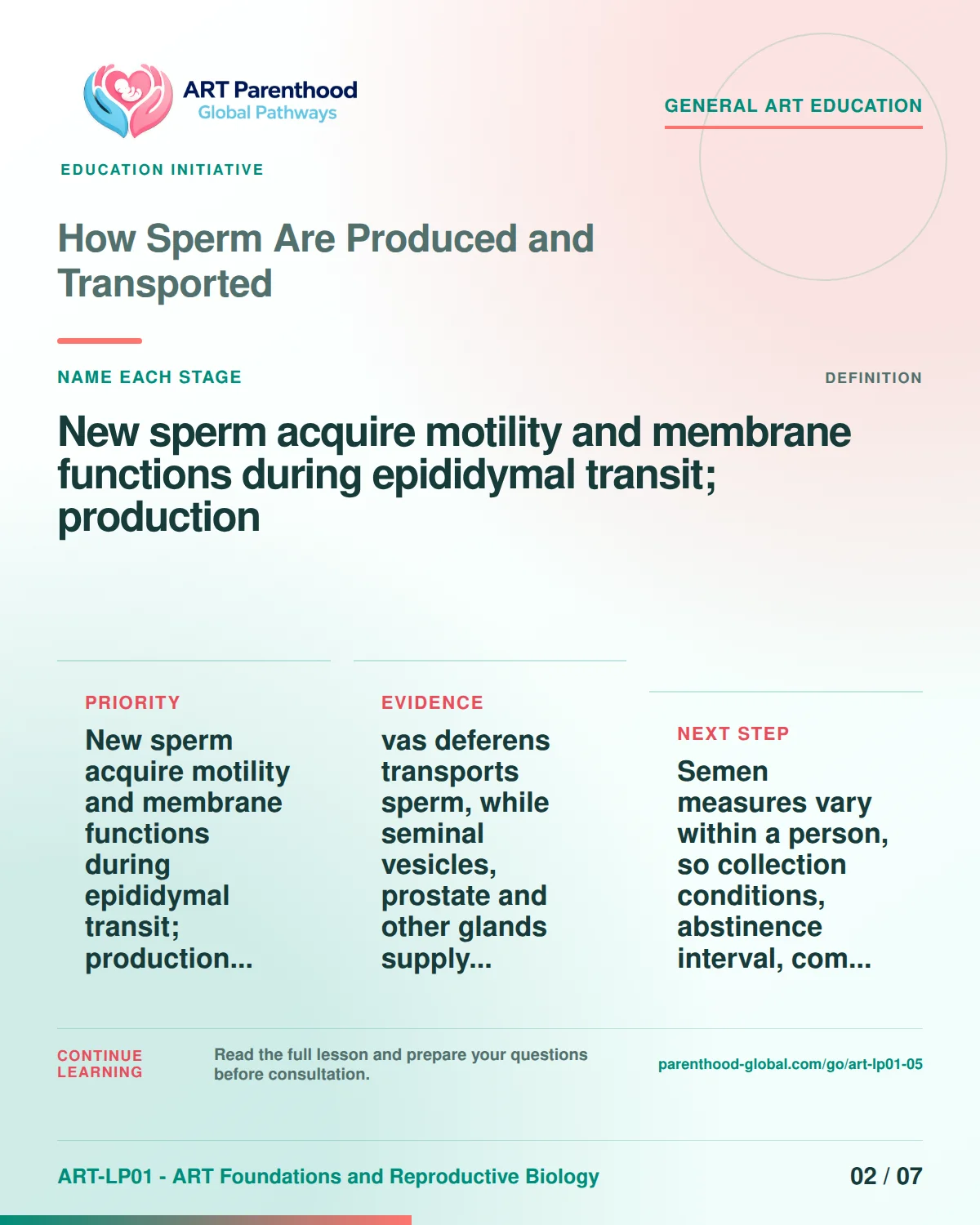
02 / 07Name each stage 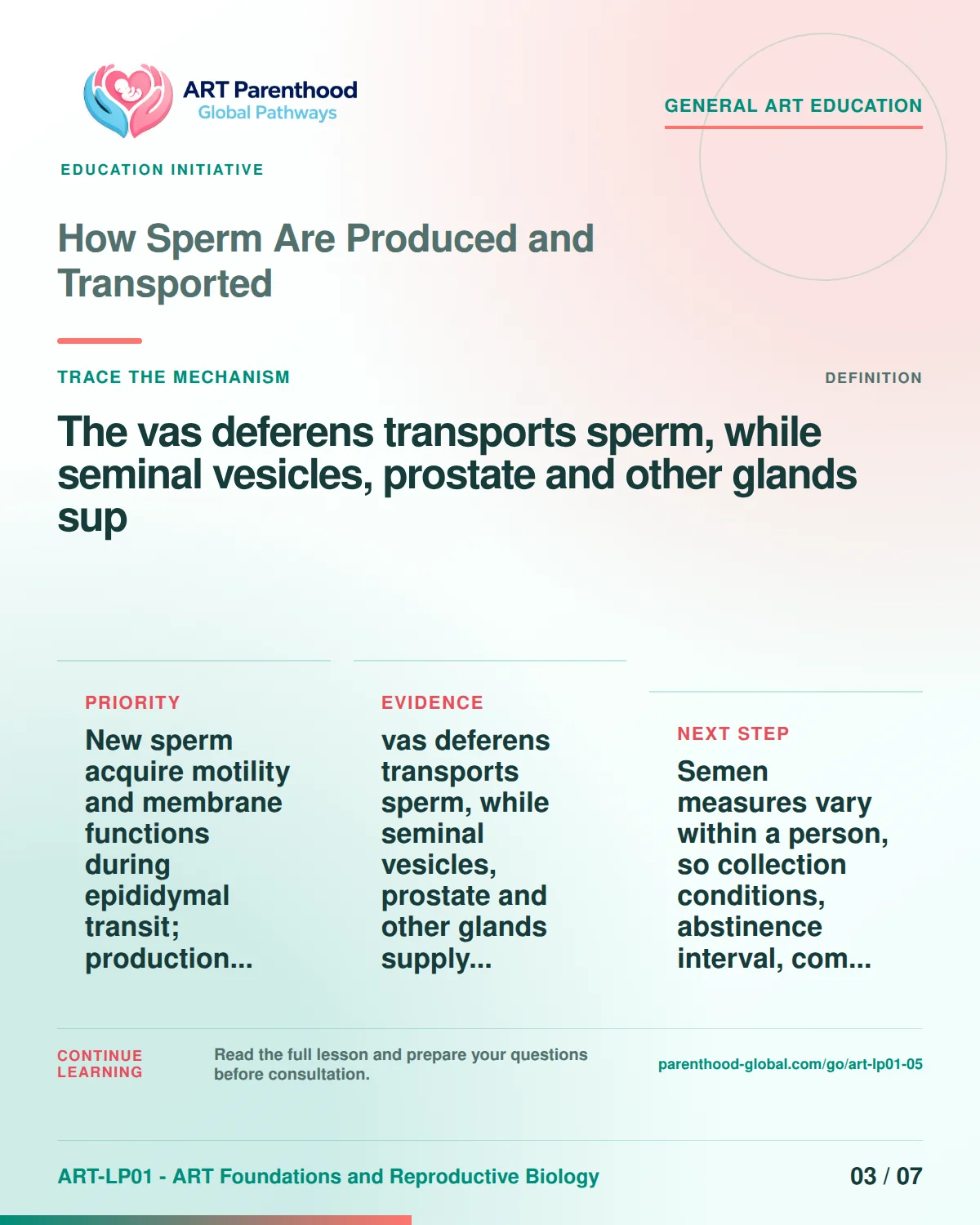
03 / 07Trace the mechanism 
04 / 07Read the measure 
05 / 07Keep the limit visible 
06 / 07Ask the next question 
07 / 07Use the full guide
Build the functional map
Sperm production begins along the seminiferous tubules. Spermatogonia divide, some enter meiosis as spermatocytes, and haploid spermatids then remodel through spermiogenesis. Sertoli cells organize this environment, provide metabolic and structural support and help form the blood-testis barrier. Leydig cells in the interstitial tissue produce testosterone. This architecture matters because endocrine signalling, germ-cell development and ductal transport can fail at different levels and require different questions.
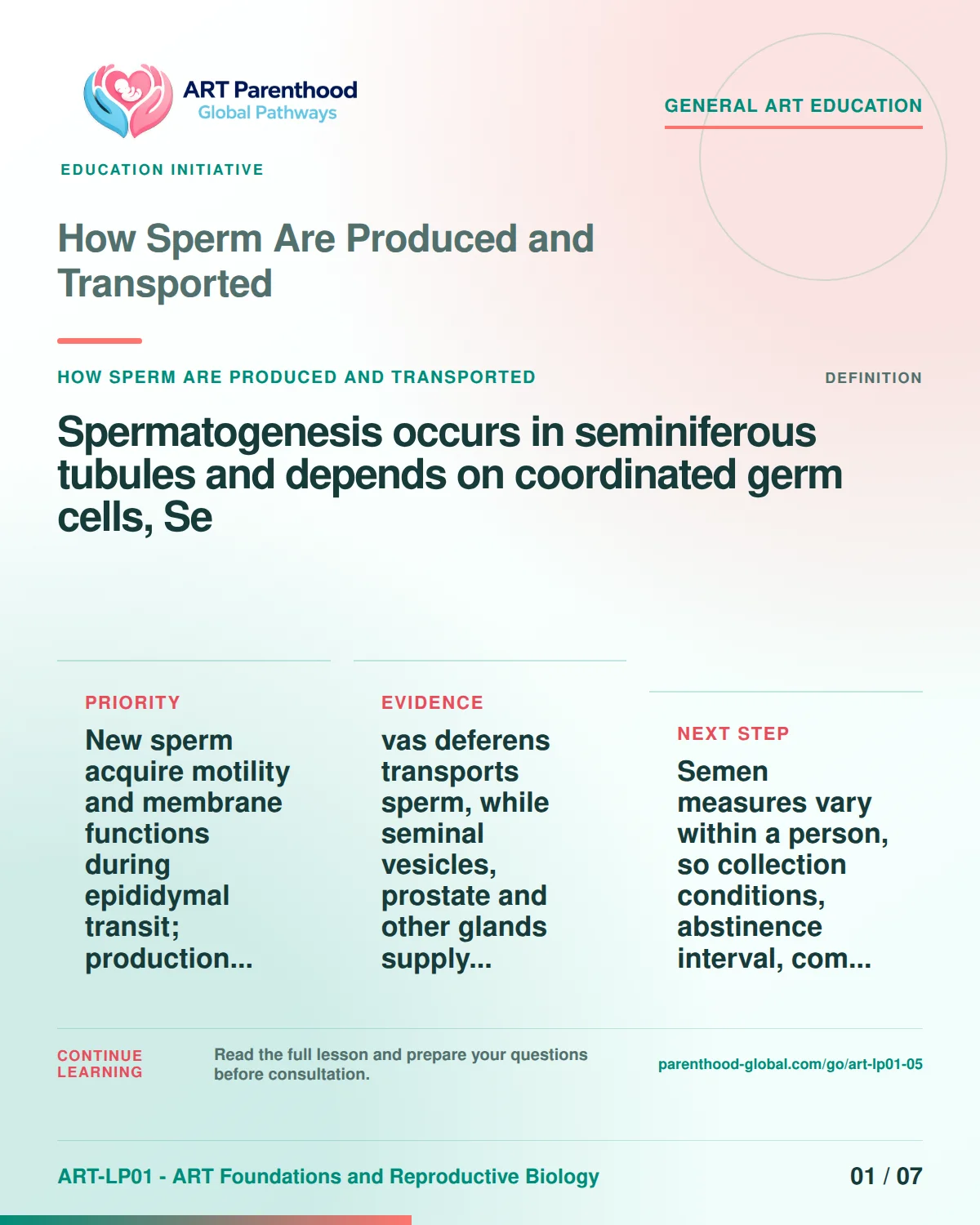
Spermatogenesis occurs in seminiferous tubules and depends on coordinated germ cells, Sertoli cells, Leydig cells, FSH and intratesticular testosterone. Keep this observation tied to its collection time, method and biological stage; the next inference requires evidence that directly answers the clinical question. Ask whether the question concerns production, transport, ejaculation, collection, laboratory measurement or fertilizing function.
Follow the biological sequence
Spermatogenesis is a sequence rather than an instant output. A changed exposure, illness or medicine may not appear immediately in an ejaculate because developing cells must progress through production and epididymal transit. The epididymis is not merely storage: sperm membranes, motility and functional readiness change as cells move through it. An ejaculate therefore samples the downstream result of biology that unfolded over preceding weeks, plus current collection and accessory-gland conditions.
New sperm acquire motility and membrane functions during epididymal transit; production and maturation are separate stages. Keep this observation tied to its collection time, method and biological stage; the next inference requires evidence that directly answers the clinical question. Ask whether the question concerns production, transport, ejaculation, collection, laboratory measurement or fertilizing function.
Separate observations from inferences
Transport follows a defined route. Sperm leave the testis through efferent ducts, mature in the epididymis and travel through the vas deferens during emission. Secretions from seminal vesicles, prostate and bulbourethral glands contribute volume, nutrients, buffering and other components. Ejaculation then expels the mixture through the urethra. An obstruction, ejaculation problem or incomplete collection can alter the sample even when sperm production in the testis is preserved.
The vas deferens transports sperm, while seminal vesicles, prostate and other glands supply most seminal fluid; volume is not a sperm count. Keep this observation tied to its collection time, method and biological stage; the next inference requires evidence that directly answers the clinical question. Ask whether the question concerns production, transport, ejaculation, collection, laboratory measurement or fertilizing function.
Connect the science to ART
A sperm cell has a condensed nuclear head, an acrosomal region, a mitochondria-rich midpiece and a flagellum. These structures support delivery of paternal DNA, interaction with the oocyte, energy metabolism and progressive movement. Appearance and motion can be measured, but neither is a complete functional test. Fertilization also involves capacitation, hyperactivation, cumulus and zona interactions, membrane fusion and oocyte responses that are only partly represented by routine semen categories.
Read counts and reports precisely
The WHO laboratory manual standardizes collection, examination and reporting to improve comparability. Concentration describes sperm per unit volume; total number combines concentration and ejaculate volume; motility categories describe observed movement; morphology uses stated criteria. These are different denominators. A result near a decision limit should not be treated as a biological cliff, and a reference distribution from fertile populations is not a pass-fail boundary for one person.
Know what the evidence cannot decide
Variation is expected. Abstinence interval, fever, collection completeness, transport time, temperature and analytic technique can influence findings. That is why clinicians may seek repeat testing when the result and clinical question warrant it. Repetition does not make the assay a direct fertility test; it helps distinguish a persistent pattern from sampling variation. Interpretation also uses history, examination, endocrine testing, genetics or imaging when those answer a plausible cause-specific question.
Turn the map into better questions
ART may change the route sperm take, but it does not make precise language optional. Intrauterine insemination places prepared sperm in the uterus; conventional IVF co-incubates gametes; ICSI introduces one selected sperm into an oocyte. Each approach changes an operational barrier and has its own indications and limits. The responsible next step is not to infer a procedure from one number, but to identify the stage in question and ask what additional evidence would change the plan.
- Spermatogenesis occurs in seminiferous tubules and depends on coordinated germ cells, Sertoli cells, Leydig cells, FSH and intratesticular testosterone.
- New sperm acquire motility and membrane functions during epididymal transit; production and maturation are separate stages.
- The vas deferens transports sperm, while seminal vesicles, prostate and other glands supply most seminal fluid; volume is not a sperm count.
- Semen measures vary within a person, so collection conditions, abstinence interval, completeness, delay and laboratory method belong with every result.
For Nerds: Technical Deep Dive
Cover Sertoli and Leydig cell roles, the seminiferous epithelial cycle, epididymal membrane changes, accessory-gland fractions, and delays between an exposure and a changed ejaculate.
Mechanism and feedback
Spermatogonial stem cells maintain the lineage while differentiating cells pass through mitotic amplification, meiosis I and II, and spermiogenesis. Meiotic recombination and segregation reduce chromosome number; spermiogenesis then condenses chromatin with protamines, forms the acrosome and flagellum, removes excess cytoplasm and reorganizes mitochondria. Sertoli cells coordinate stage-specific support and phagocytose residual bodies. LH-driven Leydig testosterone and FSH-responsive Sertoli functions are necessary components, but serum hormone values do not directly measure intratesticular concentration or the output of every seminiferous segment. Spermatogonial stem cells maintain the lineage while differentiating cells pass through mitotic amplification, meiosis I and II, and spermiogenesis. Meiotic recombination and segregation reduce chromosome number; spermiogenesis then condenses chromatin with protamines, forms the acrosome and flagellum, removes excess cytoplasm and reorganizes mitochondria. Sertoli cells coordinate stage-specific support and phagocytose residual bodies. LH-driven Leydig testosterone and FSH-responsive Sertoli functions are necessary components, but serum hormone values do not directly measure intratesticular concentration or the output of every seminiferous segment.
- Spermatogenesis occurs in seminiferous tubules and depends on coordinated germ cells, Sertoli cells, Leydig cells, FSH and intratesticular testosterone.
- New sperm acquire motility and membrane functions during epididymal transit; production and maturation are separate stages.
- The vas deferens transports sperm, while seminal vesicles, prostate and other glands supply most seminal fluid; volume is not a sperm count.
Expected ranges / examples
- Stage-specific interpretation example: seminiferous tubule -> Sertoli cell -> Leydig cell -> epididymis. A mechanism sequence used to keep adjacent biological stages and observations from being treated as interchangeable outcomes. Source: OpenStax Anatomy and Physiology 2e.
What the measurement captures
Epididymal transit modifies membrane lipids and proteins and supports progressive motility, while final fertilizing competence still requires capacitation in the female tract or laboratory conditions. Emission mixes sperm with sequential accessory-gland fractions; the first fraction can be sperm-rich, which makes incomplete collection clinically relevant. Retrograde ejaculation, duct obstruction and accessory-gland dysfunction affect different components. Azoospermia describes absence of sperm in the examined ejaculate after appropriate assessment; it does not, by itself, distinguish absent production from obstruction or guarantee that no sperm exist elsewhere. Epididymal transit modifies membrane lipids and proteins and supports progressive motility, while final fertilizing competence still requires capacitation in the female tract or laboratory conditions. Emission mixes sperm with sequential accessory-gland fractions; the first fraction can be sperm-rich, which makes incomplete collection clinically relevant. Retrograde ejaculation, duct obstruction and accessory-gland dysfunction affect different components. Azoospermia describes absence of sperm in the examined ejaculate after appropriate assessment; it does not, by itself, distinguish absent production from obstruction or guarantee that no sperm exist elsewhere.
- Spermatogenesis occurs in seminiferous tubules and depends on coordinated germ cells, Sertoli cells, Leydig cells, FSH and intratesticular testosterone.
- New sperm acquire motility and membrane functions during epididymal transit; production and maturation are separate stages.
- The vas deferens transports sperm, while seminal vesicles, prostate and other glands supply most seminal fluid; volume is not a sperm count.
Expected ranges / examples
- Stage-specific interpretation example: seminiferous tubule -> Sertoli cell -> Leydig cell -> epididymis. A mechanism sequence used to keep adjacent biological stages and observations from being treated as interchangeable outcomes. Source: OpenStax Anatomy and Physiology 2e.
Inference limits and reporting
Analytical reporting should name volume, concentration, total number, total and progressive motility, vitality when indicated, morphology method, aggregation or agglutination observations and processing conditions. Decision limits and centiles summarize reference populations; they do not create a fertile/infertile dichotomy. Within-person biological variation and counting uncertainty matter, especially near thresholds. Any clinical inference should preserve collection details, abstinence interval, completeness, analysis delay, laboratory quality controls and whether a repeat or cause-directed test could materially clarify the question. Analytical reporting should name volume, concentration, total number, total and progressive motility, vitality when indicated, morphology method, aggregation or agglutination observations and processing conditions. Decision limits and centiles summarize reference populations; they do not create a fertile/infertile dichotomy. Within-person biological variation and counting uncertainty matter, especially near thresholds. Any clinical inference should preserve collection details, abstinence interval, completeness, analysis delay, laboratory quality controls and whether a repeat or cause-directed test could materially clarify the question.
- Spermatogenesis occurs in seminiferous tubules and depends on coordinated germ cells, Sertoli cells, Leydig cells, FSH and intratesticular testosterone.
- New sperm acquire motility and membrane functions during epididymal transit; production and maturation are separate stages.
- The vas deferens transports sperm, while seminal vesicles, prostate and other glands supply most seminal fluid; volume is not a sperm count.
Key takeaways
- Spermatogenesis occurs in seminiferous tubules and depends on coordinated germ cells, Sertoli cells, Leydig cells, FSH and intratesticular testosterone.
- New sperm acquire motility and membrane functions during epididymal transit; production and maturation are separate stages.
- The vas deferens transports sperm, while seminal vesicles, prostate and other glands supply most seminal fluid; volume is not a sperm count.
- Semen measures vary within a person, so collection conditions, abstinence interval, completeness, delay and laboratory method belong with every result.
FAQ
What is the most important distinction in how sperm are produced and transported?
Spermatogenesis occurs in seminiferous tubules and depends on coordinated germ cells, Sertoli cells, Leydig cells, FSH and intratesticular testosterone.
Can one result identify the cause or predict an outcome?
No. A result answers a defined question at a particular time and with a particular method; clinical interpretation combines it with history, examination and other evidence.
Why do counts or labels change between stages?
Each label has its own numerator, denominator and observation point. Biological attrition, sampling and measurement mean adjacent stages are related but not identical.
Does being inside a reference range prove fertility?
No. Reference intervals describe a comparison population and method; they do not establish reproductive capacity or guarantee a future outcome.
What should I ask before relying on a claim?
Ask whether the question concerns production, transport, ejaculation, collection, laboratory measurement or fertilizing function.
Who should interpret a personal finding?
The clinician or laboratory professional responsible for that test should explain the method, timing, limits and relevance to the individual clinical question.