

IP-LP01-02 · IP-LP01
Learning ART vocabulary gives intended parents a steadier way to participate in appointments. The words matter because they often point to decisions about testing, consent, timing, storage, donor information, legal parentage, and emotional readiness. A glossary does not choose your path for you, but it helps you hear what is being proposed and ask for clarification before the conversation moves too far ahead.
Visual lesson summary
Review the lesson as a carousel.
Swipe or scroll through the key ideas, then continue with the detailed guidance below.
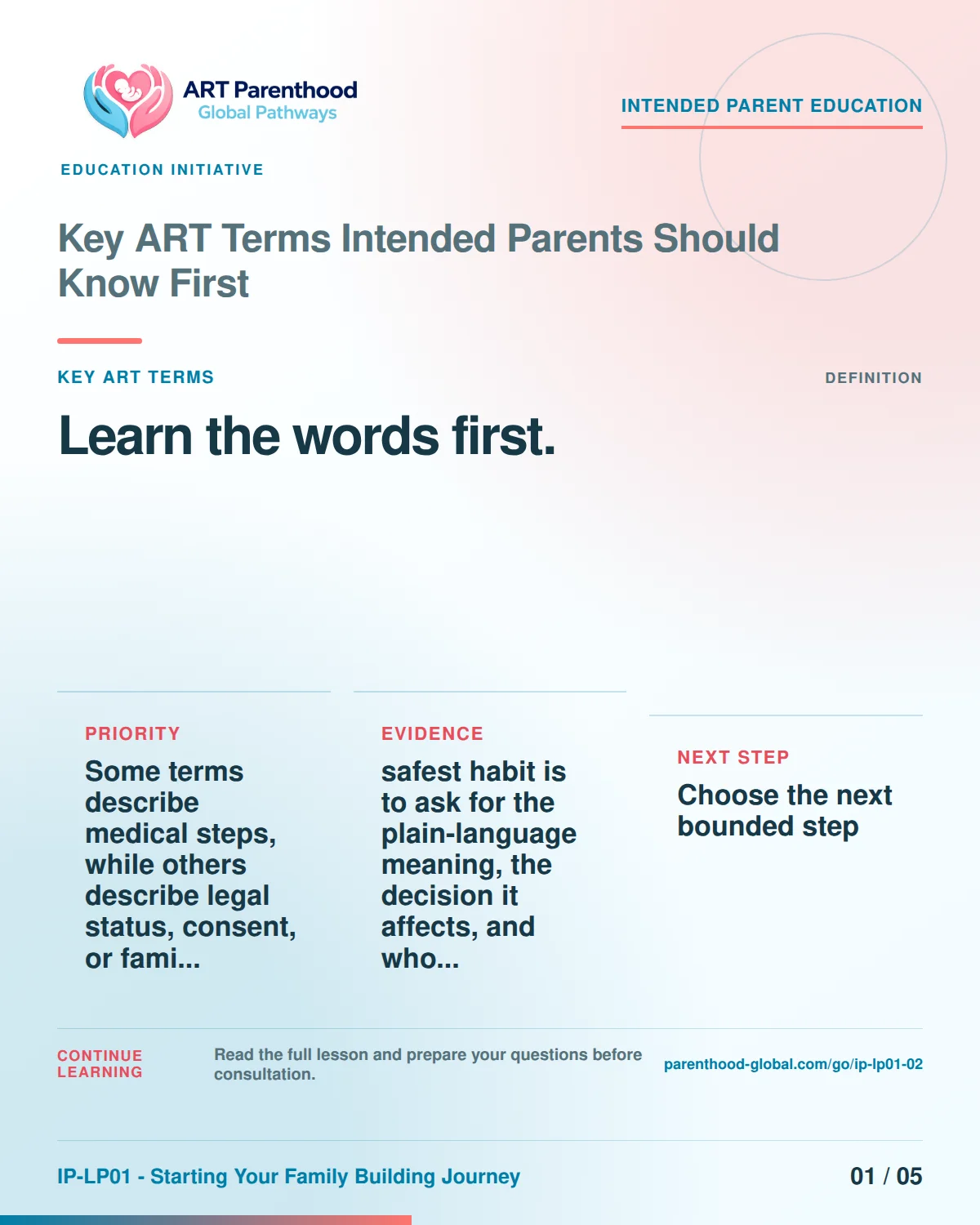
01 / 05Key ART terms 
02 / 05Medical terms 
03 / 05Role terms 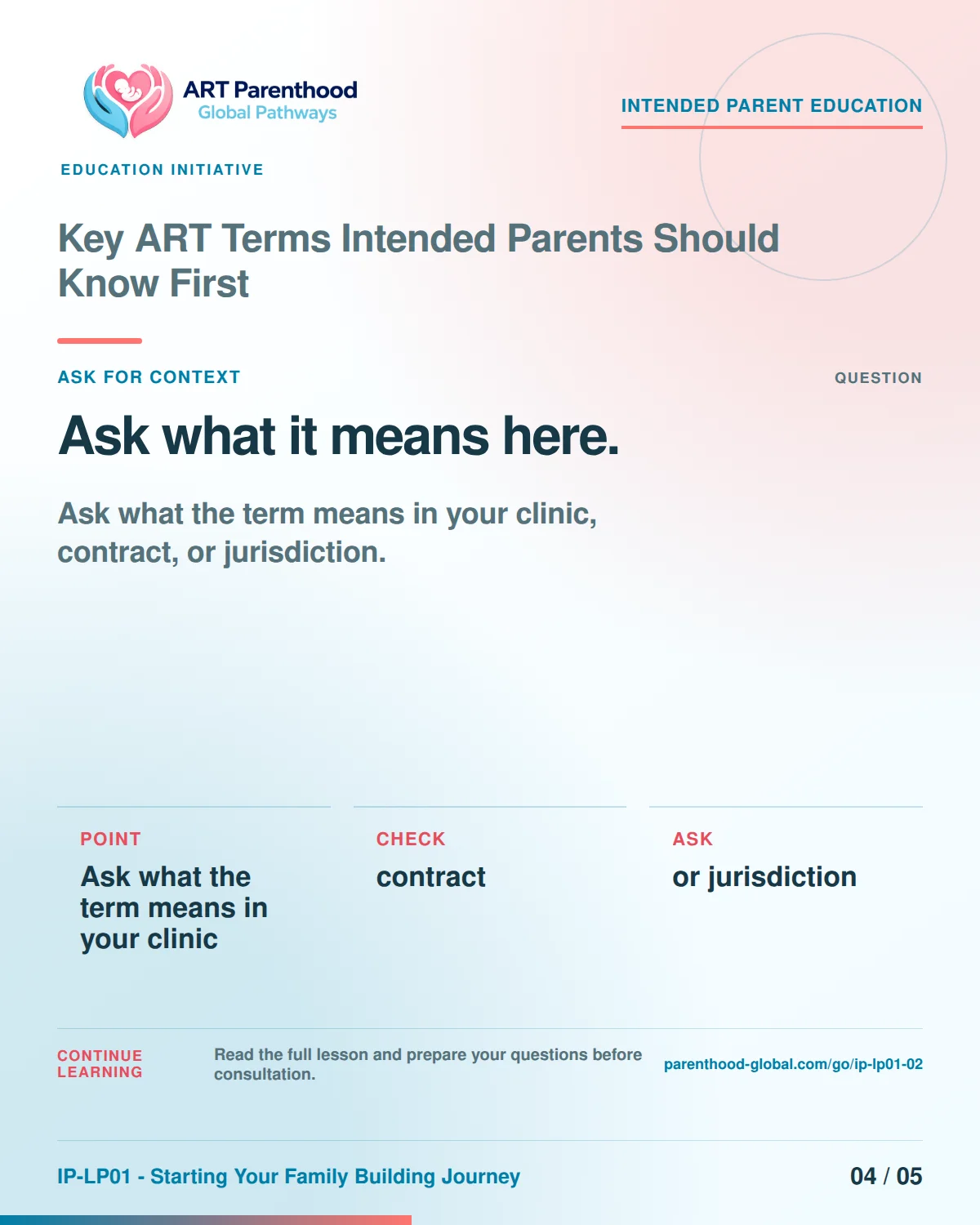
04 / 05Ask for context 
05 / 05Keep learning
What ART vocabulary does
ART vocabulary is not just a list of definitions. It is a map of the process. When a clinic says IVF, cryopreservation, embryo transfer, or screening, it is pointing to a medical step, a decision point, or a record that can affect timing and cost. Knowing that a term can signal action helps intended parents listen more carefully and ask better follow-up questions.
The same is true when the words shift into legal or psychosocial territory. Donor language, gestational-carrier language, consent language, and disclosure language may look similar on the surface, but each can trigger different responsibilities. A glossary is useful when it helps you hear those distinctions instead of flattening them into one fuzzy idea.
Why intended parents need context
Intended parents often need to know which terms change a medical plan, which terms change a legal document, and which terms are simply descriptors. For example, a fertility physician may use one word to describe a treatment step, while a lawyer may use the same word in a way that affects parentage, privacy, or agreement language. That difference matters because a clean definition can still lead to the wrong next step if it is taken out of context.
A good glossary habit is to write the term, the plain-language meaning, the person who should explain it, and whether it affects medical care, legal review, emotional readiness, or cost. That keeps the learning practical without pretending the vocabulary is the whole decision.
- Write down the term exactly as you heard it.
- Note who used it and why it came up.
- Mark whether it changes care, consent, or timing.
How to use the glossary in real life
When you hear a term, ask three things: what does it mean here, what does it change, and what does it not tell me yet? That habit is especially useful when the term touches donor screening, embryo storage, legal agreements, or a clinic’s own consent process. It helps intended parents stay grounded when the pathway becomes complicated.
Some terms are simply medical vocabulary. Others are process markers or legal markers. A term like cryopreservation may point to storage and future use, while a term like gestational carrier may point to a separate legal and psychosocial workflow. The glossary becomes most useful when it reveals those layers rather than hiding them behind one familiar label.
For Nerds: Technical Deep Dive
This advanced section goes beyond simple definitions and shows how ART vocabulary functions as a decision map. It links the terms intended parents hear to clinic roles, consent documents, treatment steps, and jurisdiction-sensitive legal language so the words can be interpreted in context rather than treated as standalone labels.
How the same word can point to different workflows
ART vocabulary becomes clinically useful only when it is tied to the workflow that is actually in play. For intended parents, a word like IVF may point to ovarian stimulation, monitoring, retrieval, fertilization, embryo culture, transfer, and possible cryopreservation. The same word may also sit inside a broader family-building discussion that includes donor screening, embryo disposition choices, parentage planning, or storage policy. A word like donor can be even more layered: in one setting it may simply mean a source of eggs, sperm, or embryos; in another it may trigger screening, identity-disclosure rules, legal review, and consent sequencing. The point of the advanced glossary is not to memorize jargon. It is to notice that the word itself rarely answers the real question. The real question is what document, person, or decision the word activates next. That is why public education should name the role of the fertility physician, the lab team, the lawyer, and the counsellor separately instead of blending them into a single generic professional. It also explains why intended parents should never assume that clinic terminology automatically equals legal terminology. The legal significance of donor, parentage, and consent can vary by jurisdiction and program policy, and a word that sounds familiar may still carry different consequences depending on where care is happening. A carefully written glossary gives readers a better map of those differences without pretending that a public lesson can substitute for local legal advice or a personalized medical plan.
- IVF can name a treatment pathway, not an outcome guarantee.
- Donor language may trigger screening, consent, and disclosure questions.
- Legal meaning can differ from clinic meaning even when the words look identical.
Timeline breakdown
- Orientation review: Early in the process. The team identifies the information, records, or questions that need the relevant professional review before the pathway moves forward.
- Follow-up review: After the first discussion. Any unresolved medical, legal, or support questions are routed to the right professional so the pathway can continue with better context.
Key takeaways
- Know the common ART words before comparing programs.
- Ask what each term means in your specific setting.
- Use vocabulary to improve decisions, not to replace professional advice.
FAQ
Is ART the same as IVF?
No. IVF is one ART pathway, but ART language can also include embryo transfer, cryopreservation, donor arrangements, and gestational-carrier planning.
Why does one word sometimes mean different things?
Because the medical meaning, legal meaning, and clinic policy meaning can differ. The right definition depends on the pathway and jurisdiction involved.
What should I do when I do not understand a term?
Write it down, ask who is using it, and ask what decision it affects. That keeps the conversation specific and easier to follow.