

IP-LP01-07 · IP-LP01
ART timing is a network of prerequisites, not a single countdown. A useful timeline shows what must happen first, what can overlap, where attrition occurs, and what should not be booked yet. Headline cycle lengths can obscure record collection, screening, matching, legal clearance, laboratory attrition, pregnancy, birth, and administrative steps. Families need sequencing, not false precision.
Visual lesson summary
Review the lesson as a carousel.
Swipe or scroll through the key ideas, then continue with the detailed guidance below.
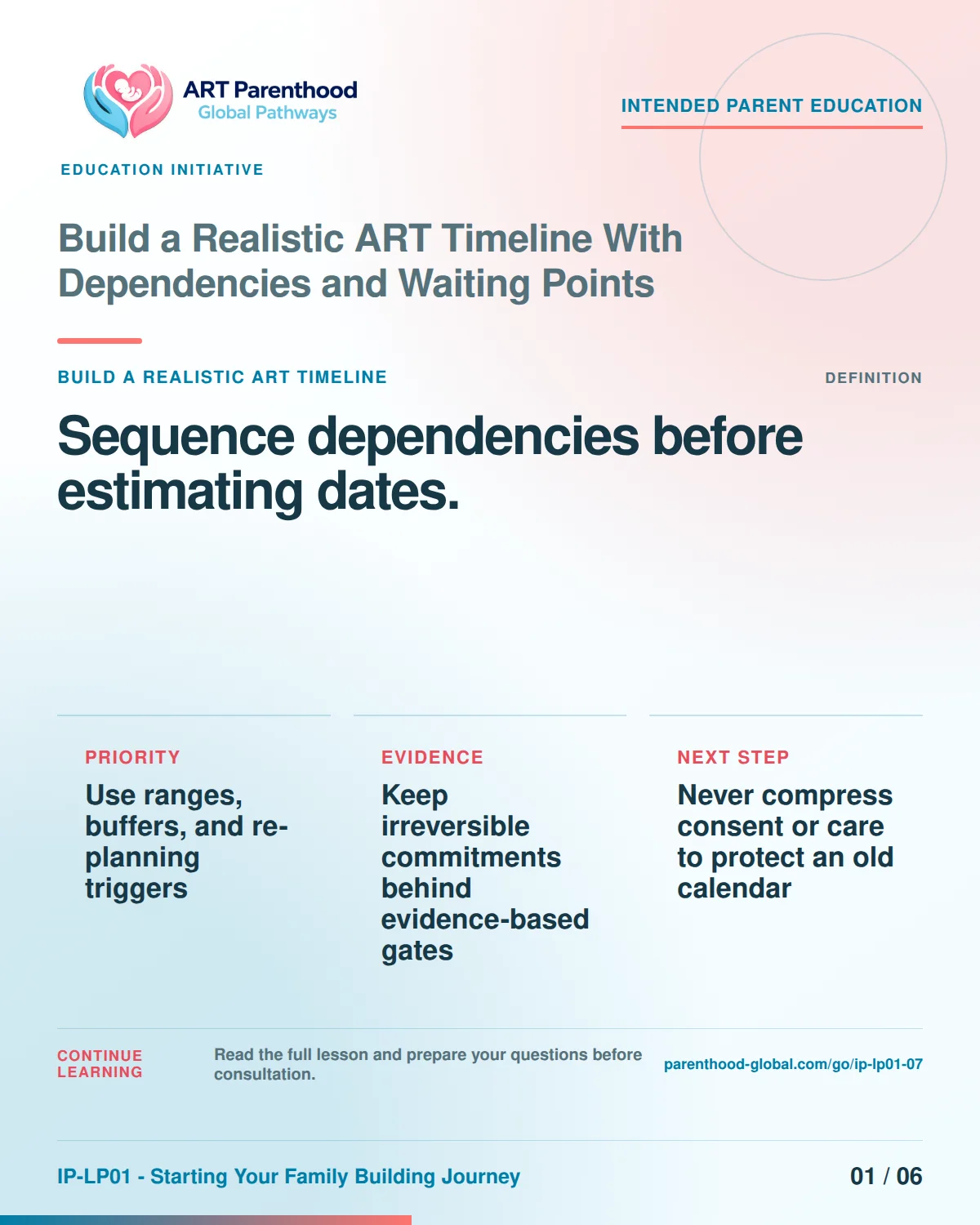
01 / 06Build a Realistic ART Timeline 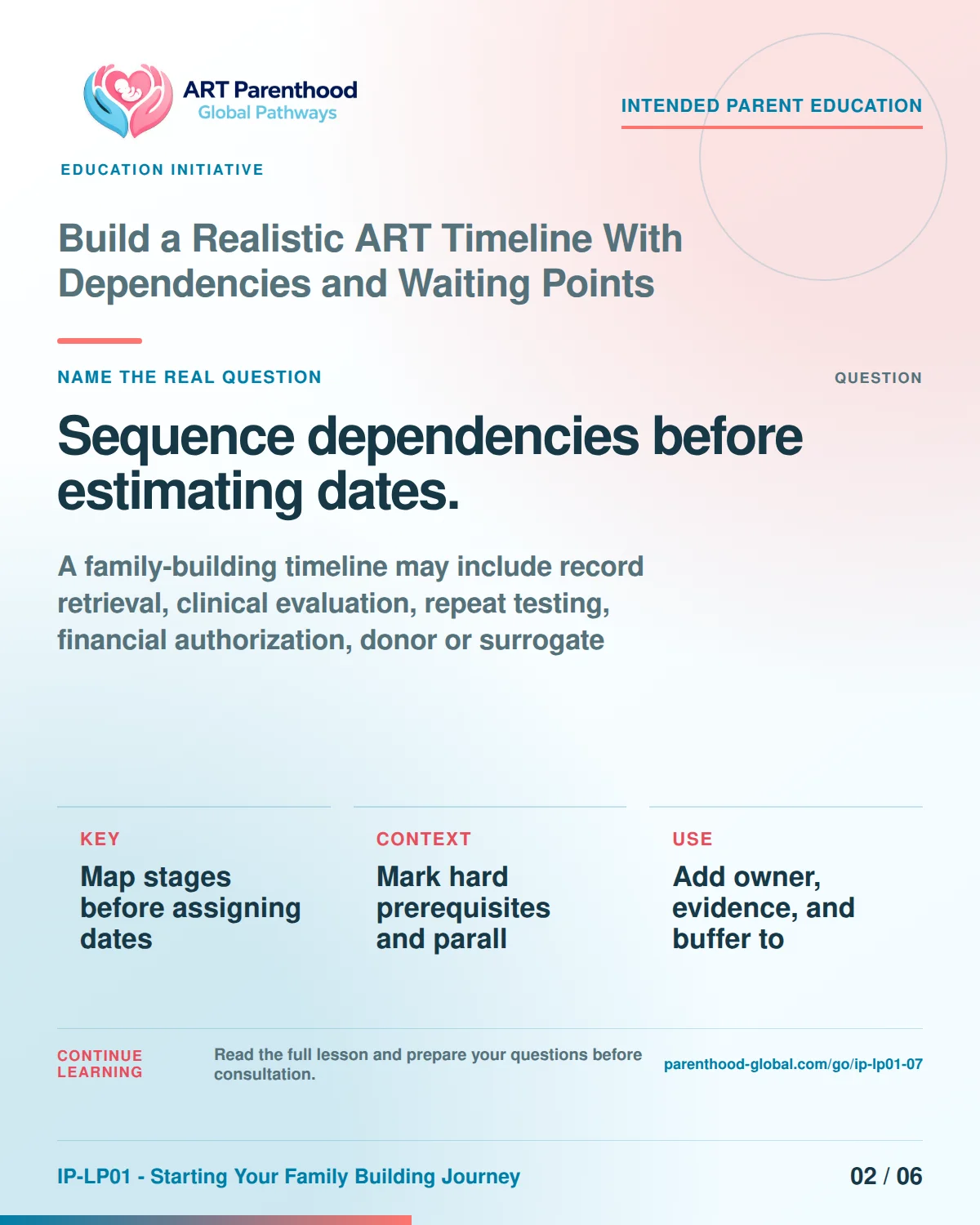
02 / 06Name the real question 
03 / 06Separate facts from assumptions 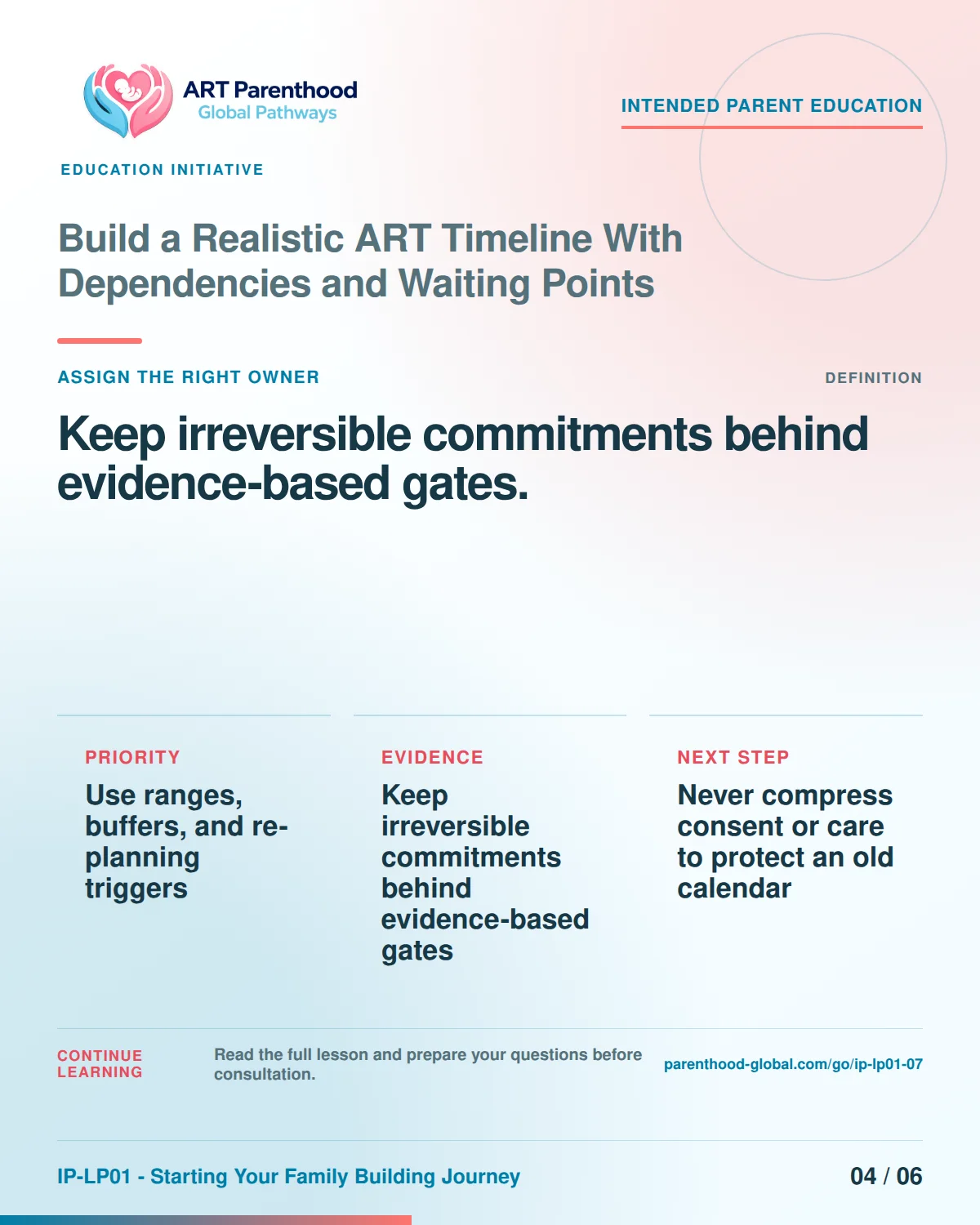
04 / 06Assign the right owner 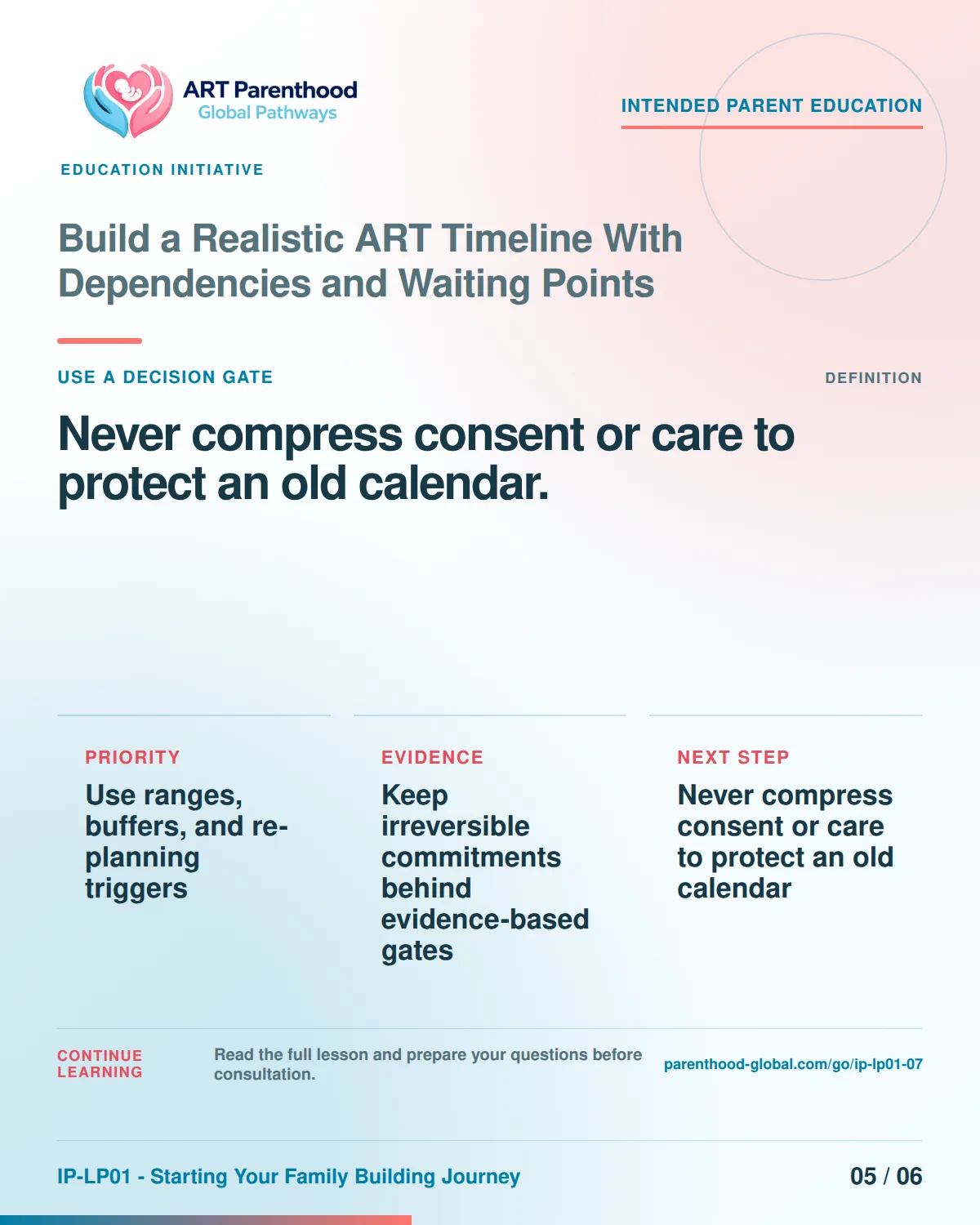
05 / 06Use a decision gate 
06 / 06Keep the roadmap revisable
What this decision actually contains
A family-building timeline may include record retrieval, clinical evaluation, repeat testing, financial authorization, donor or surrogate search, screening, counselling, independent legal work, medication, monitoring, retrieval, fertilization, embryo development, testing where chosen, cryopreservation, transfer preparation, pregnancy, birth, parentage, registration, citizenship, and travel. Not every route uses every stage, and several stages can fail or need repetition. A useful plan therefore uses dependencies and ranges rather than one promised date.
Record who owns each question, what evidence supports it, whether it is current, and where it applies. Leave a gap visible until those conditions are met.
- Map stages before assigning dates
- Mark hard prerequisites and parallel work
- Add owner, evidence, and buffer to every stage
Why early assumptions become expensive
False precision creates expensive collisions. Intended parents may book travel before a monitoring schedule is known, assume a match date controls treatment, or treat an embryo-transfer date as a birth guarantee. Laboratory and treatment data are retrospective; legal and administrative timing can change; participant availability and medical findings can interrupt a plan. Urgency can also narrow consent. A timeline should help people protect options and support, not force clinicians, donors, or surrogates to meet a marketing deadline.
Separate reversible investigation from commitment. Requests for records or independent opinions preserve options; deposits, matching, treatment consent, medication, and non-refundable bookings narrow them. Clear the controlling prerequisite first.
- Mark assumptions explicitly
- Keep reversible steps first
- Delay commitments behind gates
How to work the question in practice
Start with immovable prerequisites: medical clearance, participant consent, legal clearance, funding authorization, and any required records. Add stages that depend on them, then mark which can run in parallel. For each stage record an owner, earliest plausible start, expected range if professionally supplied, buffer, evidence of completion, and trigger for re-planning. Use decision gates such as “records accepted,” “screening complete,” “agreement effective,” “embryos available,” or “travel documents issued.” Do not use pregnancy or birth as a scheduling certainty.
A strong working note contains the exact question, the proposed answer, its source, source date, jurisdiction or clinical context, responsible professional, remaining uncertainty, and next review point. Add the consequence of being wrong. That final field changes behavior: it distinguishes a harmless preference from a blocker that could affect consent, safety, parentage, citizenship, finances, or another participant’s rights.
- Map stages before assigning dates
- Mark hard prerequisites and parallel work
- Add owner, evidence, and buffer to every stage
- Delay irreversible bookings until the gate clears
- Recalculate dependent dates when facts change
Decisions and questions to take forward
The timeline should answer what can safely be arranged now. A consultation, record request, or flexible accommodation may be reasonable while non-refundable flights, leave dates, or downstream contracts should wait. Decide how much buffer the household needs, which person will monitor dependencies, and when the whole plan is reviewed. If a stage moves, update dependent dates instead of compressing consent, clinical care, recovery, or another participant’s decision time.
Write the professional’s response in plain language and ask what evidence would change it. If the response depends on a fact that has not been established, mark it conditional. If it depends on another participant’s choice, mark it outside intended-parent control. If it depends on future treatment outcome, treat it as a forecast rather than a promise. The record should make it possible to pause without losing the reasoning already completed.
- What evidence proves this stage is complete?
- Which later tasks depend on it?
- What can proceed in parallel without creating pressure?
- Which dates come from a professional and which are assumptions?
- What booking or payment should wait for a gate?
- What event triggers a full timeline review?
What this tool cannot decide
This framework cannot provide an exact clinic schedule, predict embryo availability or pregnancy, set a medical protocol, or promise legal-processing times. Any numeric range belongs to the professional responsible for that stage and should carry a source date and assumptions. Do not compare routes by adding best-case durations from unrelated providers. A longer interval can reflect safety review, regulation, consent, or careful matching rather than poor service.
Excluded here: success-rate prediction; exact clinic schedules; medical protocol timing; and jurisdiction-specific filing deadlines. Route these issues to later lessons or qualified professionals. Unclear consent, safety concerns, pressure, legal contradiction, or uncertain child status should stop the dependent commitment.
- success-rate prediction
- exact clinic schedules
- medical protocol timing
- and jurisdiction-specific filing deadlines
Make the next step bounded and revisable
Complete a five-part record: decision under consideration, known facts, missing facts, professional owner, and review trigger. Attach current applicable sources. Note what may proceed while an answer is pending and what must wait, so one bounded step does not silently authorize the whole journey.
Review after a material medical result, route change, new participant, legal opinion, cost change, evidence update, or household shift. Archive the superseded version so the reason for a changed decision remains understandable.
- State the next bounded decision
- Attach current evidence
- Name the accountable owner
- Set a review trigger
- Archive superseded versions
For Nerds: Technical Deep Dive
A technical treatment of evidence provenance, dependency mapping, claim limits, professional accountability, and decision gates for build a realistic art timeline with dependencies and waiting points.
Model the decision as evidence and dependencies
A technically defensible decision record distinguishes source authority, applicability, and freshness. A professional guideline may describe ethical or clinical standards, a regulator may describe licensed-service data, a registry may report outcomes, and an official government page may state an administrative rule. None is interchangeable with an individualized opinion. Record the exact document title, publisher, update date, access date, jurisdiction, and claim supported. Preserve the denominator and endpoint for statistics. For law, preserve the connecting facts that make the rule relevant. For consent, distinguish education, deliberation, authorization, and the continuing right to ask questions or decline. Represent the journey as a directed acyclic graph rather than a calendar strip. Nodes are evidence-backed milestones; edges are dependencies. The critical path is the longest chain of prerequisites controlling the earliest possible completion, but stochastic stages require ranges and contingency branches. Retrieval-to-transfer statistics should not be used to predict a particular household’s timing. Version the plan whenever a medical result, match, legal opinion, embryo status, funding decision, or jurisdiction changes, and preserve the previous version so assumptions remain auditable.
- Separate values, facts, forecasts, and legal prerequisites.
- Record publisher, title, date, jurisdiction, and supported claim.
- Keep another participant’s consent and medical authority outside intended-parent control.
- Use a gate before deposits, matching, treatment, or non-refundable travel.
Timeline breakdown
- Define and classify the question: Before a material commitment. The intended parents separate the value or preference from factual assumptions, forecasts, professional prerequisites, and decisions belonging to another participant.
- Clear the controlling evidence gate: Before the dependent action starts. The accountable professional reviews current applicable evidence, records the interpretation limit, and identifies what would send the decision back for review.
Build an auditable claim and decision register
Operationalize the scope with a claim registry. Each material statement receives a stable claim ID, claim type, supporting source IDs, jurisdiction, reviewer, and interpretation limit. The reader-facing copy should never outrun the registry: if a source supports association, do not write causation; if it reports a population average, do not write an individual forecast; if it describes one country, do not universalize it. Version legal and regulatory claims when rules change and recheck them close to publication. Clinical guidance should use its current version, while psychosocial guidance should be framed as supportive practice rather than a diagnostic verdict. For build a realistic art timeline with dependencies and waiting points, create a dependency table with columns for prerequisite, owner, evidence, status, consequence of failure, and dependent action. Add a rights column when a donor, surrogate, partner, or future child is affected. Add a conflict column when a program or professional may benefit financially from the recommendation. Add an expiry column when screening, quotations, legal advice, or data can become stale. This table is valuable because it makes an apparently simple next step fail safely: the dependent action remains inactive until the controlling evidence is present and reviewed.
- Give every material claim a stable ID and source map.
- Record the consequence if an assumption proves wrong.
- Version changes instead of silently replacing earlier reasoning.
- Recheck jurisdictional and regulatory claims near publication.
Key takeaways
- Sequence dependencies before estimating dates.
- Use ranges, buffers, and re-planning triggers.
- Keep irreversible commitments behind evidence-based gates.
- Never compress consent or care to protect an old calendar.
FAQ
What evidence proves this stage is complete?
Sequence dependencies before estimating dates. Record the answer, its professional owner, and what evidence would change it.
Which later tasks depend on it?
Use ranges, buffers, and re-planning triggers. Record the answer, its professional owner, and what evidence would change it.
What can proceed in parallel without creating pressure?
Keep irreversible commitments behind evidence-based gates. Record the answer, its professional owner, and what evidence would change it.
Which dates come from a professional and which are assumptions?
Never compress consent or care to protect an old calendar. Record the answer, its professional owner, and what evidence would change it.
What booking or payment should wait for a gate?
Write the question exactly, identify the responsible professional, and keep the dependent commitment on hold until the answer is current and applicable.
What event triggers a full timeline review?
Write the question exactly, identify the responsible professional, and keep the dependent commitment on hold until the answer is current and applicable.