
IP-LP01-10 · IP-LP01
A roadmap should show the next decision, its owner, its evidence, and what would make the plan change. It is a living control document—not a promise that the journey will follow one line. Medical notes, legal advice, price lists, messages, and personal decisions often live in separate places. A disciplined roadmap turns them into a coherent next-step system without pretending uncertainty has disappeared.
Visual lesson summary
Review the lesson as a carousel.
Swipe or scroll through the key ideas, then continue with the detailed guidance below.
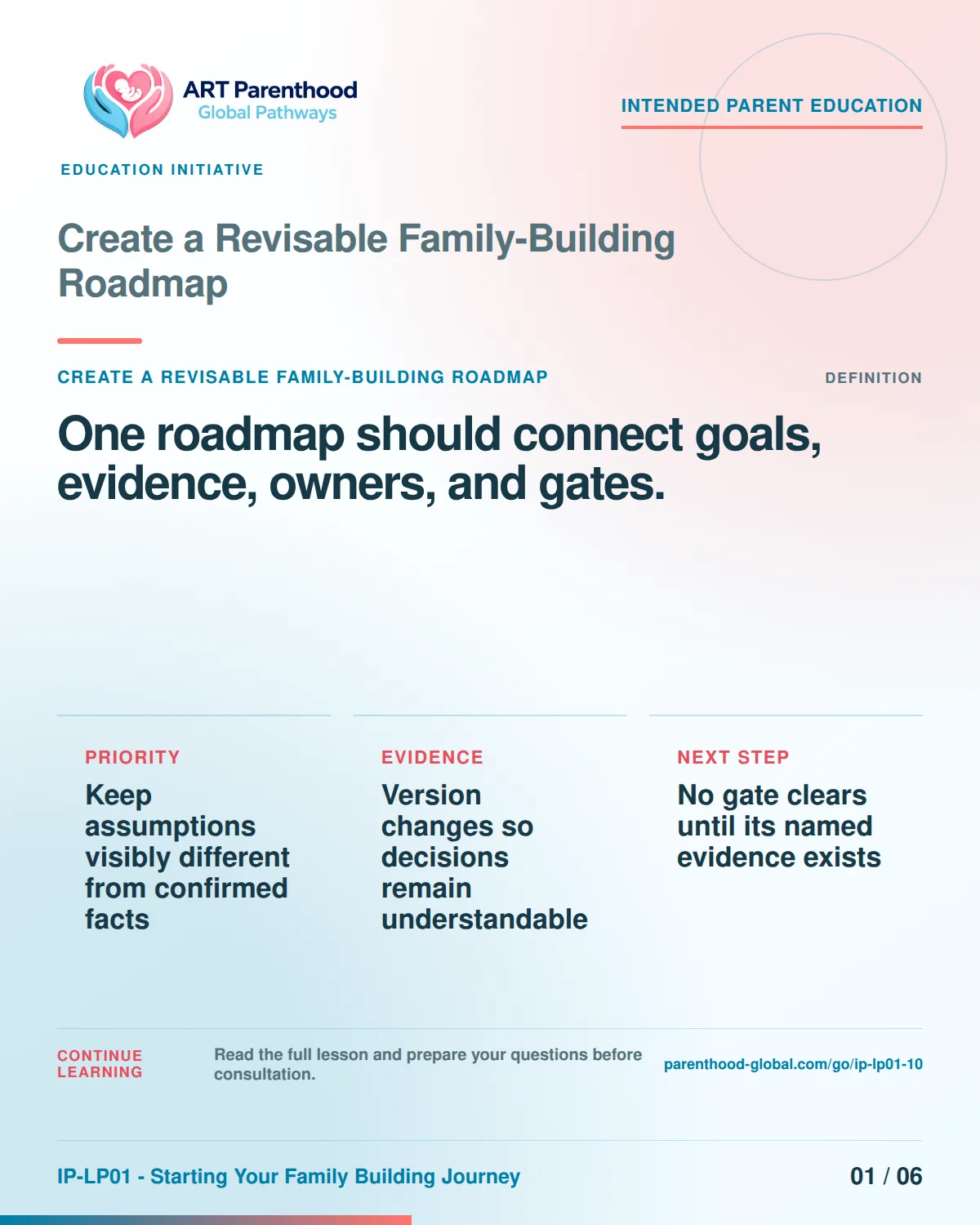
01 / 06Create a Revisable Family-Building Roadmap 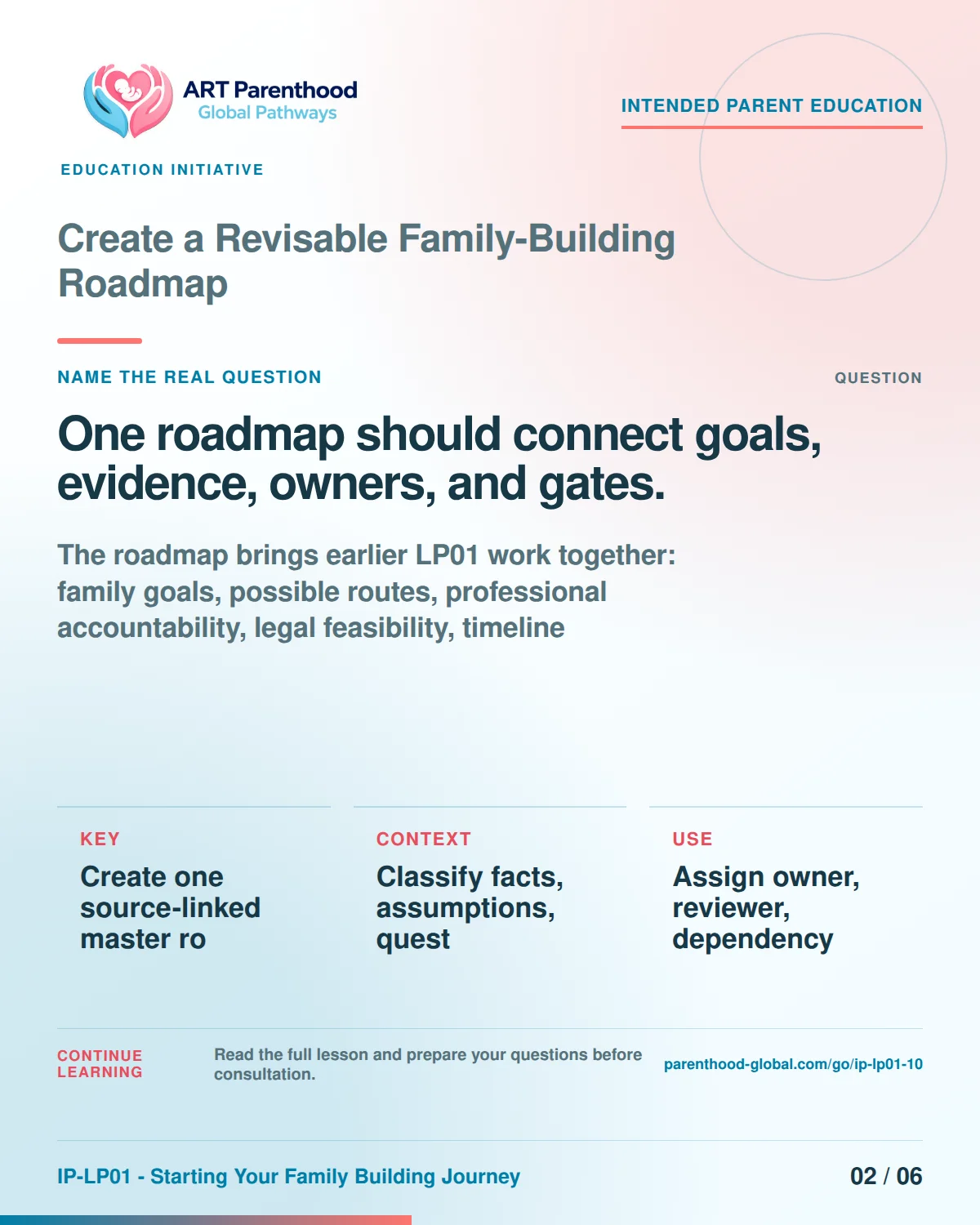
02 / 06Name the real question 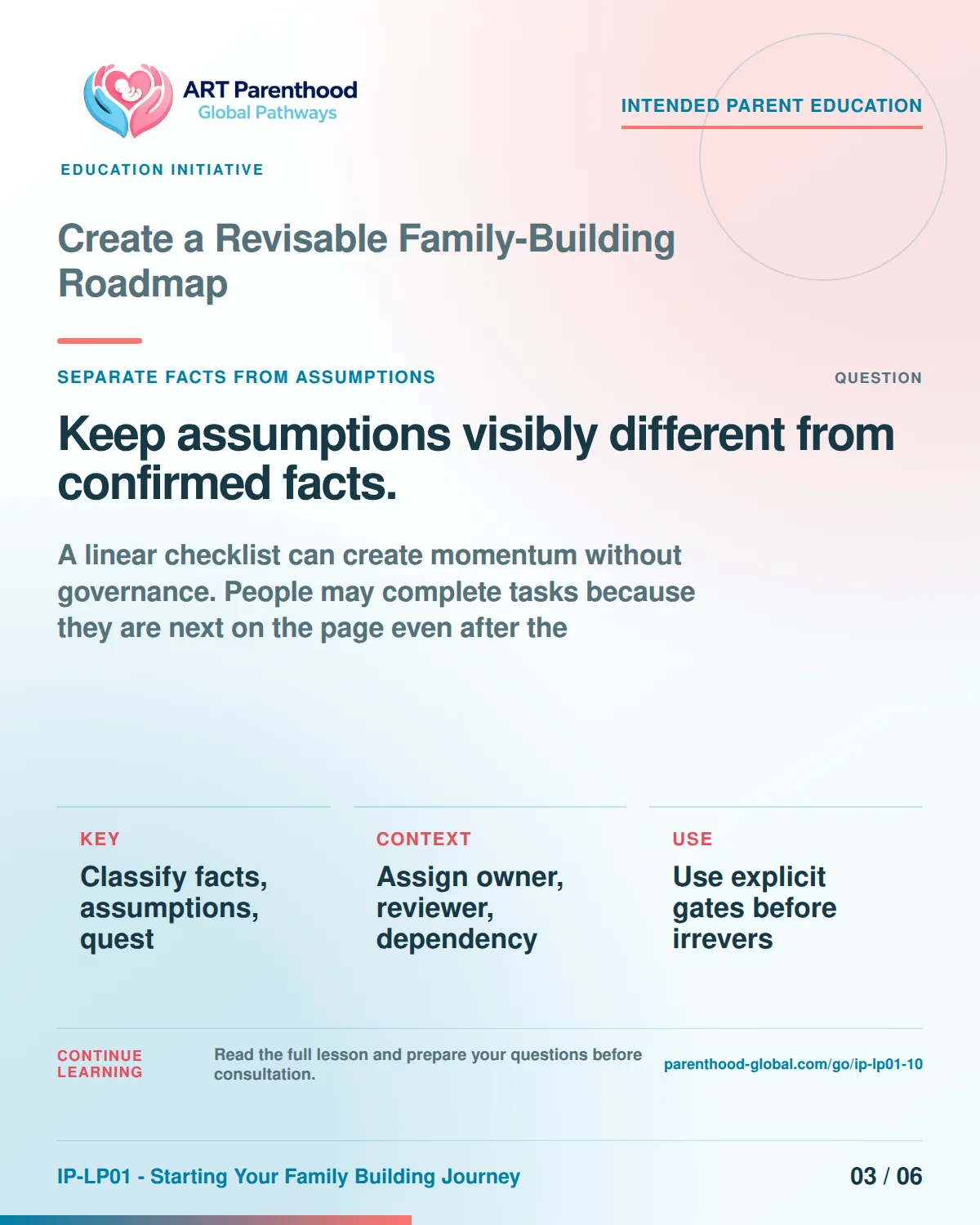
03 / 06Separate facts from assumptions 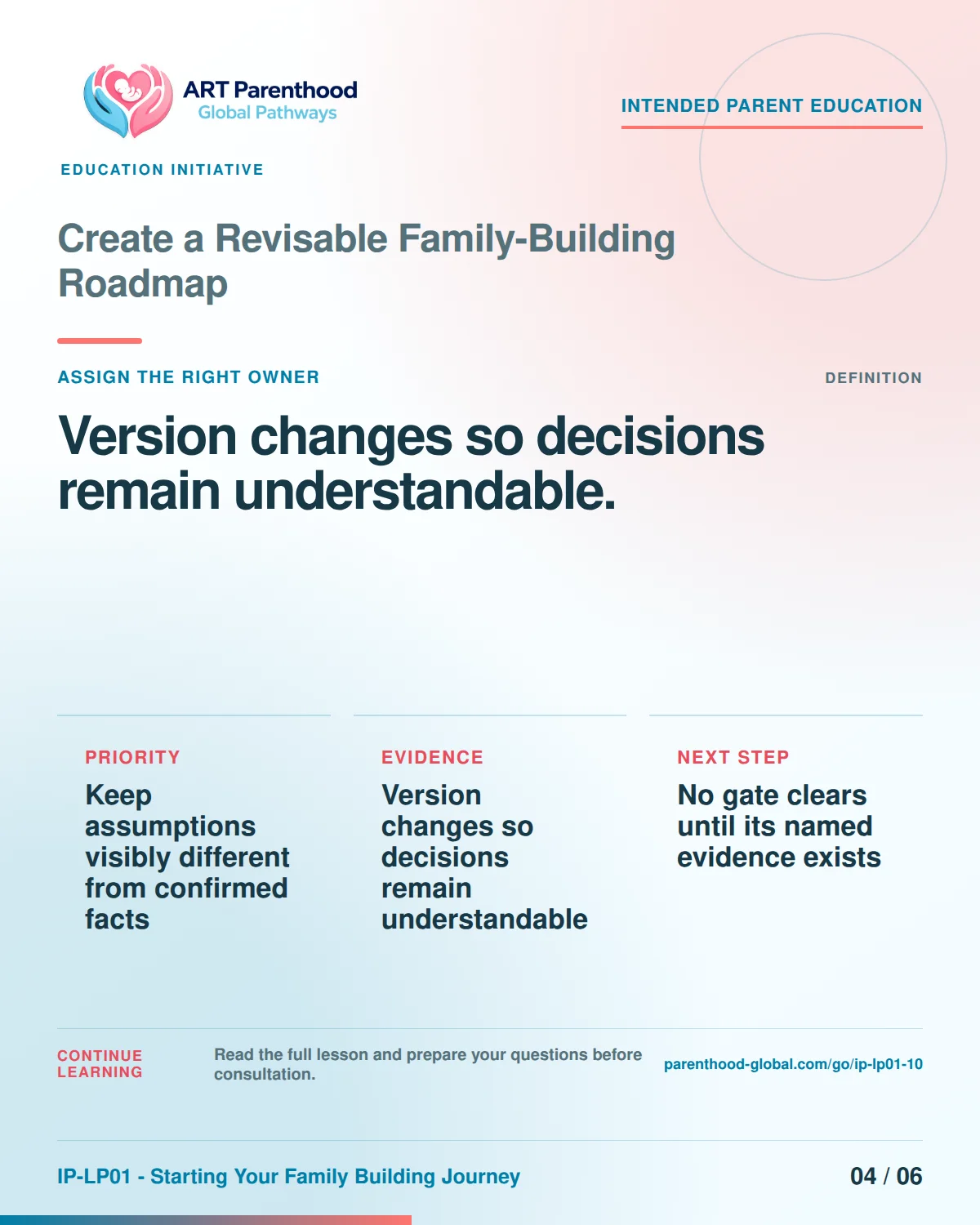
04 / 06Assign the right owner 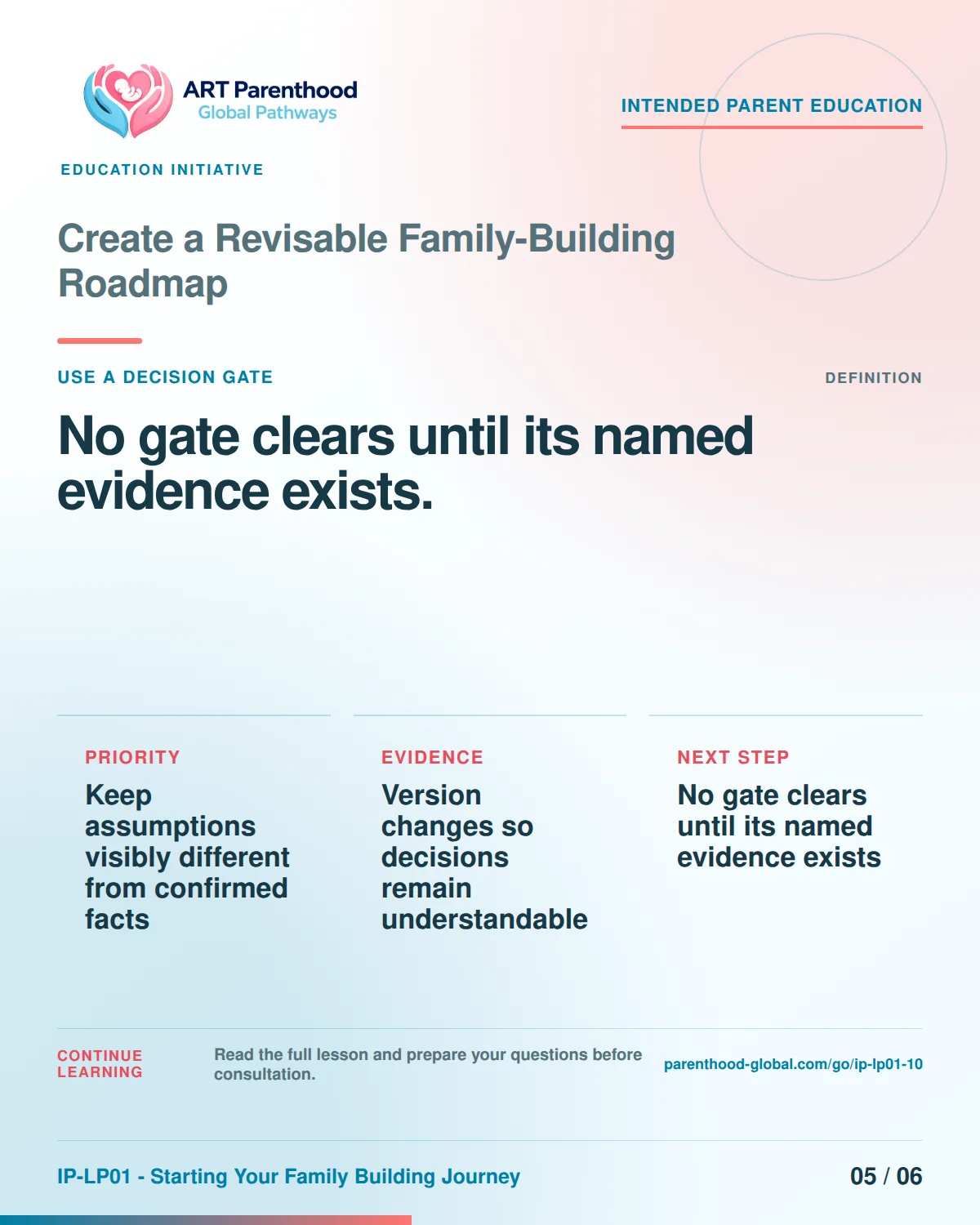
05 / 06Use a decision gate 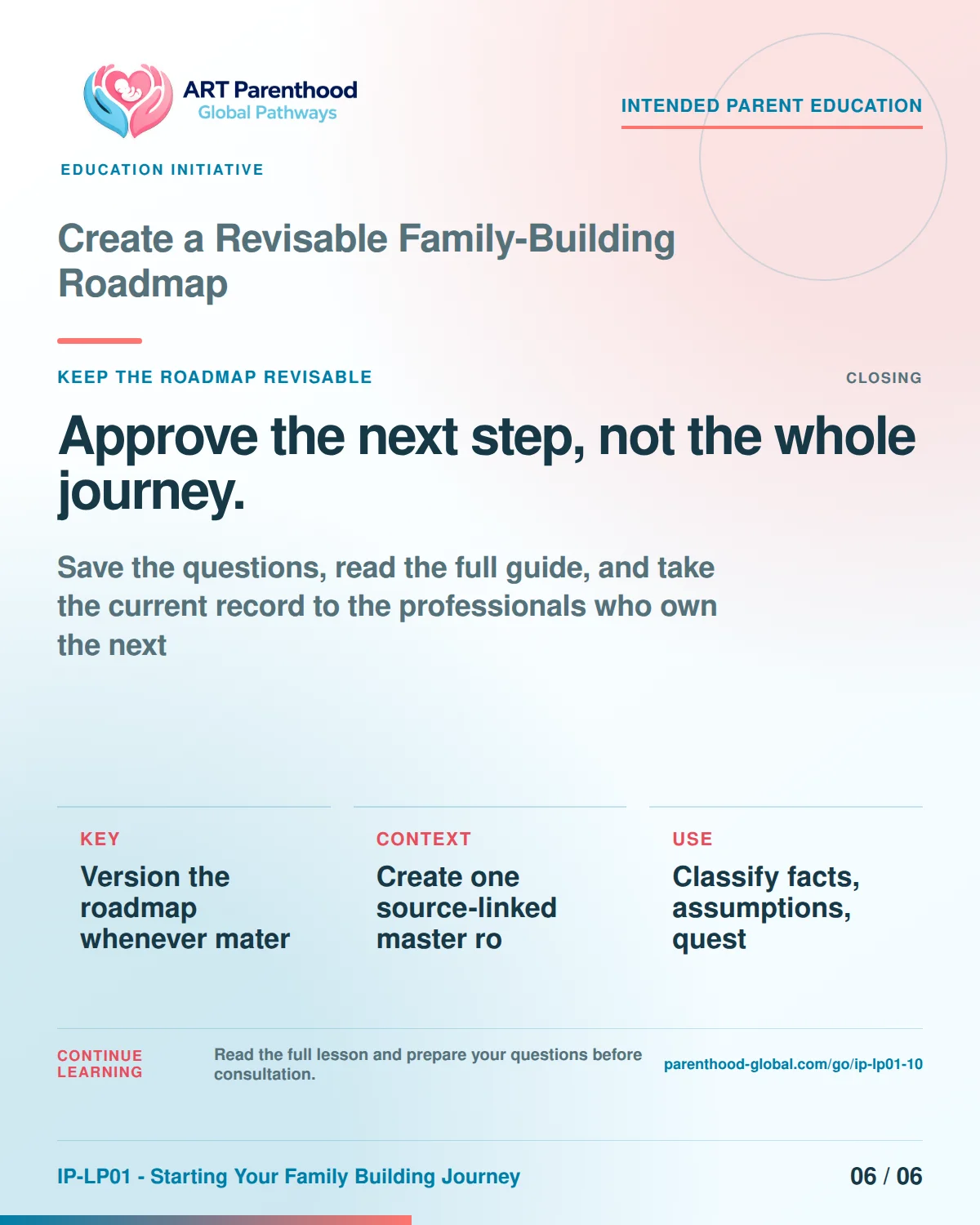
06 / 06Keep the roadmap revisable
What this decision actually contains
The roadmap brings earlier LP01 work together: family goals, possible routes, professional accountability, legal feasibility, timeline dependencies, evidence quality, and emotional readiness. Each item should be recorded as confirmed fact, working assumption, open question, or decision. The plan should show what can happen now, what must wait, and what evidence moves an item from one state to another. Its value is not predicting the future; it is making change manageable.
Record who owns each question, what evidence supports it, whether it is current, and where it applies. Leave a gap visible until those conditions are met.
- Create one source-linked master roadmap
- Classify facts, assumptions, questions, and decisions
- Assign owner, reviewer, dependency, and evidence
Why early assumptions become expensive
A linear checklist can create momentum without governance. People may complete tasks because they are next on the page even after the route changes. Old legal advice, expired screening, revised costs, staffing changes, or new medical results can silently invalidate later steps. A roadmap also becomes harmful if it is used to monitor or pressure a donor or surrogate rather than coordinate the intended parents’ own responsibilities. Version control and explicit decision authority prevent the plan from becoming false certainty.
Separate reversible investigation from commitment. Requests for records or independent opinions preserve options; deposits, matching, treatment consent, medication, and non-refundable bookings narrow them. Clear the controlling prerequisite first.
- Mark assumptions explicitly
- Keep reversible steps first
- Delay commitments behind gates
How to work the question in practice
Create sections for goals and boundaries, route hypotheses, medical prerequisites, legal and jurisdiction prerequisites, professional team, evidence and claims, budget categories, timeline dependencies, support plan, records index, and review gates. Every action needs an owner, due or review date, completion evidence, dependency, reversibility level, and status. Link advice to its author, jurisdiction, date, and question answered. Use red for unresolved safety or legal blockers, amber for conditional assumptions, and green only for evidence that is current and applicable.
A strong working note contains the exact question, the proposed answer, its source, source date, jurisdiction or clinical context, responsible professional, remaining uncertainty, and next review point. Add the consequence of being wrong. That final field changes behavior: it distinguishes a harmless preference from a blocker that could affect consent, safety, parentage, citizenship, finances, or another participant’s rights.
- Create one source-linked master roadmap
- Classify facts, assumptions, questions, and decisions
- Assign owner, reviewer, dependency, and evidence
- Use explicit gates before irreversible commitments
- Version the roadmap whenever material facts change
Decisions and questions to take forward
At each gate choose one of four states: investigate, proceed to a bounded next step, pause, or retire the current hypothesis. This LP01 roadmap does not give final authorization for an entire treatment or third-party arrangement. It identifies what must be true before later consent. Decide who maintains the plan, how partners approve changes, what requires fresh professional review, and when old information expires. Preserve prior versions so the family can see why a decision changed.
Write the professional’s response in plain language and ask what evidence would change it. If the response depends on a fact that has not been established, mark it conditional. If it depends on another participant’s choice, mark it outside intended-parent control. If it depends on future treatment outcome, treat it as a forecast rather than a promise. The record should make it possible to pause without losing the reasoning already completed.
- What is the next bounded decision rather than the final outcome?
- Which evidence must exist before this step starts?
- Who owns the decision and who must review it?
- Which assumption is most likely to invalidate the plan?
- What information has an expiry or jurisdiction limit?
- What event sends the roadmap back to review?
What this tool cannot decide
The roadmap is not a medical record, legal opinion, contract, financial guarantee, or clinic instruction. Sensitive information should be stored securely and shared only with authorization. It should reference, not copy, another participant’s private records. Status colors do not substitute for professional judgment. If the plan contains a legal contradiction, safety concern, coercion, unclear parentage or citizenship route, or unaffordable commitment, the correct status is pause until the responsible professional resolves it.
Excluded here: proceed, conditional, pause, or stop authorization in IP-LP05-10; individual treatment recommendations; detailed contracts or budgets; provider rankings or outcome guarantees. Route these issues to later lessons or qualified professionals. Unclear consent, safety concerns, pressure, legal contradiction, or uncertain child status should stop the dependent commitment.
- proceed, conditional, pause, or stop authorization in IP-LP05-10
- individual treatment recommendations
- detailed contracts or budgets
- provider rankings or outcome guarantees
Make the next step bounded and revisable
Complete a five-part record: decision under consideration, known facts, missing facts, professional owner, and review trigger. Attach current applicable sources. Note what may proceed while an answer is pending and what must wait, so one bounded step does not silently authorize the whole journey.
Review after a material medical result, route change, new participant, legal opinion, cost change, evidence update, or household shift. Archive the superseded version so the reason for a changed decision remains understandable.
- State the next bounded decision
- Attach current evidence
- Name the accountable owner
- Set a review trigger
- Archive superseded versions
For Nerds: Technical Deep Dive
A technical treatment of evidence provenance, dependency mapping, claim limits, professional accountability, and decision gates for create a revisable family-building roadmap.
Model the decision as evidence and dependencies
A technically defensible decision record distinguishes source authority, applicability, and freshness. A professional guideline may describe ethical or clinical standards, a regulator may describe licensed-service data, a registry may report outcomes, and an official government page may state an administrative rule. None is interchangeable with an individualized opinion. Record the exact document title, publisher, update date, access date, jurisdiction, and claim supported. Preserve the denominator and endpoint for statistics. For law, preserve the connecting facts that make the rule relevant. For consent, distinguish education, deliberation, authorization, and the continuing right to ask questions or decline. Treat the roadmap as a lightweight requirements-and-risk register. Use stable item IDs, source provenance, change history, owner, reviewer, applicability, expiry, and dependency links. A decision log records alternatives considered, evidence available, uncertainties, chosen next step, and review trigger. A risk register separates probability from impact and identifies mitigation without fabricating numerical precision. The roadmap’s most important control is the gate: no downstream payment, match, medication, transfer, or travel commitment becomes active until named prerequisites have evidence.
- Separate values, facts, forecasts, and legal prerequisites.
- Record publisher, title, date, jurisdiction, and supported claim.
- Keep another participant’s consent and medical authority outside intended-parent control.
- Use a gate before deposits, matching, treatment, or non-refundable travel.
Timeline breakdown
- Define and classify the question: Before a material commitment. The intended parents separate the value or preference from factual assumptions, forecasts, professional prerequisites, and decisions belonging to another participant.
- Clear the controlling evidence gate: Before the dependent action starts. The accountable professional reviews current applicable evidence, records the interpretation limit, and identifies what would send the decision back for review.
Build an auditable claim and decision register
Operationalize the scope with a claim registry. Each material statement receives a stable claim ID, claim type, supporting source IDs, jurisdiction, reviewer, and interpretation limit. The reader-facing copy should never outrun the registry: if a source supports association, do not write causation; if it reports a population average, do not write an individual forecast; if it describes one country, do not universalize it. Version legal and regulatory claims when rules change and recheck them close to publication. Clinical guidance should use its current version, while psychosocial guidance should be framed as supportive practice rather than a diagnostic verdict. For create a revisable family-building roadmap, create a dependency table with columns for prerequisite, owner, evidence, status, consequence of failure, and dependent action. Add a rights column when a donor, surrogate, partner, or future child is affected. Add a conflict column when a program or professional may benefit financially from the recommendation. Add an expiry column when screening, quotations, legal advice, or data can become stale. This table is valuable because it makes an apparently simple next step fail safely: the dependent action remains inactive until the controlling evidence is present and reviewed.
- Give every material claim a stable ID and source map.
- Record the consequence if an assumption proves wrong.
- Version changes instead of silently replacing earlier reasoning.
- Recheck jurisdictional and regulatory claims near publication.
Key takeaways
- One roadmap should connect goals, evidence, owners, and gates.
- Keep assumptions visibly different from confirmed facts.
- Version changes so decisions remain understandable.
- No gate clears until its named evidence exists.
FAQ
What is the next bounded decision rather than the final outcome?
One roadmap should connect goals, evidence, owners, and gates. Record the answer, its professional owner, and what evidence would change it.
Which evidence must exist before this step starts?
Keep assumptions visibly different from confirmed facts. Record the answer, its professional owner, and what evidence would change it.
Who owns the decision and who must review it?
Version changes so decisions remain understandable. Record the answer, its professional owner, and what evidence would change it.
Which assumption is most likely to invalidate the plan?
No gate clears until its named evidence exists. Record the answer, its professional owner, and what evidence would change it.
What information has an expiry or jurisdiction limit?
Write the question exactly, identify the responsible professional, and keep the dependent commitment on hold until the answer is current and applicable.
What event sends the roadmap back to review?
Write the question exactly, identify the responsible professional, and keep the dependent commitment on hold until the answer is current and applicable.